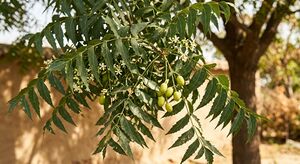
Nimba (Azadirachta indica) or Margosa tree is a plant species widely recognized in Ayurveda and modern pharmacology for its broad spectrum of therapeutic applications.
Nimba, Pichumarda (Nimba is very efficacious drug when it comes to skin disease ), Arishta(it cures many disease, does good always if use.), Tiktaka(best drug having tikta rasa), Paribhadra(does good always if use), Hinguniryasa(the exudate from nimba resemble hingu niryasa.)
Azadirachta indica exerts multi-targeted therapeutic action through phytocompounds that modulate cellular signaling pathways including p53, NF-κB, PI3K/Akt, and Nrf2.[6]
Pharmacological Properties and Bioactivities of Azadirachta indica
Therapeutic Category
Primary Active Compounds
Key Molecular Targets & Bioactivities
Antimicrobial & Dental
Azadirachtin, Mahmoodin
Biofilm disruption; growth inhibition of S. mutans, E. faecalis, and C. albicans
Anticancer & Antiproliferative
Nimbolide, Azadiradione
Apoptosis induction via p53/pTEN upregulation and downregulation of Bcl-2 and PI3K/Akt
Anti-inflammatory & Analgesic
Nimbidin, Sodium Nimbidate
Suppression of macrophage/neutrophil activity and inhibition of prostaglandin synthesis
Reproductive & Contraceptive
Neem seed oil extracts
Spermicidal action and anti-ovulatory efficacy without reducing libido
Key Clinical & Preclinical Evidence
Antimicrobial & Dental Health
Aqueous and ethanolic leaf extracts exhibit potent broad-spectrum activity against oral pathogens. In endodontic and periodontal models, A. indica preparations suppress polymicrobial biofilms with efficacy comparable to chlorhexidine rinses.[7]
Oncological Management
Active limonoids—primarily nimbolide—suppress cellular proliferation and induce apoptosis in androgen-receptor (AR)-positive and AR-negative prostate cancer lines. Preclinical xenograft models demonstrate significant tumor weight reduction via combined inhibition of AR signaling and the PI3K/Akt pathway.[8]
Anti-inflammatory Activity
Crude bitter constituents, notably nimbidin, demonstrate dose-dependent anti-inflammatory action in acute paw edema and arthritis assays, suppressing cellular exudation and systemic inflammatory cascades.[6]
Fertility Control
Concentrated seed extracts act as localized spermicides and systemic contraceptives by interrupting sperm membrane integrity and blocking folliculogenesis without disrupting secondary sex hormones.[9]
References
↑Anonymous. The Ayurvedic Pharmacopoeia of India. Department of Ayush, Ministry of Health and Family welfare, Govt. of India, New Delhi, Part I. 1986; Volume 5:55
↑Anonymous. The Ayurvedic Pharmacopoeia of India. Department of Ayush, Ministry of Health and Family welfare, Govt. of India, New Delhi, Part I. 1986; Volume 5:55
↑Anonymous. The Ayurvedic Pharmacopoeia of India. Department of Ayush, Ministry of Health and Family welfare, Govt. of India, New Delhi, Part I. 1986; Volume 5:55
↑Anonymous. The Ayurvedic Pharmacopoeia of India. Department of Ayush, Ministry of Health and Family welfare, Govt. of India, New Delhi, Part I. 1986; Volume 5:55
↑Patil, S. M.; Shirahatti, P. S.; V B, C. K.; Ramu, R.; M N, N. P. (2021). "Azadirachta indica A. Juss (neem) as a contraceptive: An evidence-based review on its pharmacological efficiency". Phytomedicine. 88: 153596. PMID34116323Check |pmid= value (help). doi:10.1016/j.phymed.2021.153596.

 . PMID 27034694. doi:10.1155/2016/7382506.