Nimba

From Charak Samhita
Revision as of 06:42, 17 August 2026 by Agnivesha (talk | contribs)
(diff) ← Older revision | Latest revision (diff) | Newer revision → (diff)
Jump to navigation Jump to search

Azadirachta indica A. Juss

Nimba
Section/Chapter Herb database/Nimba
Botanical name(s) Azadirachta indica A. Juss
Family Meliaceae
Availability Available
Contributors Team Dravyaguna
Year of publication 2026
Publisher Charak Samhita Research, Training and Skill Development Centre
DOI Awaited

Nimba (Azadirachta indica) or Margosa tree is a plant species widely recognized in Ayurveda and modern pharmacology for its broad spectrum of therapeutic applications.

General Overview

  • Taxonomic Name: Azadirachta indica A. Juss.
  • Ayurvedic Designation: Nimba / Arishtha ("Reliever of Sickness")
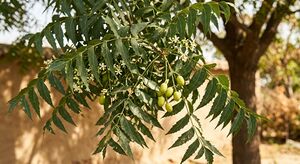
  • Nimba (Azadirachta indica)
    Primary Phytochemicals: Azadirachtin, Nimbolide, Nimbidin, Gedunin, Quercetin, Salannin

Therapeutic uses

Daha(burning), jwara (fever) , Krumi roga(worms), Kandu(itching), Kushtha(skin disease), Prameha(diabetes), Rakta pitta(bleeding disorder), Vrana(wound)[1]

Synonyms in Charak Samhita

Nimba, Pichumarda (Nimba is very efficacious drug when it comes to skin disease ), Arishta(it cures many disease, does good always if use.), Tiktaka(best drug having tikta rasa), Paribhadra(does good always if use), Hinguniryasa(the exudate from nimba resemble hingu niryasa.)

Synonyms in Bhavprakasa Nighantu

Pichumarda[2]

Varieties

  1. Nimba
  2. Mahanimba
  3. Parvata nimba
  4. Akasa nimba

Ayurvedic pharmacological properties

Properties
Sr.no. Pharmacological criteria Properties
1 Taste (rasa) Bitter (tikta), Astringent (kashaya)
2 Potency (veerya) Cold (sheeta)
3 Post digestion effect (vipaka) Pungent (katu)
4 Qualities (guna) Light (laghu)
5 Actions (karma) Pacify kapha and pitta

Reference in Charak Samhita and its actions

Herbs and their activities
Sr.no. Reference in Charak Samhita Activity
1 Cha.Sa.Sutra Sthana 2/7 Vamana (Therapeutic emesis)
2 Cha.Sa.Sutra Sthana 3/3 Siddhatama churna pradeha(Local application)
3 Cha.Sa.Sutra Sthana 4/9(14) Kandughna mahakashaya(anti-pruritic/itching)
4 Cha.Sa.Sutra Sthana 4/9(48) Sandnyasthapana mahakashaya(restoring consciousness)
5 Cha.Sa.Chikitsa Sthana 30/279 Used in the treatment of Gaurava stanya dosha( vitiated breast milk)
6 Cha.Sa.Sutra Sthana 23/10 Santarpanajanya vikara chikitsa(Over-nutrition disorders)
7 Cha.Sa.Sutra Sthana 23/12 Santarpanajanya vikaar chikitsa(Over-nutrition disorders)
8 Cha.Sa.Sutra Sthana 27/97 Shaka Varga (Class of vegetables)
9 Cha.Sa.Vimana Sthana 6/17 Abhyantar Krimi Chikitsa
10 Cha.Sa.Vimana Sthana 8/135 Vaman dravyani List of medicines used in therapeutic emesis
11 Cha.Sa.Vimana Sthana 8/143 Tikta skandha(group of bitter drugs)
12 Ch.Sa.Sharira Sthana 8/32 Garbha shalya chikitsa
13 Cha.Sa.Kalpa Sthana 1/22 Vamanartha
14 Cha.Sa.Chikitsa Sthana 3/201 Used as kwatha in Anydyushka jwara
15 Cha.Sa.Chikitsa Sthana 3/204 As an ingredient of Vatsakadi kashaya
16 Cha.Sa.Chikitsa Sthana 3/224 Used in formulation of Baladi Ghrita
17 Cha.Sa.Chikitsa Sthana 3/241 Used in niruha basti
18 Cha.Sa.Chikitsa Sthana 3/252 As an ingredient of Patoladi anuvasana basti
19 Cha.Sa.Chikitsa Sthana 3/258 As an ingredient of Chandanadya taila
20 Cha.Sa.Chikitsa Sthana 3/307 Used as Dhoopana dravya for Vishama jwara
21 Cha.Sa.Chikitsa Sthana 4/38 As pathya ahara in Rakta Pitta
22 Cha.Sa.Chikitsa Sthana 5/115 Ingredient of Rohinyadya Ghrita for Pittaja Gulma
23 Cha.Sa.Chikitsa Sthana 6/30 Used for making decoction in Pittaja Prameha
24 Cha.Sa.Chikitsa Sthana 6/31 Used for making decoction in Pittaja Prameha
25 Cha.Sa.Chikitsa Sthana 6/38 Trikantakadhya Taila/Ghrita in Vata-kaphaja prameha
26 Cha.Sa.Chikitsa Sthana 7/43 As Vamana dravya
27 Cha.Sa.Chikitsa Sthana 7/46 As Asthapan Basti dravya
28 Cha.Sa.Chikitsa Sthana 7/47 As Anuvasana Basti dravya
29 Cha.Sa.Chikitsa Sthana 7/57 For Scrapping
30 Cha.Sa.Chikitsa Sthana 7/65 Ingredient in Mustadi Churna
31 Cha.Sa.Chikitsa Sthana 7/68 Ingredient in Triphaladi Churna
32 Cha.Sa.Chikitsa Sthana 7/82 Pathya diet in Kushtha
33 Cha.Sa.Chikitsa Sthana 7/97 Ingredient in Kushthaghna Yoga
34 Cha.Sa.Chikitsa Sthana 7/100 Kwath prayog in Kapha-Pittaja Kushtha
35 Cha.Sa.Chikitsa Sthana 7/101 Kwath prayog in Kapha-Pittaja Kushtha
36 Cha.Sa.Chikitsa Sthana 7/103 Bahyaprayogartha taila in Kushtha
37 Cha.Sa.Chikitsa Sthana 7/112 Ingredient in Kanakakshiri Taila
38 Cha.Sa.Chikitsa Sthana 7/129 Abhyantar and Bahyaprayogartha, Pana, Snana
39 Cha.Sa.Chikitsa Sthana 7/131 Abhyantar and Bahyaprayogarth in Pittaja Kushtha
40 Cha.Sa.Chikitsa Sthana 7/135 For Rakta and Pitta Shamana
41 Cha.Sa.Chikitsa Sthana 7/136 Ingredient in Vata-Pitta Nashak Ghrita
42 Cha.Sa.Chikitsa Sthana 7/140 Ingredient in Tiktashatpala Ghrita
43 Cha.Sa.Chikitsa Sthana 7/144 Ingredient in Mahatikta Ghrita
44 Cha.Sa.Chikitsa Sthana 7/152 Ingredient in Mahakhadira Ghrita
45 Cha.Sa.Chikitsa Sthana 7/157 Snana, Pana and Pradeh in Galit-Kushtha
46 Cha.Sa.Chikitsa Sthana 7/158 Abhyantar and Bahyaprayogarth, Pana, Snana, Lepa
47 Cha.Sa.Chikitsa Sthana 10/33 Ingredient in oil preparation for Bahyaprayogartha
48 Cha.Sa.Chikitsa Sthana 12/63 As a Pathya Diet in treatment of Shvayathu
49 Cha.Sa.Chikitsa Sthana 12/72 As an Unmardan dravya in Kaphaja Shvayathu
50 Cha.Sa.Chikitsa Sthana 14/186 Used for rakta stambhana
51 Cha.Sa.Chikitsa Sthana 14/214 Used for parishechana in rakta arsha
52 Cha.Sa.Chikitsa Sthana 14/220 Used for pratisarana in rakta arsha
53 Cha.Sa.Chikitsa Sthana 15/126 As an ingredient of Chandanadya ghrita
54 Cha.Sa.Chikitsa Sthana 15/138 As an ingredient of Kiratadhya churna (Pittaja Grahani chiktsa)
55 Cha.Sa.Chikitsa Sthana 15/181 As an ingredient of Bhunimbadhya Kshara
56 Cha.Sa.Chikitsa Sthana 15/189 Used in preparation of Pancham Kshara
57 Cha.Sa.Chikitsa Sthana 16/46 As an ingredient of Katukadi Ghrita
58 Cha.Sa.Chikitsa Sthana 16/53 Used in Haridradi Ghrita
59 Cha.Sa.Chikitsa Sthana 16/63 Formulation which use in treatment of pandu
60 Cha.Sa.Chikitsa Sthana 16/87 As an ingredient of Shilajatu vataka
61 Cha.Sa.Chikitsa Sthana 17/97 Used in yusha preparation for hikka shvasa
62 Cha.Sa.Chikitsa Sthana 20/34 For vamana(emesis) in Kaphaja chhardi
63 Cha.Sa.Chikitsa Sthana 20/35 As a pathya ahara(wholesome diet) in kaphaja chhardi
64 Cha.Sa.Chikitsa Sthana 21/51 For Vamana karma
65 Cha.Sa.Chikitsa Sthana 21/54 For Kashaya (decoction) pana
66 Cha.Sa.Chikitsa Sthana 21/52 For Vamana (emesis) karma
67 Cha.Sa.Chikitsa Sthana 21/59 For Kashaya (decoction)pana
68 Cha.Sa.Chikitsa Sthana 21/97 As a prakshalana prayoga for vrana – ropana
69 Cha.Sa.Chikitsa Sthana 23/51 For Agada pana in 8th vega of visha
70 Cha.Sa.Chikitsa Sthana 23/69 For Anjana prayoga, obstruction in eye
71 Cha.Sa.Chikitsa Sthana 23/79 As an ingredient of Maha-Gandha hasti agada
72 Cha.Sa.Chikitsa Sthana 23/202 As an ingredient of Madhukadi yoga
73 Cha.Sa.Chikitsa Sthana 23/243 As an ingredient of Amruta ghrita
74 Cha.Sa.Chikitsa Sthana 24/160 Used as lepa in Madyajanita daha
75 Cha.Sa.Chikitsa Sthana 25/84 Used as vranashodhaka kashaya
76 Cha.Sa.Chikitsa Sthana 25/85 Used as vranashodhaka lepa
77 Cha.Sa.Chikitsa Sthana 25/90 As an ingredient of Kampillakadi taila
78 Cha.Sa.Chikitsa Sthana 26/239 Used for aaschotana in Kaphaja netraroga
79 Cha.Sa.Chikitsa Sthana 27/27 As Pathya in Urustambha(Diseases of thigh and hip)
80 Cha.Sa.Chikitsa Sthana 27/52 As an ingredient of Tarkaryadi Parishechana
81 Cha.Sa.Chikitsa Sthana 27/50 As an ingredient of Utsadana Yoga
82 Cha.Sa.Chikitsa Sthana 29/148 Apply lepa for Kaphaja Vatarakta
83 Cha.Sa.Chikitsa Sthana 30/74 As an ingredient of Udumbaradi taila
84 Cha.Sa.Chikitsa Sthana 30/82 For yoni prakshalana
85 Cha.Sa.Chikitsa Sthana 30/99 Used in the treatment of Kaphaja pradara
86 Cha.Sa.Chikitsa Sthana 30/253 Used in the treatment of Stanya dosha( vitiated breast milk), for vamana

Dose

  • 2-4 g. of the drug in powder form.
  • Decoction should be used externally.[3]

Useful part

Important formulations

As per A.P.I.[5]

  • Sudarsana churna
  • Nimbadi kwatha
  • Nimbadi churna
  • Panchanimba churna
  • Panchatikta ghruta guggulu
  • Pathyadi kwatha churna

Current availability

Available

Current researches

Pharmacological Profile & Mechanisms

Azadirachta indica exerts multi-targeted therapeutic action through phytocompounds that modulate cellular signaling pathways including p53, NF-κB, PI3K/Akt, and Nrf2.[6]

Pharmacological Properties and Bioactivities of Azadirachta indica
Therapeutic Category Primary Active Compounds Key Molecular Targets & Bioactivities
Antimicrobial & Dental Azadirachtin, Mahmoodin Biofilm disruption; growth inhibition of S. mutans, E. faecalis, and C. albicans
Anticancer & Antiproliferative Nimbolide, Azadiradione Apoptosis induction via p53/pTEN upregulation and downregulation of Bcl-2 and PI3K/Akt
Anti-inflammatory & Analgesic Nimbidin, Sodium Nimbidate Suppression of macrophage/neutrophil activity and inhibition of prostaglandin synthesis
Reproductive & Contraceptive Neem seed oil extracts Spermicidal action and anti-ovulatory efficacy without reducing libido

Key Clinical & Preclinical Evidence

Antimicrobial & Dental Health

Aqueous and ethanolic leaf extracts exhibit potent broad-spectrum activity against oral pathogens. In endodontic and periodontal models, A. indica preparations suppress polymicrobial biofilms with efficacy comparable to chlorhexidine rinses.[7]

Oncological Management

Active limonoids—primarily nimbolide—suppress cellular proliferation and induce apoptosis in androgen-receptor (AR)-positive and AR-negative prostate cancer lines. Preclinical xenograft models demonstrate significant tumor weight reduction via combined inhibition of AR signaling and the PI3K/Akt pathway.[8]

Anti-inflammatory Activity

Crude bitter constituents, notably nimbidin, demonstrate dose-dependent anti-inflammatory action in acute paw edema and arthritis assays, suppressing cellular exudation and systemic inflammatory cascades.[6]

Fertility Control

Concentrated seed extracts act as localized spermicides and systemic contraceptives by interrupting sperm membrane integrity and blocking folliculogenesis without disrupting secondary sex hormones.[9]

References

  1. Anonymous. The Ayurvedic Pharmacopoeia of India. Department of Ayush, Ministry of Health and Family welfare, Govt. of India, New Delhi, Part I. 1986; Volume 5:55
  2. Shri Bhavamishra, Bhavaprakash Nighantu, Haritakyadi Varga, Verse no. 53, Edited by Padmashree Pro. Krushnachandra Chunekar, Reprint Edition, Chaukhambha Bharati Academy, 2020;
  3. Anonymous. The Ayurvedic Pharmacopoeia of India. Department of Ayush, Ministry of Health and Family welfare, Govt. of India, New Delhi, Part I. 1986; Volume 5:55
  4. Anonymous. The Ayurvedic Pharmacopoeia of India. Department of Ayush, Ministry of Health and Family welfare, Govt. of India, New Delhi, Part I. 1986; Volume 5:55
  5. Anonymous. The Ayurvedic Pharmacopoeia of India. Department of Ayush, Ministry of Health and Family welfare, Govt. of India, New Delhi, Part I. 1986; Volume 5:55
  6. 6.0 6.1 Alzohairy, M. A. (2016). "Therapeutics Role of Azadirachta indica (Neem) and Their Active Constituents in Diseases Prevention and Treatment". Evidence-Based Complementary and Alternative Medicine. 2016: 7382506. PMC 4791507Freely accessible. PMID 27034694. doi:10.1155/2016/7382506. 
  7. Wylie, M. R.; Merrell, D. S. (2022). "The Antimicrobial Potential of the Neem Tree Azadirachta indica". Frontiers in Pharmacology. 13: 891535. PMC 9198380Freely accessible Check |pmc= value (help). PMID 35711603 Check |pmid= value (help). doi:10.3389/fphar.2022.891535. 
  8. Batra, N.; Kumar, V. E.; Nambiar, R. (2022). "Exploring the therapeutic potential of Neem (Azadirachta Indica) for the treatment of prostate cancer: a literature review". Annals of Translational Medicine. 10 (13): 754. PMC 9358521Freely accessible Check |pmc= value (help). PMID 35928741 Check |pmid= value (help). doi:10.21037/atm-22-94. 
  9. Patil, S. M.; Shirahatti, P. S.; V B, C. K.; Ramu, R.; M N, N. P. (2021). "Azadirachta indica A. Juss (neem) as a contraceptive: An evidence-based review on its pharmacological efficiency". Phytomedicine. 88: 153596. PMID 34116323 Check |pmid= value (help). doi:10.1016/j.phymed.2021.153596. 
External Links

IMPPAT database

Herbs