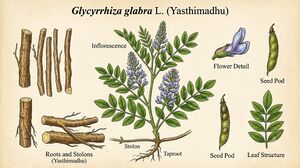
|keywords= Yashtimadhu (Glycyrrhiza glabra L.). Liquorice, jethimadh, jyeshthamadha, Charak Samhita, Dravyaguna, carakasamhitaonline, carakasamhita, caraka samhita, Ayurveda, Charak Samhita English translation, ancient Ayurveda text, Indian system of medicine, Ayurveda, Charak, Charaka Samhita, agnivesha, atreya, gopal basisht, yogesh deole, charak samhita wikipedia edition, charak samhita new edition, charaka samhita new edition, carak samhita new edition, caraka samhita new edition, research on charak samhita, text book charak samhita, fundamental principles of ayurveda, basic concepts of ayurveda,
|description= Yashtimadhu (Glycyrrhiza glabra L., Fabaceae) is a widely recognized medicinal herb in [[Ayurveda|Ayurvedic medicine]] and modern phytotherapy, valued for its gastroprotective, anti-inflammatory, antiviral, and hepatoprotective properties.
|data5 = [[Charak Samhita Research, Training and Skill Development Centre]]
|data5 = [[Charak Samhita Research, Training and Skill Development Centre]]
Line 16:
Line 27:
}}
}}
==English name ==
Yashtimadhu (Glycyrrhiza glabra L., Liquorice, Fabaceae) is a widely recognized medicinal herb in [[Ayurveda|Ayurvedic medicine]] and modern phytotherapy, valued for its gastroprotective, anti-inflammatory, antiviral, and hepatoprotective properties. Its bioactivity is primarily mediated by triterpenoid saponins, notably glycyrrhizin, and prenylated flavonoids like glabridin.
Liquorice
== Botanical & Phytochemical Profile ==
* '''Scientific Name:''' ''Glycyrrhiza glabra'' L. (Family: Fabaceae)
* '''Pathways:''' Glabridin and glycyrrhizin suppress inducible nitric oxide synthase (iNOS) and cyclooxygenase-2 (COX-2) by inhibiting nuclear factor kappa B (NF-κB) signaling pathways.<ref name="Bisht2022" /><ref name="Zhang2023" />
* '''Cytokine Regulation:''' Downregulates pro-inflammatory cytokines, including TNF-α, IL-1β, and IL-6 in systemic inflammatory models.<ref name="Bisht2022" />
=== Antiviral Properties ===
* '''Protease Inhibition:''' Glycyrrhizic acid directly binds to and inhibits viral replication through inhibition of the viral main protease (M<sup>pro</sup>) and disruption of viral attachment to host cells.<ref name="vandeSand2021" />
* '''Host Response:''' Dampens hyper-inflammatory pulmonary damage by inhibiting extracellular High Mobility Group Box 1 (HMGB1) cytokine release.<ref name="Bisht2022" />
=== Hepatoprotective & Antioxidant Activity ===
* '''Oxidative Stress Reduction:''' Glabridin scavenges reactive oxygen species (ROS) and activates peroxisome proliferator-activated receptor gamma (PPAR-γ) pathways to mitigate liver fibrosis and tissue injury.<ref name="Simmler2013" /><ref name="Zhang2023" />
* '''Clinical Findings:''' Standardized licorice extracts lower serum alanine aminotransferase (ALT) and aspartate aminotransferase (AST) levels in metabolic and viral liver disorders.<ref name="Kwon2020" />
== Phytochemical & Pharmacological Summary ==
{| class="wikitable sortable"
|+ Key Bioactive Compounds of ''Glycyrrhiza glabra''
Prolonged, high-dose administration of intact glycyrrhizin (≥ 500 mg/day) can cause pseudohyperaldosteronism via renal 11β-HSD2 inhibition, resulting in sodium retention, hypokalemia, and hypertension.<ref name="Asl2008" /><ref name="Kwon2020" /> Deglycyrrhizinated licorice (DGL) or standardized daily glycyrrhizin intakes capped under 100–200 mg demonstrate an optimal clinical safety profile.<ref name="Kwon2020" />
== References ==
{{reflist|refs=
<ref name="Asl2008">{{cite journal |vauthors=Asl MN, Hosseinzadeh H |title=Review of Pharmacological Effects of ''Glycyrrhiza'' sp. and its Bioactive Compounds |journal=Phytotherapy Research |date=2008 |volume=22 |issue=6 |pages=709–724 |doi=10.1002/ptr.2362}}</ref>
<ref name="Bisht2022">{{cite journal |vauthors=Bisht D, Rashid M, Arya RKK, et al. |title=Revisiting liquorice (''Glycyrrhiza glabra'' L.) as anti-inflammatory, antivirals and immunomodulators: Potential pharmacological applications with mechanistic insight |journal=Phytomedicine Plus |date=2022 |volume=2 |issue=1 |pages=100206 |doi=10.1016/j.phyplu.2021.100206}}</ref>
<ref name="Kwon2020">{{cite journal |vauthors=Kwon YJ, Son DH, Chung TH, Lee YJ |title=A Review of the Pharmacological Efficacy and Safety of Licorice Root from Corroborative Clinical Trial Findings |journal=Journal of Medicinal Food |date=2020 |volume=23 |issue=1 |pages=12–20 |doi=10.1089/jmf.2019.4459}}</ref>
<ref name="Simmler2013">{{cite journal |vauthors=Simmler C, Pauli GF, Chen SN |title=Phytochemistry and biological properties of glabridin |journal=Fitoterapia |date=2013 |volume=90 |pages=160–184 |doi=10.1016/j.fitote.2013.07.003}}</ref>
<ref name="vandeSand2021">{{cite journal |vauthors=van de Sand L, Bormann M, Alt M, et al. |title=Glycyrrhizin Effectively Inhibits SARS-CoV-2 Replication by Inhibiting the Viral Main Protease |journal=Viruses |date=2021 |volume=13 |issue=4 |pages=609 |doi=10.3390/v13040609}}</ref>
<ref name="Zhang2023">{{cite journal |vauthors=Zhang J, Wu X, Zhong B, et al. |title=Review on the Diverse Biological Effects of Glabridin |journal=Drug Design, Development and Therapy |date=2023 |volume=17 |pages=15–37 |doi=10.2147/dddt.s385981}}</ref>
Yashtimadhu (Glycyrrhiza glabra L., Liquorice, Fabaceae) is a widely recognized medicinal herb in Ayurvedic medicine and modern phytotherapy, valued for its gastroprotective, anti-inflammatory, antiviral, and hepatoprotective properties. Its bioactivity is primarily mediated by triterpenoid saponins, notably glycyrrhizin, and prenylated flavonoids like glabridin.
Anti-H. pylori: Deglycyrrhizinated licorice (DGL) preparations inhibit Helicobacter pylori mucosal adherence without causing mineralocorticoid-related side effects.[2]
Anti-Inflammatory & Immunomodulatory Effects
Pathways: Glabridin and glycyrrhizin suppress inducible nitric oxide synthase (iNOS) and cyclooxygenase-2 (COX-2) by inhibiting nuclear factor kappa B (NF-κB) signaling pathways.[3][4]
Cytokine Regulation: Downregulates pro-inflammatory cytokines, including TNF-α, IL-1β, and IL-6 in systemic inflammatory models.[3]
Antiviral Properties
Protease Inhibition: Glycyrrhizic acid directly binds to and inhibits viral replication through inhibition of the viral main protease (Mpro) and disruption of viral attachment to host cells.[5]
Host Response: Dampens hyper-inflammatory pulmonary damage by inhibiting extracellular High Mobility Group Box 1 (HMGB1) cytokine release.[3]
Hepatoprotective & Antioxidant Activity
Oxidative Stress Reduction: Glabridin scavenges reactive oxygen species (ROS) and activates peroxisome proliferator-activated receptor gamma (PPAR-γ) pathways to mitigate liver fibrosis and tissue injury.[6][4]
Clinical Findings: Standardized licorice extracts lower serum alanine aminotransferase (ALT) and aspartate aminotransferase (AST) levels in metabolic and viral liver disorders.[2]
Phytochemical & Pharmacological Summary
Key Bioactive Compounds of Glycyrrhiza glabra
Bioactive Constituent
Phytochemical Class
Molecular Targets
Primary Therapeutic Efficacy
Glycyrrhizin
Triterpenoid Saponin
Mpro protease, HMGB1, 11β-HSD
Gastroprotective, Antiviral, Anti-ulcer
Glabridin
Isoflavane
COX-2, iNOS, ROS, PPAR-γ
Antioxidant, Hepatoprotective, Anti-atherogenic
Isoliquiritigenin
Chalcone
NF-κB, Nrf2 pathway
Spasmolytic, Immunomodulatory, Anti-tumor
Liquiritin
Flavanone
TRPV1 / Capsaicin receptors
Antitussive, Expectorant, Neuroprotective
Safety & Toxicology
Prolonged, high-dose administration of intact glycyrrhizin (≥ 500 mg/day) can cause pseudohyperaldosteronism via renal 11β-HSD2 inhibition, resulting in sodium retention, hypokalemia, and hypertension.[1][2] Deglycyrrhizinated licorice (DGL) or standardized daily glycyrrhizin intakes capped under 100–200 mg demonstrate an optimal clinical safety profile.[2]
References
↑ 1.01.1Asl MN, Hosseinzadeh H (2008). "Review of Pharmacological Effects of Glycyrrhiza sp. and its Bioactive Compounds". Phytotherapy Research. 22 (6): 709–724. doi:10.1002/ptr.2362.
↑ 2.02.12.22.32.4Kwon YJ, Son DH, Chung TH, Lee YJ (2020). "A Review of the Pharmacological Efficacy and Safety of Licorice Root from Corroborative Clinical Trial Findings". Journal of Medicinal Food. 23 (1): 12–20. doi:10.1089/jmf.2019.4459.
↑ 3.03.13.2Bisht D, Rashid M, Arya R, et al. (2022). "Revisiting liquorice (Glycyrrhiza glabra L.) as anti-inflammatory, antivirals and immunomodulators: Potential pharmacological applications with mechanistic insight". Phytomedicine Plus. 2 (1): 100206. doi:10.1016/j.phyplu.2021.100206.Vancouver style error: initials (help)
↑ 4.04.1Zhang J, Wu X, Zhong B, et al. (2023). "Review on the Diverse Biological Effects of Glabridin". Drug Design, Development and Therapy. 17: 15–37. doi:10.2147/dddt.s385981.
↑van de Sand L, Bormann M, Alt M, et al. (2021). "Glycyrrhizin Effectively Inhibits SARS-CoV-2 Replication by Inhibiting the Viral Main Protease". Viruses. 13 (4): 609. doi:10.3390/v13040609.
↑Simmler C, Pauli GF, Chen SN (2013). "Phytochemistry and biological properties of glabridin". Fitoterapia. 90: 160–184. doi:10.1016/j.fitote.2013.07.003.