Visha Chikitsa: Difference between revisions
No edit summary |
No edit summary |
||
| (41 intermediate revisions by 3 users not shown) | |||
| Line 1: | Line 1: | ||
{{CiteButton}} | |||
{{#seo: | {{#seo: | ||
|title=Visha Chikitsa | |title=Visha Chikitsa | ||
|titlemode=append | |titlemode=append | ||
|keywords=Agada, visha, toxins, poisons, dushi visha, slow poisons, snake bite, snake venoms, mosquito bite, antidotes, shanka visha (pseudo poison), gara visha (slow poisons) | |keywords=Agada, visha, toxins, poisons, dushi visha, slow poisons, snake bite, snake venoms, mosquito bite, antidotes, shanka visha (pseudo poison), gara visha (slow poisons),Ayurveda, Indian system of medicine, charak samhita. | ||
|description=Chikitsa Sthana Chapter 23. Management of Visha (various types of poisoning) | |description=Chikitsa Sthana Chapter 23. Management of Visha (various types of poisoning) | ||
|image=http://www.carakasamhitaonline.com/resources/assets/ogimgs.jpg | |||
|image_alt=charak samhita | |||
|type=article | |||
}} | }} | ||
<big>'''[[Chikitsa Sthana]] Chapter 23. Management of Visha (various types of poisoning) </big>''' | <big>'''[[Chikitsa Sthana]] Chapter 23. Management of Visha (various types of poisoning) </big>''' | ||
{{Infobox | {{Infobox | ||
|title = Visha Chikitsa | |title = Visha Chikitsa | ||
| Line 27: | Line 21: | ||
|label5 = Other Sections | |label5 = Other Sections | ||
|data5 = [[Sutra Sthana]], [[Nidana Sthana]], [[Vimana Sthana]], [[Sharira Sthana]], [[Indriya Sthana]], [[Kalpa Sthana]], [[Siddhi Sthana]] | |data5 = [[Sutra Sthana]], [[Nidana Sthana]], [[Vimana Sthana]], [[Sharira Sthana]], [[Indriya Sthana]], [[Kalpa Sthana]], [[Siddhi Sthana]] | ||
|label6 = Translator and commentator | |||
|data6 = Gopikrishna, Bhatt S., Binorkar S. | |||
|label7 = Reviewer | |||
|data7 = Binorkar S. | |||
|label8 = Editors | |||
|data8 = Binorkar S., [[Yogesh Deole|Deole Y.S.]], [[Gopal Basisht|Basisht G.]] | |||
|label9 = Year of publication | |||
|data9 = 2020 | |||
|label10 = Publisher | |||
|data10 = [[Charak Samhita Research, Training and Skill Development Centre]] | |||
|label11 = DOI | |||
|data11 = [https://doi.org/10.47468/CSNE.2020.e01.s06.024 10.47468/CSNE.2020.e01.s06.024] | |||
|header3 = | |header3 = | ||
| Line 32: | Line 38: | ||
}} | }} | ||
= | <big>'''Abstract </big>''' | ||
<p style="text-align:justify;">Among the Ashtangas, ''agada tantra'' (toxicology) stands separate in its concept, clinical approach, management and result. This is the only chapter which guides us in the management of poison and the conditions of poisoning. As we all know ''visha'' and ''visha chikitsa'' requires a special mention in any medical system. It is rightly justified by the following facts: | |||
<br/> | |||
Treatment of poisoning is an emergency and should be managed as a house on fire, earlier its extinguished, lesser the damage, and the result for the effort of ''vaidya'' is immediate when compared to the other disorders. This chapter deals with study of the poison, its origin and criterion of classification. The group of ''sthavara'' (poisons of plant origin, minerals and metal, poison of immobile origin or vegetable poison) and ''jangama'' (poisons of animal origin) are described. A special category called ''kritrima visha'' (artificial poison) with a significant role for a good physician in treating severe cases. ''Dushivisha'' (slow poisons) is explained in a sentence but, has lot of hidden meaning and is a treasure in innovating the treatment skills of a physician. Various treatment methods for the poisons and ''chaturvimshati upakrama'' (24 fold treatments) is a special contribution of Charak. Medicines as a single drug and as a combination are told as remedial measures and also as symptomatic treatments as per the requirement of condition are described. Together with this, ''jangama vishas'' (poison of animal origin) and specific approach for their management are very systematically mentioned. | |||
<br/> | |||
'''Keywords''': ''Agada, visha,'' toxins, poisons, ''dushi visha,'' slow poisons, snake bite, snake venoms, mosquito bite, antidotes, ''shanka visha'' (pseudo poison), ''gara visha'' (slow poisons), poisoning. | |||
</p> | |||
== Introduction == | |||
<div style="text-align:justify;"> | |||
''Agada'' is enlisted in one of the eight branches of ayurveda. Management of poisoning is an important aspect of medical system. ''Visha'' is a substance that leads to decline of overall functions of the person. The ''vaidya'' should have knowledge and training in ''visha gara vairodhika prashamana'' (anti-toxin treatment). In India especially in Kerala, the role of traditional practitioners in this field is significant. Their simple, but effective treatments, has really been astonishing. They are also well versed in the details regarding the good and bad omen based on ''doota'' (messenger), the happenings the ''vaidya'' sees when he is going to make house call for treating such cases and also what he observes in the house and in the patient. He is also well versed in astrology. | ''Agada'' is enlisted in one of the eight branches of ayurveda. Management of poisoning is an important aspect of medical system. ''Visha'' is a substance that leads to decline of overall functions of the person. The ''vaidya'' should have knowledge and training in ''visha gara vairodhika prashamana'' (anti-toxin treatment). In India especially in Kerala, the role of traditional practitioners in this field is significant. Their simple, but effective treatments, has really been astonishing. They are also well versed in the details regarding the good and bad omen based on ''doota'' (messenger), the happenings the ''vaidya'' sees when he is going to make house call for treating such cases and also what he observes in the house and in the patient. He is also well versed in astrology. | ||
| Line 40: | Line 55: | ||
With the advancement in medical technology, the new methods of treatments of poisoning have evolved with time. However the basic treatments like applying tourniquet at the site of bite to prevent spread of poison, therapeutic emesis in the form of gastric lavage in case of ingested poison, or purgation are the same as in contemporary medicine. However with the development of forensic medicine, the investigations of types of poisons, their identification and their blood levels are newer additions. The chapter describes ancient methods of management of poisoning cases that need to be highlighted and blended with todays modern techniques. | With the advancement in medical technology, the new methods of treatments of poisoning have evolved with time. However the basic treatments like applying tourniquet at the site of bite to prevent spread of poison, therapeutic emesis in the form of gastric lavage in case of ingested poison, or purgation are the same as in contemporary medicine. However with the development of forensic medicine, the investigations of types of poisons, their identification and their blood levels are newer additions. The chapter describes ancient methods of management of poisoning cases that need to be highlighted and blended with todays modern techniques. | ||
== Sanskrit Text, Transliteration and English Translation == | |||
<div class="mw-collapsible mw-collapsed"> | <div class="mw-collapsible mw-collapsed"> | ||
| Line 69: | Line 84: | ||
</div></div> | </div></div> | ||
Now we shall expound the chapter | Now we shall expound the chapter "Visha chikitsa"(Management of different types of poisoning). Thus said Lord Atreya. | ||
Agnivesha, hear me carefully. Next I will explain about ''visha'' with the following aspects. ''Utpatti'' (origin), | Agnivesha, hear me carefully. Next I will explain about ''visha'' with the following aspects. ''Utpatti'' (origin), [[guna]] (properties), ''yoni'' (source), ''vegas'' (stages), ''lakshana'' (signs and symptoms) and ''chikitsa'' (therapeutic measures).[1-3] | ||
=== History of origin of ''visha'' === | |||
<div class="mw-collapsible mw-collapsed"> | <div class="mw-collapsible mw-collapsed"> | ||
| Line 104: | Line 119: | ||
While the ocean was being churned by ''devas'' and ''asuras'' for obtaining ''amrita'' (nectar of life), before the formation of ''amrita'' a ferocious looking person with fiery eyes, four fangs and greenish locks emerged. After seeing him the whole world became desperate and from that desperation, ''visha'' originated. [4-5] | While the ocean was being churned by ''devas'' and ''asuras'' for obtaining ''amrita'' (nectar of life), before the formation of ''amrita'' a ferocious looking person with fiery eyes, four fangs and greenish locks emerged. After seeing him the whole world became desperate and from that desperation, ''visha'' originated. [4-5] | ||
=== Sources of poison === | |||
<div class="mw-collapsible mw-collapsed"> | <div class="mw-collapsible mw-collapsed"> | ||
| Line 129: | Line 144: | ||
Lord Brahma deposited these ''visha'' in ''jangama''(animal origin) and ''sthavara'' (earthen and plant origin) categories. Hence in general ''visha'', originated from water; it is (hot) like fire and is of two types. Its action is manifested in 8 stages; it has 10 properties and can be treated with 24 therapeutic measures.[6-7] | Lord Brahma deposited these ''visha'' in ''jangama''(animal origin) and ''sthavara'' (earthen and plant origin) categories. Hence in general ''visha'', originated from water; it is (hot) like fire and is of two types. Its action is manifested in 8 stages; it has 10 properties and can be treated with 24 therapeutic measures.[6-7] | ||
=== Aggravation and pacification of potency === | |||
<div class="mw-collapsible mw-collapsed"> | <div class="mw-collapsible mw-collapsed"> | ||
| Line 154: | Line 169: | ||
During rainy season, due to its origin from water, when it comes in contact; it becomes moist similar to ''gud'' (jaggery) due to its ''kleda guna'' and after that it spreads. However the star Agastya at the end of rainy season, counteracts the effects of ''visha'' thereby getting milder in potency.[7-8] | During rainy season, due to its origin from water, when it comes in contact; it becomes moist similar to ''gud'' (jaggery) due to its ''kleda guna'' and after that it spreads. However the star Agastya at the end of rainy season, counteracts the effects of ''visha'' thereby getting milder in potency.[7-8] | ||
=== Animal origin === | |||
<div class="mw-collapsible mw-collapsed"> | <div class="mw-collapsible mw-collapsed"> | ||
| Line 185: | Line 200: | ||
''Sarpa'' (snakes), ''kita'' (insects), ''loota'' (spiders), ''vrishchika'' (scorpions), ''griha godhika'' (house lizards), ''jalauka'' (leeches), ''matsya'' (fish), ''manduka'' (frogs), ''kanabha'' or ''salabha'' (locusts), ''krkantaka'' (chameleon), ''shwa'' (dogs), ''simha'' (lion), ''vyaghra'' (tiger), ''gomayu'' (jackal), ''taraksu'' (hyena), ''nakula'' (mongoose), etc., are the fanged animals through whose fangs the poison is transmitted. The poisons of these creatures constitute animal poisons (poisons of mobile origin).[9-10] | ''Sarpa'' (snakes), ''kita'' (insects), ''loota'' (spiders), ''vrishchika'' (scorpions), ''griha godhika'' (house lizards), ''jalauka'' (leeches), ''matsya'' (fish), ''manduka'' (frogs), ''kanabha'' or ''salabha'' (locusts), ''krkantaka'' (chameleon), ''shwa'' (dogs), ''simha'' (lion), ''vyaghra'' (tiger), ''gomayu'' (jackal), ''taraksu'' (hyena), ''nakula'' (mongoose), etc., are the fanged animals through whose fangs the poison is transmitted. The poisons of these creatures constitute animal poisons (poisons of mobile origin).[9-10] | ||
=== Earthen and plant origin === | |||
<div class="mw-collapsible mw-collapsed"> | <div class="mw-collapsible mw-collapsed"> | ||
| Line 228: | Line 243: | ||
The poisons of the immobile (earthen and plant) origin are: the roots (including rhizomes) of ''mustaka, puskara, kraunca, vatsanabha'' (Aconitum ferox), ''balahaka, karkata, kalakuta, karavira'' (Nerium indicum / Cerbera thevetia), ''palaka, indrayudha taila, meghaka, kusa-puspaka, rohisa, pundarika, langalaki'' (Gloriosa superb), ''anjanabhaka, sankoca, markata, sringi-visa, halahala,'' and such other poisonous roots.[11-13] | The poisons of the immobile (earthen and plant) origin are: the roots (including rhizomes) of ''mustaka, puskara, kraunca, vatsanabha'' (Aconitum ferox), ''balahaka, karkata, kalakuta, karavira'' (Nerium indicum / Cerbera thevetia), ''palaka, indrayudha taila, meghaka, kusa-puspaka, rohisa, pundarika, langalaki'' (Gloriosa superb), ''anjanabhaka, sankoca, markata, sringi-visa, halahala,'' and such other poisonous roots.[11-13] | ||
=== ''Gara visha'' ( artificial poison) === | |||
<div class="mw-collapsible mw-collapsed"> | <div class="mw-collapsible mw-collapsed"> | ||
| Line 247: | Line 262: | ||
There is another variety of poison called ''gara-visha'' which is prepared artificially by the combination of various substances. It produces various diseases. Since it takes time to get metabolized and to produce its toxic effects, it does not cause instantaneous death of a person.[14] | There is another variety of poison called ''gara-visha'' which is prepared artificially by the combination of various substances. It produces various diseases. Since it takes time to get metabolized and to produce its toxic effects, it does not cause instantaneous death of a person.[14] | ||
=== Clinical features of poisoning === | |||
<div class="mw-collapsible mw-collapsed"> | <div class="mw-collapsible mw-collapsed"> | ||
| Line 294: | Line 309: | ||
The animal poison moves downwards whereas the vegetable poison moves upwards in the alimentary canal. Therefore, the animal poison cures poisoning by vegetable-poison and the poisoning caused by animal-poison is cured by vegetable poison.[15-17] | The animal poison moves downwards whereas the vegetable poison moves upwards in the alimentary canal. Therefore, the animal poison cures poisoning by vegetable-poison and the poisoning caused by animal-poison is cured by vegetable poison.[15-17] | ||
=== Stage wise clinical features in humans === | |||
<div class="mw-collapsible mw-collapsed"> | <div class="mw-collapsible mw-collapsed"> | ||
| Line 342: | Line 357: | ||
In human beings, the effects of poisons are manifested in eight different stages as follows: | In human beings, the effects of poisons are manifested in eight different stages as follows: | ||
*In the first stage, because of the vitiation of | *In the first stage, because of the vitiation of [[rasa dhatu]], the patient suffers from morbid thirst, unconsciousness, tingling sensation in teeth, salivation, vomiting and mental fatigue; | ||
*In the second stage, because of the vitiation of | *In the second stage, because of the vitiation of [[rakta dhatu]] the patient suffers from discoloration of the skin, giddiness, trembling; fainting, yawning, tingling sensation in the limbs and dyspnea. | ||
*In the third stage, because of the vitiation of | *In the third stage, because of the vitiation of [[mamsa dhatu]], the patient suffers from ''mandala'' (skin rash), pruritus, edema and urticaria; | ||
*In the fourth stage, because of the vitiation of | *In the fourth stage, because of the vitiation of [[vayu]], etc., the patient suffers from vomiting, burning sensation, pain in the limbs, fainting, etc.; | ||
*In the fifth stage, the patient suffers from blue-vision, or dark- vision, etc.; | *In the fifth stage, the patient suffers from blue-vision, or dark- vision, etc.; | ||
*In the sixth stage, the patient suffers from hiccup.; | *In the sixth stage, the patient suffers from hiccup.; | ||
| Line 353: | Line 368: | ||
The above mentioned eight stages of poisoning are manifested in human beings.[18-23] | The above mentioned eight stages of poisoning are manifested in human beings.[18-23] | ||
=== Stage wise features in animals and birds === | |||
<div class="mw-collapsible mw-collapsed"> | <div class="mw-collapsible mw-collapsed"> | ||
| Line 402: | Line 417: | ||
#In the third stage, the bird develops looseness of the limbs resulting in death.[21-23] | #In the third stage, the bird develops looseness of the limbs resulting in death.[21-23] | ||
=== Properties of ''visha'' and its effect on body === | |||
<div class="mw-collapsible mw-collapsed"> | <div class="mw-collapsible mw-collapsed"> | ||
| Line 455: | Line 470: | ||
</div></div> | </div></div> | ||
''Laghu'' (lightness for digestion), ''ruksha'' (dryness), ''ashu'' (rapid), ''vishada'' (non sliminess), ''vyavayi'' (which pervades whole body before getting digested), ''tikshna'' (sharply acting), ''vikashi'' (causing looseness of joints by diminution of | ''Laghu'' (lightness for digestion), ''ruksha'' (dryness), ''ashu'' (rapid), ''vishada'' (non sliminess), ''vyavayi'' (which pervades whole body before getting digested), ''tikshna'' (sharply acting), ''vikashi'' (causing looseness of joints by diminution of [[dhatu]])'', sukshma'' (subtleness), ''ushna'' (hot), and ''anirdeshya rasa'' (indistinct taste)- these are the ten properties of poison according to the expert ''vaidyas''. | ||
Because of dryness property, | Because of dryness property, [[vayu]] gets aggravated; due to hot property, [[pitta]] gets vitiated; subtleness leads to vitiation of [[rakta]]; Due to ''[[Avyakta|avyakta]] rasa'' (indistinct taste), [[kapha]] is vitiated; due to rapidly acting, it quickly permeates through the nutrient fluid; vyavayi [[guna]] spreads it throughout the body instantaneously. Tikshna [[guna]] (sharply acting) property causes injury to marmas, vikashi [[guna]] results in death of the patient. Due to laghu [[guna]] it becomes difficult to manage therapeutically; because of vaishadya [[guna]], it pervades all over the body with [[dosha]] without any obstruction in circulation. Depending upon the location of [[dosha]] and [[prakriti]] of patient, ''visha'' produces several other complications. [24-27] | ||
=== Clinical features as per site of [[dosha]] === | |||
<div class="mw-collapsible mw-collapsed"> | <div class="mw-collapsible mw-collapsed"> | ||
| Line 500: | Line 515: | ||
</div></div> | </div></div> | ||
If ''visha'' is situated at | If ''visha'' is situated at [[vata]] sthana in a person having vatika [[prakriti]], then he suffers from ''trit'' (excessive thirst), ''moha'' (loss of consciousness), ''arati'' (dislikness for everything), ''moorchha'' (fainting), ''galagraha'' (obstruction in the throat), ''phena chhardi'' (vomitus containing froth). There will be less manifestation of signs and symptoms of ''kapha'' and ''pitta''. | ||
If the poison gets lodged in | If the poison gets lodged in [[pitta]] sthana in a person having paittiika [[prakriti]] he will suffer from ''trit'' (excessive thirst), ''kasa'' (cough), ''jwara'' (fever), ''vamadhu'' (vomiting sensation), ''klama'' (mental fatigue), ''daha'' (burning sensation), ''tama'' (appearance of darkness), ''atisara'' (diarrhea). There will be less manifestation of signs and symptoms of [[kapha]] and [[vayu]]. | ||
If the poison gets lodged in | If the poison gets lodged in [[kapha]] sthana in a person having [[kapha]] prakriri then he will be suffering from ''shwasa'' (dyspnea), ''galagraha'' (obstruction of throat), ''kandu'' (itching), ''laala vamana'' (excessive salivation). There will be less manifestation of signs and symptoms of [[vayu]] and [[pitta]].[28-30] | ||
<div class="mw-collapsible mw-collapsed"> | <div class="mw-collapsible mw-collapsed"> | ||
| Line 521: | Line 536: | ||
</div></div> | </div></div> | ||
''Dushi-visha'' (a type of artificial poison) vitiates blood and produces symptoms like ''aru'' (eczema in the head), ''kitibha'' (psoriasis) and ''kotha'' (urticaria). This type of poison afflicts each one of the | ''Dushi-visha'' (a type of artificial poison) vitiates blood and produces symptoms like ''aru'' (eczema in the head), ''kitibha'' (psoriasis) and ''kotha'' (urticaria). This type of poison afflicts each one of the [[dosha]] and causes death of the patient.[31] | ||
<div class="mw-collapsible mw-collapsed"> | <div class="mw-collapsible mw-collapsed"> | ||
| Line 542: | Line 557: | ||
If the poison is taken orally it stays in heart and if the poison is transmitted by bite or from poisoned arrow, it gets lodged in the place of bite.[32] | If the poison is taken orally it stays in heart and if the poison is transmitted by bite or from poisoned arrow, it gets lodged in the place of bite.[32] | ||
=== Fatal signs === | |||
<div class="mw-collapsible mw-collapsed"> | <div class="mw-collapsible mw-collapsed"> | ||
| Line 573: | Line 588: | ||
Bluish lips, loose teeth, ''kesha pathana'' (hair fall), ''anga bhanga'' (cutting type of pain in all over body), ''vikshepa'' (convulsions), absence of horripilation even if touched by cold things, non-formation of contusion marks when hit by stick, absence of bleeding from ulcers- these are the signs of imminent death of a poisoned patient. Patients without such signs should be treated with the following therapeutic measures.[33-34] | Bluish lips, loose teeth, ''kesha pathana'' (hair fall), ''anga bhanga'' (cutting type of pain in all over body), ''vikshepa'' (convulsions), absence of horripilation even if touched by cold things, non-formation of contusion marks when hit by stick, absence of bleeding from ulcers- these are the signs of imminent death of a poisoned patient. Patients without such signs should be treated with the following therapeutic measures.[33-34] | ||
=== Twenty four treatment modalities === | |||
<div class="mw-collapsible mw-collapsed"> | <div class="mw-collapsible mw-collapsed"> | ||
| Line 623: | Line 638: | ||
#''Parisheka'' (affusion); | #''Parisheka'' (affusion); | ||
#''Avagaha'' (bath with medicated water); | #''Avagaha'' (bath with medicated water); | ||
# | #[[Raktamokshana]] (blood-letting); | ||
# | #[[Vamana]] (therapeutic emesis); | ||
# | #[[Virechana]] (therapeutic purgation); | ||
#''Upadhana'' (application of medicine after making an incision over the scalp); | #''Upadhana'' (application of medicine after making an incision over the scalp); | ||
#''Hridayavaram'' (giving medicines-to protect the heart); | #''Hridayavaram'' (giving medicines-to protect the heart); | ||
#''Anjana'' (application of collyrium); | #''Anjana'' (application of collyrium); | ||
# | #[[Nasya]] (inhalation of medicated oil, etc.); | ||
#''Dhuma'' (smoking therapy); | #''Dhuma'' (smoking therapy); | ||
#''Leha'' (drugs in the form of linctus given for licking); | #''Leha'' (drugs in the form of linctus given for licking); | ||
| Line 640: | Line 655: | ||
#''Mrita-sanjivana'' (measures for the revival of life of an apparently dead person).[35-37] | #''Mrita-sanjivana'' (measures for the revival of life of an apparently dead person).[35-37] | ||
=== First aid treatment === | |||
<div class="mw-collapsible mw-collapsed"> | <div class="mw-collapsible mw-collapsed"> | ||
| Line 665: | Line 680: | ||
Immediately after bite, before the spreading of the poison from the place of the bite, the ''venika'' (string or rope or torniquet) should be tied (at the proximal part of the bite), the site of the bite should be squeezed frequently and forcefully; the place of bite should be excised unless it is a vital part (''arma''); and the poison should be sucked out with the help of mouth filled with the flour of barley or dust.[38-39] | Immediately after bite, before the spreading of the poison from the place of the bite, the ''venika'' (string or rope or torniquet) should be tied (at the proximal part of the bite), the site of the bite should be squeezed frequently and forcefully; the place of bite should be excised unless it is a vital part (''arma''); and the poison should be sucked out with the help of mouth filled with the flour of barley or dust.[38-39] | ||
=== Blood letting === | |||
<div class="mw-collapsible mw-collapsed"> | <div class="mw-collapsible mw-collapsed"> | ||
| Line 726: | Line 741: | ||
Thereafter bloodletting should be done with ''prachhana'' (scratching with the help of rough instruments), ''shringa'' (horn), ''jalauka'' (leech), or ''siravyadhana'' (venesection). | Thereafter bloodletting should be done with ''prachhana'' (scratching with the help of rough instruments), ''shringa'' (horn), ''jalauka'' (leech), or ''siravyadhana'' (venesection). | ||
The blood vitiated by ''visha'' can cause vitiation of other | The blood vitiated by ''visha'' can cause vitiation of other [[dhatu]] there by resulting in death. Therefore blood does not come out of site of bite, then ''pragharshana'' (rubbing therapy) should be employed to cause the blood to flow out. | ||
''Pragharshana'' done with the help of powdered ''trikatu'' (Zingiber officinale, Piper nigrum, Piper longum), ''grihadhooma, haridra'' (Curcuma longa), ''panchalavana'' (five varieties of salts) and ''varthaka''. Excessive bleeding can be treated with ''sheetalepa'' with the paste of | ''Pragharshana'' done with the help of powdered ''trikatu'' (Zingiber officinale, Piper nigrum, Piper longum), ''grihadhooma, haridra'' (Curcuma longa), ''panchalavana'' (five varieties of salts) and ''varthaka''. Excessive bleeding can be treated with ''sheetalepa'' with the paste of [[vata]] (Ficus bengalensis), etc. | ||
[[Rakta dhatu]] is abode of ''visha'' (circulates ''visha'' all over the body) just like wind spreads the fire. With the help of ''pradeha'' (external application) and ''seka'' which are cooling in effect, blood gets coagulated thereby arresting the spread of poison. Due to the ''vega avastha'' of ''visha'' (different stages), patient suffers from ''mada'' (intoxication), ''murchha'' (fainting), ''vishada'' (depression), ''hridaya drava'' (palpitation) etc. Application of cooling therapies alleviates such complication. The patient should sufficiently ventilated till the occurrence of horripilation.[39-43] | |||
=== Benefits of first aid treatments === | |||
<div class="mw-collapsible mw-collapsed"> | <div class="mw-collapsible mw-collapsed"> | ||
| Line 753: | Line 768: | ||
The process of ''achooshana'' (suction) induces the poison mixed with blood to flow out. As the flow of water is arrested by a dam so also the flow and spread of poison can be arrested by tying ''arishtas'' (tourniquet).[44] | The process of ''achooshana'' (suction) induces the poison mixed with blood to flow out. As the flow of water is arrested by a dam so also the flow and spread of poison can be arrested by tying ''arishtas'' (tourniquet).[44] | ||
=== Treatment of first stage === | |||
<div class="mw-collapsible mw-collapsed"> | <div class="mw-collapsible mw-collapsed"> | ||
| Line 772: | Line 787: | ||
''Agnikarma'' (cauterization) causes burning of poison located in skin and flesh. ''Sravana'' (drugs used to cause exudation of liquid) helps in flowing out of poison from the blood. | ''Agnikarma'' (cauterization) causes burning of poison located in skin and flesh. ''Sravana'' (drugs used to cause exudation of liquid) helps in flowing out of poison from the blood. | ||
[[Vamana]] (emesis) helps in eliminating poison which has been taken orally. The second stage of poisoning [[virechana]] (purgation) places a definite role in eliminating the ''visha'' from the body. [45] | |||
=== Treatment of second stage === | |||
<div class="mw-collapsible mw-collapsed"> | <div class="mw-collapsible mw-collapsed"> | ||
| Line 805: | Line 820: | ||
In the second stage, ''hridaya'' (heart) should be protected and an ''avarana'' (covering) should be made according to the availability of drugs. ''Madhu'' (honey), ghee (clarified butter), ''majja'' (bone marrow), ''payas'' (milk), ''gairikam'' (red ochre), ''gomaya rasa'' (juice of cow dung), well boiled sugar cane juice or the juice squeezed out of meat of crow should be given to the patient for protecting the heart. Patient can be treated immediately with blood of goat etc, ashes or mud diluted with water to drink. [46-47] | In the second stage, ''hridaya'' (heart) should be protected and an ''avarana'' (covering) should be made according to the availability of drugs. ''Madhu'' (honey), ghee (clarified butter), ''majja'' (bone marrow), ''payas'' (milk), ''gairikam'' (red ochre), ''gomaya rasa'' (juice of cow dung), well boiled sugar cane juice or the juice squeezed out of meat of crow should be given to the patient for protecting the heart. Patient can be treated immediately with blood of goat etc, ashes or mud diluted with water to drink. [46-47] | ||
=== Treatment of third to eighth stage === | |||
<div class="mw-collapsible mw-collapsed"> | <div class="mw-collapsible mw-collapsed"> | ||
| Line 850: | Line 865: | ||
During the 4th stage, patient should be administered with juice of cow dung along with ''kapita rasa'', honey and ghee. | During the 4th stage, patient should be administered with juice of cow dung along with ''kapita rasa'', honey and ghee. | ||
During the 5th stage, patient administered with ''aschothana, anjana'' and | During the 5th stage, patient administered with ''aschothana, anjana'' and [[nasya]] with the juice of ''kakanda'' (Diospyros Montana or Strychnos nuxvomica) and ''shireesha'' (Albizzia procera). | ||
During the 6th stage, patient should be administered with ''samjnasthapana'' drugs (drugs for regaining the consciousness). For that patient should be given to drink ''gopitta'' (cows bile) mixed with ''rajani'' (Curcuma longa), ''manjishta'' (Rubia cordifolia), ''maricha'' (Piper nigrum) and ''pippali'' (Piper longum). | During the 6th stage, patient should be administered with ''samjnasthapana'' drugs (drugs for regaining the consciousness). For that patient should be given to drink ''gopitta'' (cows bile) mixed with ''rajani'' (Curcuma longa), ''manjishta'' (Rubia cordifolia), ''maricha'' (Piper nigrum) and ''pippali'' (Piper longum). | ||
| Line 856: | Line 871: | ||
At the end, patient should be given poison to drink if he is afflicted with the poison caused by bite, if he is afflicted by oral poison then he should be made to be bitten by a poisonous animal.[48-50] | At the end, patient should be given poison to drink if he is afflicted with the poison caused by bite, if he is afflicted by oral poison then he should be made to be bitten by a poisonous animal.[48-50] | ||
=== Treatment in eighth stage === | |||
<div class="mw-collapsible mw-collapsed"> | <div class="mw-collapsible mw-collapsed"> | ||
| Line 890: | Line 905: | ||
Alternatively, this pill should be prepared of ''surasa'' (Ocimum sanctum), ''granthi'' (pippalimula), ''haridra'' (Curcuma longa), ''daruharidra'' (Berberis aristata), ''madhuka'' (Glycerrhiza glabra) and ''kushta'' (Saussurea lappa) by triturating with the juice of the flower of ''shirisha'' (Albizzia lebbeck) and the juice of ''kakandaka'' (Canavalia ensiformis).[51-52] | Alternatively, this pill should be prepared of ''surasa'' (Ocimum sanctum), ''granthi'' (pippalimula), ''haridra'' (Curcuma longa), ''daruharidra'' (Berberis aristata), ''madhuka'' (Glycerrhiza glabra) and ''kushta'' (Saussurea lappa) by triturating with the juice of the flower of ''shirisha'' (Albizzia lebbeck) and the juice of ''kakandaka'' (Canavalia ensiformis).[51-52] | ||
=== Treatment in case of hanging and drowning === | |||
<div class="mw-collapsible mw-collapsed"> | <div class="mw-collapsible mw-collapsed"> | ||
| Line 909: | Line 924: | ||
If the patient appears to be dead because of ''udbandhana'' (hanging), poisoning or drowning in water (''jalamrita''), then the potion comprising ''kakanda'' (Canavalia ensiformis), ''surasa'' (Ocimum sanctum), ''gavakshi'' (Citrullus colocynthis), ''punarnava'' (Boerhavia diffusa), ''vayasi'' (Solanum nigrum) and fruits of ''shirisha'' (Albizzia lebbeck) should be administered in the form of ''lepa'' (ointment) along with ''aupadhi'' (application of the paste over the head after making incisions in the form of ''kaakapaada'' or the paw of a crow, ''nasya'' and ''pana'' for his revival. [53] | If the patient appears to be dead because of ''udbandhana'' (hanging), poisoning or drowning in water (''jalamrita''), then the potion comprising ''kakanda'' (Canavalia ensiformis), ''surasa'' (Ocimum sanctum), ''gavakshi'' (Citrullus colocynthis), ''punarnava'' (Boerhavia diffusa), ''vayasi'' (Solanum nigrum) and fruits of ''shirisha'' (Albizzia lebbeck) should be administered in the form of ''lepa'' (ointment) along with ''aupadhi'' (application of the paste over the head after making incisions in the form of ''kaakapaada'' or the paw of a crow, ''nasya'' and ''pana'' for his revival. [53] | ||
=== ''Mritasanjivana agada'' === | |||
<div class="mw-collapsible mw-collapsed"> | <div class="mw-collapsible mw-collapsed"> | ||
| Line 1,010: | Line 1,025: | ||
If inhaled, applied externally as an ointment, carried in the body as an amulet, smoked or kept in the house, it annihilates the afflictions by evil spirits, poisons, germs, ''alaksmi'' (inauspiciousness), ''karmana'' (black magic), ''mantra'' (incantations recited to inflict injury to others), fire, thunder-bolt and enemies. It counteracts the evil effects of bad dreams and ''stri-dosha'' (poisons secretly given by women). It prevents untimely death, fear of water and fear of thieves. It endows a person with wealth, food-grains and success in undertakings. It promotes auspiciousness, nourishment and longevity. This excellent recipe is called ''mrtasanjivana'' (recipe that helps in the revival of a dead person). Lord Brahma propounded this recipe prior to the discovery of ''amrita''(ambrosia).[54-60] | If inhaled, applied externally as an ointment, carried in the body as an amulet, smoked or kept in the house, it annihilates the afflictions by evil spirits, poisons, germs, ''alaksmi'' (inauspiciousness), ''karmana'' (black magic), ''mantra'' (incantations recited to inflict injury to others), fire, thunder-bolt and enemies. It counteracts the evil effects of bad dreams and ''stri-dosha'' (poisons secretly given by women). It prevents untimely death, fear of water and fear of thieves. It endows a person with wealth, food-grains and success in undertakings. It promotes auspiciousness, nourishment and longevity. This excellent recipe is called ''mrtasanjivana'' (recipe that helps in the revival of a dead person). Lord Brahma propounded this recipe prior to the discovery of ''amrita''(ambrosia).[54-60] | ||
=== Principle of treatment as per site of [[dosha]] === | |||
<div class="mw-collapsible mw-collapsed"> | <div class="mw-collapsible mw-collapsed"> | ||
| Line 1,065: | Line 1,080: | ||
''Dhamani bandha'' (application of tourniquet), ''avamarjana'' (eliminating the poison), and ''atmaraksha'' (protecting ourselves from the attack of evil spirits) should be done with the help of ''mantras''. | ''Dhamani bandha'' (application of tourniquet), ''avamarjana'' (eliminating the poison), and ''atmaraksha'' (protecting ourselves from the attack of evil spirits) should be done with the help of ''mantras''. | ||
The predominant site of | The predominant site of [[dosha]] in whose place where ''visha'' lodged should be treated first. | ||
If the ''visha'' is located in | If the ''visha'' is located in [[vata]] sthana (site of [[vata]]),then the patient should be administered with [[swedana]] (fomentation therapy) and should be given to drink the paste of ''nata'' (Valeriana wallichii) and ''kushta'' (Saussurea lappa) mixed with curd. | ||
If the ''visha'' is located in | If the ''visha'' is located in [[pitta]] sthana (site of [[pitta]]),then the patient should be administered with ghee, honey, milk and water to drink. He should also be given ''avagaha'' and ''parisheka'' (types of fomentation therapies). | ||
If the ''visha'' is located in | If the ''visha'' is located in [[kapha]] sthana(site of [[kapha]]), then the patient should be administered with ''ksharagada, [[swedana]] (fomentation therapy) and ''siravydhana'' (bloodletting). | ||
If the ''visha'' is located in ''rakta sthana'' (site of | If the ''visha'' is located in ''rakta sthana'' (site of [[rakta dhatu]]), or if the patient is afflicted with ''dooshivisha'' then the patient should be administered with ''siravyadhana'' (bloodletting) and [[Panchakarma]] (five types of elimination therapies). | ||
=== Treatment of obstruction by [[kapha]] and ''kakapada'' (incision in the shape of paw of crow) === | |||
<div class="mw-collapsible mw-collapsed"> | <div class="mw-collapsible mw-collapsed"> | ||
| Line 1,116: | Line 1,131: | ||
</div></div> | </div></div> | ||
When the channel of circulation of | When the channel of circulation of [[kapha]] gets vitiated by poison, then this causes obstruction in the channel because of which the movement of [[vayu]] gets obstructed. As a result of this, the patient breaths as if he is going to die very soon. If he is free from signs and symptoms of incurability, then incisions should be made on his scalp resembling the paw of the crow (''kakapada''), and one bilva (nearly 40 grams) of the paste of ''charmakasha'' (''saptala'' – Acacia concinna) should be applied over it. He may also be given ''pradhamana'' (a type of inhalation therapy in which the recipe in powder form is blown into the nostrils) with ''katabhi'' (Albizzia procera), ''katu'' (''shunti'' – Zingiber officinale, ''pippali'' – Piper longum and ''maricha'' – Piper nigrum) and ''katphala'' (Luffa cylindrica). | ||
Over the ''kakapada'' (incisions in the scalp), the meat of goat, cow, buffalo or cock should be applied which will absorb the poison from the body.[65-67] | Over the ''kakapada'' (incisions in the scalp), the meat of goat, cow, buffalo or cock should be applied which will absorb the poison from the body.[65-67] | ||
=== | === [[Nasya]] and ''anjana'' administration === | ||
<div class="mw-collapsible mw-collapsed"> | <div class="mw-collapsible mw-collapsed"> | ||
| Line 1,149: | Line 1,164: | ||
</div></div> | </div></div> | ||
If there is obstruction to the nose, eyes (vision), ears, tongue and throat, then the patient should be given | If there is obstruction to the nose, eyes (vision), ears, tongue and throat, then the patient should be given [[nasya]] (inhalation therapy) with the help of the paste of ''vartaku'' (Solanum melongena), ''bijapura'' (Citrus medica), ''jyotishmati'' (Celastrus paniculatus), etc. | ||
If there is obstruction to the eyes (vision), then the collyrium prepared of ''devadaru'' (Cedrus deodara), ''shunthi'' (Zingiber officinale), ''pippali'' (Piper longum) and ''maricha'' (Piper nigrum), ''haridra'' (Curcuma longa), ''karavira'' (Nerium indicum), ''karanja'' (Pongamia pinnata), ''nimba'' (Azadirechta indica) and ''surasa'' (Ocimum sanctum) by triturating with goat’s urine should be applied over the eyes.[68-69] | If there is obstruction to the eyes (vision), then the collyrium prepared of ''devadaru'' (Cedrus deodara), ''shunthi'' (Zingiber officinale), ''pippali'' (Piper longum) and ''maricha'' (Piper nigrum), ''haridra'' (Curcuma longa), ''karavira'' (Nerium indicum), ''karanja'' (Pongamia pinnata), ''nimba'' (Azadirechta indica) and ''surasa'' (Ocimum sanctum) by triturating with goat’s urine should be applied over the eyes.[68-69] | ||
=== ''Gandhahasti agada'' === | |||
<div class="mw-collapsible mw-collapsed"> | <div class="mw-collapsible mw-collapsed"> | ||
| Line 1,260: | Line 1,275: | ||
This recipe which is an antidote of poisons is called ''gandhahasti''. As trees are destroyed by an elephant, so also all the ailments caused by poisoning are cured by this recipe.[70-76] | This recipe which is an antidote of poisons is called ''gandhahasti''. As trees are destroyed by an elephant, so also all the ailments caused by poisoning are cured by this recipe.[70-76] | ||
=== ''Mahagandhahastinama agada'' === | |||
<div class="mw-collapsible mw-collapsed"> | <div class="mw-collapsible mw-collapsed"> | ||
| Line 1,571: | Line 1,586: | ||
Thus, ends the description of the recipe called ''mahagandhahasti''.[77-94] | Thus, ends the description of the recipe called ''mahagandhahasti''.[77-94] | ||
=== ''Rushabhakadi agada'' === | |||
<div class="mw-collapsible mw-collapsed"> | <div class="mw-collapsible mw-collapsed"> | ||
| Line 1,590: | Line 1,605: | ||
Intake of ''rishabhaka'' (Microstylis wallichii), ''jeevaka'' (Microstylis musifera), ''bharngi'' (Clerodendrum serratum), ''madhuka'' (Glycerrhiza glabra), ''utpala'' (Nymphaea stellata), ''dhanya'' (Coriandrum sativum), ''kesara''(Mesua ferrea), ''ajaji'' (Cuminum cyminum), ''sitagiri'' (Clitoria ternatea) and the pulp of ''kola'' (Zizyphus jujube) in the form of a ''peya'' (thin gruel made up of rice) cures ''shwasa'', fever etc., caused by poisoning.[95] | Intake of ''rishabhaka'' (Microstylis wallichii), ''jeevaka'' (Microstylis musifera), ''bharngi'' (Clerodendrum serratum), ''madhuka'' (Glycerrhiza glabra), ''utpala'' (Nymphaea stellata), ''dhanya'' (Coriandrum sativum), ''kesara''(Mesua ferrea), ''ajaji'' (Cuminum cyminum), ''sitagiri'' (Clitoria ternatea) and the pulp of ''kola'' (Zizyphus jujube) in the form of a ''peya'' (thin gruel made up of rice) cures ''shwasa'', fever etc., caused by poisoning.[95] | ||
=== ''Hingvadi yoga'' === | |||
<div class="mw-collapsible mw-collapsed"> | <div class="mw-collapsible mw-collapsed"> | ||
| Line 1,609: | Line 1,624: | ||
Intake of ''hingu'' (Ferula foetida) and ''krishna'' (Piper longum) along with honey and sugar, or the juice of ''kapittha'' (Feronia limonia) and ''saindhava'' (rock salt) along with honey and sugar cures fever, hiccup, dyspnea and cough caused by poisoning. [96] | Intake of ''hingu'' (Ferula foetida) and ''krishna'' (Piper longum) along with honey and sugar, or the juice of ''kapittha'' (Feronia limonia) and ''saindhava'' (rock salt) along with honey and sugar cures fever, hiccup, dyspnea and cough caused by poisoning. [96] | ||
=== Treatment of vomiting and hiccups === | |||
<div class="mw-collapsible mw-collapsed"> | <div class="mw-collapsible mw-collapsed"> | ||
| Line 1,630: | Line 1,645: | ||
''Dhumavarti'' (inhalation of the fume from an incense stick) of ''brihati'' (Solanum indicum), ''kantakari'' and leaves of ''adhaki'' cures hiccups caused by poisoning.[97] | ''Dhumavarti'' (inhalation of the fume from an incense stick) of ''brihati'' (Solanum indicum), ''kantakari'' and leaves of ''adhaki'' cures hiccups caused by poisoning.[97] | ||
=== Fumigation === | |||
<div class="mw-collapsible mw-collapsed"> | <div class="mw-collapsible mw-collapsed"> | ||
| Line 1,649: | Line 1,664: | ||
The fumigation with peacock’s feather, crane’s bone, ''sarshapa'' (Brassica campestris) and ''chandana'' (Santalam album) added with ghee (clarified butter) removes the toxicities in the home, beds, seats and clothes. [98] | The fumigation with peacock’s feather, crane’s bone, ''sarshapa'' (Brassica campestris) and ''chandana'' (Santalam album) added with ghee (clarified butter) removes the toxicities in the home, beds, seats and clothes. [98] | ||
=== Medicated fumigation for swelling === | |||
<div class="mw-collapsible mw-collapsed"> | <div class="mw-collapsible mw-collapsed"> | ||
| Line 1,668: | Line 1,683: | ||
Fumigation with ''nata'' (Valeriana wallichii), ''kushta'' (Saussurea lappa), head of ''bhujagapati'' (snake having two heads or fangs) and flower of ''shirisha'' (Albizzia labbec) by adding ghee is called ''dhumagada'', and it cures all types of poison and edema.[99] | Fumigation with ''nata'' (Valeriana wallichii), ''kushta'' (Saussurea lappa), head of ''bhujagapati'' (snake having two heads or fangs) and flower of ''shirisha'' (Albizzia labbec) by adding ghee is called ''dhumagada'', and it cures all types of poison and edema.[99] | ||
=== ''Jatwadi'' medicated fumigation === | |||
<div class="mw-collapsible mw-collapsed"> | <div class="mw-collapsible mw-collapsed"> | ||
| Line 1,687: | Line 1,702: | ||
The fumigation with ''jatu'' (lac), ''sevya'' (Vetiveria zizanoides), ''patra'' (Cinnamomum tamala), ''guggulu'' (Commiphora mukul), ''bhallataka'' (Semecarpus anacardium), flower of ''kakubha'' (Terminalia arjuna), ''sarjarasa'' (Vateria indica) and ''shveta'' (Clitoria ternatea) is an excellent remedy for curing poisoning by snake and rat bite. It also helps in destroying the insects (counteracting their poison) and ''vastrakrimi'' (''yuka'' or lice). [100] | The fumigation with ''jatu'' (lac), ''sevya'' (Vetiveria zizanoides), ''patra'' (Cinnamomum tamala), ''guggulu'' (Commiphora mukul), ''bhallataka'' (Semecarpus anacardium), flower of ''kakubha'' (Terminalia arjuna), ''sarjarasa'' (Vateria indica) and ''shveta'' (Clitoria ternatea) is an excellent remedy for curing poisoning by snake and rat bite. It also helps in destroying the insects (counteracting their poison) and ''vastrakrimi'' (''yuka'' or lice). [100] | ||
=== ''Ksharagada'' === | |||
<div class="mw-collapsible mw-collapsed"> | <div class="mw-collapsible mw-collapsed"> | ||
| Line 1,777: | Line 1,792: | ||
The details regarding the ''lakshanas'' and ''chikitsa'' of those who has consumed ''sthavara visha'' or who has been bitten by poisonous animals or who has been injured by the weapons smeared in poisons or whose cloths have been afflicted by poisons are explained so far in this chapter. Now, hear carefully about the treatment of different types of poison which are to be elaborated separately.[105-106] | The details regarding the ''lakshanas'' and ''chikitsa'' of those who has consumed ''sthavara visha'' or who has been bitten by poisonous animals or who has been injured by the weapons smeared in poisons or whose cloths have been afflicted by poisons are explained so far in this chapter. Now, hear carefully about the treatment of different types of poison which are to be elaborated separately.[105-106] | ||
=== Characteristics of poison giver and intoxicated poisonous food === | |||
<div class="mw-collapsible mw-collapsed"> | <div class="mw-collapsible mw-collapsed"> | ||
| Line 1,853: | Line 1,868: | ||
If the poison is added to drinks like water, milk or alcohol, blue lines appear over its surface or it becomes discolored. A person’s own shadow is not reflected through such drinks or the shadow is reflected in a distorted manner. If such drinks are added with salt, then there is froth.[110-111] | If the poison is added to drinks like water, milk or alcohol, blue lines appear over its surface or it becomes discolored. A person’s own shadow is not reflected through such drinks or the shadow is reflected in a distorted manner. If such drinks are added with salt, then there is froth.[110-111] | ||
=== Effects of food poisoning === | |||
<div class="mw-collapsible mw-collapsed"> | <div class="mw-collapsible mw-collapsed"> | ||
| Line 1,929: | Line 1,944: | ||
If the oil for application over the head is poisoned, then the patient suffers from hair-fall, headache and tumors in the head.[112-116] | If the oil for application over the head is poisoned, then the patient suffers from hair-fall, headache and tumors in the head.[112-116] | ||
=== Clinical features of poison through various routes of consumption/exposure === | |||
<div class="mw-collapsible mw-collapsed"> | <div class="mw-collapsible mw-collapsed"> | ||
| Line 2,022: | Line 2,037: | ||
A poisoned garland loses its aroma and gets withered soon. It causes headache and horripilation. The poisoned fume causes stiffness in the channels of circulation and impairment of the functioning of the nose and eyes. | A poisoned garland loses its aroma and gets withered soon. It causes headache and horripilation. The poisoned fume causes stiffness in the channels of circulation and impairment of the functioning of the nose and eyes. | ||
If the water of wells and ponds are poisoned, then the water becomes foul-smelling, dirty and discolored. Intake of this poisoned water causes edema, urticaria and pimples, and even death. If the poison has reached the stomach, then the physician in the beginning should administer emetic therapy. If the poisonous material is located in the skin, then ointments and fomentation therapy etc. should be administered. These therapeutic measures should be administered, keeping in view the nature of the | If the water of wells and ponds are poisoned, then the water becomes foul-smelling, dirty and discolored. Intake of this poisoned water causes edema, urticaria and pimples, and even death. If the poison has reached the stomach, then the physician in the beginning should administer emetic therapy. If the poisonous material is located in the skin, then ointments and fomentation therapy etc. should be administered. These therapeutic measures should be administered, keeping in view the nature of the [[dosha]] and the strength of the patient. [117-123] | ||
=== Description of snakes and poisoning === | |||
<div class="mw-collapsible mw-collapsed"> | <div class="mw-collapsible mw-collapsed"> | ||
| Line 2,043: | Line 2,058: | ||
Let us now discuss on the various aspects of animal poisoning. At first, let us discuss on the various aspects of snakes and the special treatment of ailments caused by the snake-bite. [123] | Let us now discuss on the various aspects of animal poisoning. At first, let us discuss on the various aspects of snakes and the special treatment of ailments caused by the snake-bite. [123] | ||
=== Types of snakes and their effect on [[dosha]] === | |||
<div class="mw-collapsible mw-collapsed"> | <div class="mw-collapsible mw-collapsed"> | ||
| Line 2,060: | Line 2,075: | ||
</div></div> | </div></div> | ||
Snakes are classified into three categories- ''darvikara, mandali'' and ''rajiman'' and they cause aggravation of | Snakes are classified into three categories- ''darvikara, mandali'' and ''rajiman'' and they cause aggravation of [[vayu]], [[pitta]] and [[kapha]] respectively.[124] | ||
=== Identification of snakes === | |||
<div class="mw-collapsible mw-collapsed"> | <div class="mw-collapsible mw-collapsed"> | ||
| Line 2,081: | Line 2,096: | ||
The ''darvikara'' snake has a hood; the ''mandali'' snakes are hoodless but possess rounded marks on their body whereas the ''rajiman'' type of snakes possess variegated spots and streaks on its body.[125] | The ''darvikara'' snake has a hood; the ''mandali'' snakes are hoodless but possess rounded marks on their body whereas the ''rajiman'' type of snakes possess variegated spots and streaks on its body.[125] | ||
=== Properties of snake poisons === | |||
<div class="mw-collapsible mw-collapsed"> | <div class="mw-collapsible mw-collapsed"> | ||
| Line 2,102: | Line 2,117: | ||
The poison of ''mandali'' snake is sour and hot due to which it aggravates pitta ,whereas that of ''rajiman'' snake is sweet and cold due to which it aggravates ''kapha''.[126] | The poison of ''mandali'' snake is sour and hot due to which it aggravates pitta ,whereas that of ''rajiman'' snake is sweet and cold due to which it aggravates ''kapha''.[126] | ||
=== Characteristics of ''darvikara'' snake bite === | |||
<div class="mw-collapsible mw-collapsed"> | <div class="mw-collapsible mw-collapsed"> | ||
| Line 2,119: | Line 2,134: | ||
</div></div> | </div></div> | ||
The bite by the ''darvikara sarpa'' is characterized by minute fang marks, is black, there is absence of bleeding, swelling having the shape of back of a tortoise and it produces several disorders due to aggravation of | The bite by the ''darvikara sarpa'' is characterized by minute fang marks, is black, there is absence of bleeding, swelling having the shape of back of a tortoise and it produces several disorders due to aggravation of [[vata]].[127] | ||
=== Characteristics of ''mandali'' snake bite === | |||
<div class="mw-collapsible mw-collapsed"> | <div class="mw-collapsible mw-collapsed"> | ||
| Line 2,138: | Line 2,153: | ||
</div></div> | </div></div> | ||
The fang marks due to the bite by ''mandali sarpa'' is deep, the wound is spread over a large surface area, associated with edema. There is yellowish discoloration at the site of bite and the exudates at the bite site are yellowish and bloody. They cause several other disorders due to aggravation of | The fang marks due to the bite by ''mandali sarpa'' is deep, the wound is spread over a large surface area, associated with edema. There is yellowish discoloration at the site of bite and the exudates at the bite site are yellowish and bloody. They cause several other disorders due to aggravation of [[pitta]].[128] | ||
=== Characteristics of ''rajimana'' snake bite === | |||
<div class="mw-collapsible mw-collapsed"> | <div class="mw-collapsible mw-collapsed"> | ||
| Line 2,157: | Line 2,172: | ||
</div></div> | </div></div> | ||
The bite by the ''rajimana sarpa'' is characterized by a soft and stable edema.The bite site is unctuous and pale. The bloody exudates coming from the bite site is thick and several disorders due to aggravation of | The bite by the ''rajimana sarpa'' is characterized by a soft and stable edema.The bite site is unctuous and pale. The bloody exudates coming from the bite site is thick and several disorders due to aggravation of [[kapha]] are produced. [129] | ||
=== Gender wise characteristics of snakes === | |||
<div class="mw-collapsible mw-collapsed"> | <div class="mw-collapsible mw-collapsed"> | ||
| Line 2,184: | Line 2,199: | ||
The snake which is round coiled has a large body, that hisses loudly, that which looks upward, has a large head and an even body is a male. The ones with an opposite characteristics is a female. The eunuch snake is timid in nature.[130] | The snake which is round coiled has a large body, that hisses loudly, that which looks upward, has a large head and an even body is a male. The ones with an opposite characteristics is a female. The eunuch snake is timid in nature.[130] | ||
=== Differentiation in features in snake bite of different genders === | |||
<div class="mw-collapsible mw-collapsed"> | <div class="mw-collapsible mw-collapsed"> | ||
| Line 2,209: | Line 2,224: | ||
The patient bitten by a female snake looks downwards, has feeble voice and trembles. In a patient bitten by a male snake, the features contrary to the above are found.if mixed characters is found, one should be known as bitten by an eunuch snake.Thus characters of female, male and eunuch snakes are said.[131-132] | The patient bitten by a female snake looks downwards, has feeble voice and trembles. In a patient bitten by a male snake, the features contrary to the above are found.if mixed characters is found, one should be known as bitten by an eunuch snake.Thus characters of female, male and eunuch snakes are said.[131-132] | ||
=== Bite of a pregnant snake === | |||
<div class="mw-collapsible mw-collapsed"> | <div class="mw-collapsible mw-collapsed"> | ||
| Line 2,262: | Line 2,277: | ||
The bite which is deeply performed, elevated, painful, placed lengthwise and having marks of fangs and inflammation is very troublesome, while the other bites are not so much distressing.[135] | The bite which is deeply performed, elevated, painful, placed lengthwise and having marks of fangs and inflammation is very troublesome, while the other bites are not so much distressing.[135] | ||
=== Characters of snakes of different ages === | |||
<div class="mw-collapsible mw-collapsed"> | <div class="mw-collapsible mw-collapsed"> | ||
| Line 2,281: | Line 2,296: | ||
Black snakes in young age, ''gonasa'' in old age, ''rajimana'' in middle age are like a ''sivisha'' (dreadful snakes with poisoned vision and breadth).[136] | Black snakes in young age, ''gonasa'' in old age, ''rajimana'' in middle age are like a ''sivisha'' (dreadful snakes with poisoned vision and breadth).[136] | ||
=== Fangs of snakes === | |||
<div class="mw-collapsible mw-collapsed"> | <div class="mw-collapsible mw-collapsed"> | ||
| Line 2,334: | Line 2,349: | ||
The bites caused by fangs have the quantity of poison increased in progressive order and are similar (to fangs) in color. The later ones have profuse poison and are very troublesome.[139] | The bites caused by fangs have the quantity of poison increased in progressive order and are similar (to fangs) in color. The later ones have profuse poison and are very troublesome.[139] | ||
=== ''Dooshi visha'' (slowly acting poison) === | |||
<div class="mw-collapsible mw-collapsed"> | <div class="mw-collapsible mw-collapsed"> | ||
| Line 2,376: | Line 2,391: | ||
The bites of ''dooshivisha'' insects shows the signs and symptoms as the part become red, white, black or blackish, covered with boils, associated with itching, burning, spreading and inflammation and gets ''necrosed''.[141] | The bites of ''dooshivisha'' insects shows the signs and symptoms as the part become red, white, black or blackish, covered with boils, associated with itching, burning, spreading and inflammation and gets ''necrosed''.[141] | ||
=== Bad prognostic fatal signs === | |||
<div class="mw-collapsible mw-collapsed"> | <div class="mw-collapsible mw-collapsed"> | ||
| Line 2,407: | Line 2,422: | ||
Now listen to the symptoms of deadly poison. The swelling increases as in snake bite, the bitten spot contains blood with intense odor, there is heaviness in eyes, fainting, pain, dyspnea, thirst and anorexia. [142-143] | Now listen to the symptoms of deadly poison. The swelling increases as in snake bite, the bitten spot contains blood with intense odor, there is heaviness in eyes, fainting, pain, dyspnea, thirst and anorexia. [142-143] | ||
=== Characteristics of insect bite with ''dooshi visha'' === | |||
<div class="mw-collapsible mw-collapsed"> | <div class="mw-collapsible mw-collapsed"> | ||
| Line 2,432: | Line 2,447: | ||
The bite is black or blackish in center, covered with membrane, burn like, exceedingly inflaming and associated with moistening, swelling and fever. These are the signs and symptoms of bite by ''Dooshivisha Lootha'' (spider).[144] | The bite is black or blackish in center, covered with membrane, burn like, exceedingly inflaming and associated with moistening, swelling and fever. These are the signs and symptoms of bite by ''Dooshivisha Lootha'' (spider).[144] | ||
=== General features === | |||
<div class="mw-collapsible mw-collapsed"> | <div class="mw-collapsible mw-collapsed"> | ||
| Line 2,457: | Line 2,472: | ||
In general the following are the signs and symptoms of spider bite-swelling, boils, white-black-red or yellow, fever, terrible dyspnea, burning sensation, hiccups and stiffness in head.[146] | In general the following are the signs and symptoms of spider bite-swelling, boils, white-black-red or yellow, fever, terrible dyspnea, burning sensation, hiccups and stiffness in head.[146] | ||
=== Characteristics of rat bite === | |||
<div class="mw-collapsible mw-collapsed"> | <div class="mw-collapsible mw-collapsed"> | ||
| Line 2,476: | Line 2,491: | ||
Pale blood coming out in the region of bite, rashes, fever, anorexia, horripilation and burning sensation- these are the signs and symptoms in the bite by the ''dooshi visha'' rats. [147] | Pale blood coming out in the region of bite, rashes, fever, anorexia, horripilation and burning sensation- these are the signs and symptoms in the bite by the ''dooshi visha'' rats. [147] | ||
=== Features of rat bite === | |||
<div class="mw-collapsible mw-collapsed"> | <div class="mw-collapsible mw-collapsed"> | ||
| Line 2,495: | Line 2,510: | ||
In incurable rat poisoning there is fainting, swelling in the part, discoloration, moistening, deafness, fever, heaviness in head, salivation and hematemesis.[148] | In incurable rat poisoning there is fainting, swelling in the part, discoloration, moistening, deafness, fever, heaviness in head, salivation and hematemesis.[148] | ||
=== Characteristics of chameleon bite === | |||
<div class="mw-collapsible mw-collapsed"> | <div class="mw-collapsible mw-collapsed"> | ||
| Line 2,514: | Line 2,529: | ||
In bite by chameleon, there is blackish discoloration or other discoloration, mental confusion and diarrhea. [149] | In bite by chameleon, there is blackish discoloration or other discoloration, mental confusion and diarrhea. [149] | ||
=== Characteristics of scorpion bite === | |||
<div class="mw-collapsible mw-collapsed"> | <div class="mw-collapsible mw-collapsed"> | ||
| Line 2,550: | Line 2,565: | ||
If bitten by scorpion with incurable poison the patient loses the senses of vision, smell and taste, has flesh falling down excessively, suffers from intense pain and finally dies.[151] | If bitten by scorpion with incurable poison the patient loses the senses of vision, smell and taste, has flesh falling down excessively, suffers from intense pain and finally dies.[151] | ||
=== Characteristics of hornet bite === | |||
<div class="mw-collapsible mw-collapsed"> | <div class="mw-collapsible mw-collapsed"> | ||
| Line 2,569: | Line 2,584: | ||
Spreading affliction, swelling, pain, fever, vomiting and decomposition of the bitten part- these are the symptoms of hornet bite.[152] | Spreading affliction, swelling, pain, fever, vomiting and decomposition of the bitten part- these are the symptoms of hornet bite.[152] | ||
=== Characteristics of crab bite === | |||
<div class="mw-collapsible mw-collapsed"> | <div class="mw-collapsible mw-collapsed"> | ||
| Line 2,588: | Line 2,603: | ||
If bitten by ''uchittinga'' (crab), the patient suffers from horripilation, stiffness of penis, intense pain, and feels as if the body parts are sprinkled over by cold water. [153] | If bitten by ''uchittinga'' (crab), the patient suffers from horripilation, stiffness of penis, intense pain, and feels as if the body parts are sprinkled over by cold water. [153] | ||
=== Characteristics of frog bite === | |||
<div class="mw-collapsible mw-collapsed"> | <div class="mw-collapsible mw-collapsed"> | ||
| Line 2,607: | Line 2,622: | ||
If bitten by poisonous frogs, the part is pierced with single fang, is swollen, painful and yellow associated with general symptoms like thirst, vomiting and sleep.[154] | If bitten by poisonous frogs, the part is pierced with single fang, is swollen, painful and yellow associated with general symptoms like thirst, vomiting and sleep.[154] | ||
=== Effects of poisonous fish === | |||
<div class="mw-collapsible mw-collapsed"> | <div class="mw-collapsible mw-collapsed"> | ||
| Line 2,620: | Line 2,635: | ||
The poisonous fish produce burning, swelling and pain.[155] | The poisonous fish produce burning, swelling and pain.[155] | ||
=== Effects of poisonous leech === | |||
<div class="mw-collapsible mw-collapsed"> | <div class="mw-collapsible mw-collapsed"> | ||
| Line 2,633: | Line 2,648: | ||
The poisonous leech causes itching, swelling, fever and fainting.[155] | The poisonous leech causes itching, swelling, fever and fainting.[155] | ||
=== Effects of poisonous lizards === | |||
<div class="mw-collapsible mw-collapsed"> | <div class="mw-collapsible mw-collapsed"> | ||
| Line 2,646: | Line 2,661: | ||
The house lizard produces burning piercing pain, sweating and swelling. [156] | The house lizard produces burning piercing pain, sweating and swelling. [156] | ||
=== Effects of poisonous centipede === | |||
<div class="mw-collapsible mw-collapsed"> | <div class="mw-collapsible mw-collapsed"> | ||
| Line 2,659: | Line 2,674: | ||
The poison of ''shatapadi'' (centipede) causes sweating pain and burning in the site of sting.[156] | The poison of ''shatapadi'' (centipede) causes sweating pain and burning in the site of sting.[156] | ||
=== Effects of mosquito bite === | |||
<div class="mw-collapsible mw-collapsed"> | <div class="mw-collapsible mw-collapsed"> | ||
| Line 2,678: | Line 2,693: | ||
By the sting of ''mashaka'' (mosquito) the site is affected with itching, slight swelling and mild pain. The sting of incurable mosquito poison causes symptoms similar to those in incurable insect bites.[157] | By the sting of ''mashaka'' (mosquito) the site is affected with itching, slight swelling and mild pain. The sting of incurable mosquito poison causes symptoms similar to those in incurable insect bites.[157] | ||
=== Effects of bee sting === | |||
<div class="mw-collapsible mw-collapsed"> | <div class="mw-collapsible mw-collapsed"> | ||
| Line 2,697: | Line 2,712: | ||
In ''makshika'' (bee) stings, there is pimple oozing quickly and blackish associated with general symptoms such as burning, fainting and fever. Of them ''sthagika'' bee is fatal.[158] | In ''makshika'' (bee) stings, there is pimple oozing quickly and blackish associated with general symptoms such as burning, fainting and fever. Of them ''sthagika'' bee is fatal.[158] | ||
=== Prognosis as per place and time of bite === | |||
<div class="mw-collapsible mw-collapsed"> | <div class="mw-collapsible mw-collapsed"> | ||
| Line 2,745: | Line 2,760: | ||
The above said is observed in bites by snakes as well as the insects born by them.[161] | The above said is observed in bites by snakes as well as the insects born by them.[161] | ||
=== Aggravating factors of effects of poison === | |||
<div class="mw-collapsible mw-collapsed"> | <div class="mw-collapsible mw-collapsed"> | ||
| Line 2,764: | Line 2,779: | ||
Effect of poison aggravates in persons who are afraid, drunken, weak and afflicted with heat, hunger and thirst and also if the body constitution and time are similar. Otherwise it has mild effect.[162] | Effect of poison aggravates in persons who are afraid, drunken, weak and afflicted with heat, hunger and thirst and also if the body constitution and time are similar. Otherwise it has mild effect.[162] | ||
=== Snakes with mild poisonous effect === | |||
<div class="mw-collapsible mw-collapsed"> | <div class="mw-collapsible mw-collapsed"> | ||
| Line 2,783: | Line 2,798: | ||
The snakes which are affected with water, are weak, terrorized, defeated by mongoose, old, of tender age, sloughed are known as having mild poison.[163] | The snakes which are affected with water, are weak, terrorized, defeated by mongoose, old, of tender age, sloughed are known as having mild poison.[163] | ||
=== Effect of anger, hunger and fear on releasing snake poison === | |||
<div class="mw-collapsible mw-collapsed"> | <div class="mw-collapsible mw-collapsed"> | ||
| Line 2,802: | Line 2,817: | ||
The poison though situated in whole body is released by the snake when angry, but the same is not released due to hunger or fear.[164] | The poison though situated in whole body is released by the snake when angry, but the same is not released due to hunger or fear.[164] | ||
=== | === [[Dosha]] dominance in insects poison === | ||
<div class="mw-collapsible mw-collapsed"> | <div class="mw-collapsible mw-collapsed"> | ||
| Line 2,819: | Line 2,834: | ||
</div></div> | </div></div> | ||
Poisons of crab and scorpion are predominant in | Poisons of crab and scorpion are predominant in [[vata]], those of ''keeta'' (insects) are predominant in [[vata]] and [[pitta]] and ''kanabha'' (hornets) etc. are predominant in [[kapha]].[165] | ||
=== Treatment as per [[dosha]] dominance === | |||
<div class="mw-collapsible mw-collapsed"> | <div class="mw-collapsible mw-collapsed"> | ||
| Line 2,838: | Line 2,853: | ||
</div></div> | </div></div> | ||
Treatment is given with the measures having qualities contrary to those of the | Treatment is given with the measures having qualities contrary to those of the [[dosha]] exhibiting predominant symptoms.[166] | ||
=== Clinical effects of [[vata]] dominant ''visha'' === | |||
<div class="mw-collapsible mw-collapsed"> | <div class="mw-collapsible mw-collapsed"> | ||
| Line 2,857: | Line 2,872: | ||
</div></div> | </div></div> | ||
In ''vatika'' poisoning the symptoms are – cardiac pain, upward movement of | In ''vatika'' poisoning the symptoms are – cardiac pain, upward movement of [[vayu]], stiffness, dilatation of blood vessels, pain in the bone joints, giddiness, twisting and blackishness in the body.[167] | ||
=== Clinical effects of ''pitta'' dominant ''visha'' === | |||
<div class="mw-collapsible mw-collapsed"> | <div class="mw-collapsible mw-collapsed"> | ||
| Line 2,878: | Line 2,893: | ||
In ''paittika'' poisoning, the symptoms are loss of consciousness, hot expiration (feeling heat while long exhalation), heart burning, pungent taste in mouth, tearing down of flesh, swelling red or yellow.[168] | In ''paittika'' poisoning, the symptoms are loss of consciousness, hot expiration (feeling heat while long exhalation), heart burning, pungent taste in mouth, tearing down of flesh, swelling red or yellow.[168] | ||
=== Clinical effects of ''kapha'' dominant ''visha'' === | |||
<div class="mw-collapsible mw-collapsed"> | <div class="mw-collapsible mw-collapsed"> | ||
| Line 2,897: | Line 2,912: | ||
Poison predominant in ''kapha'' should be known by vomiting, anorexia, nausea, salivation, excitement, heaviness, feeling of cold and sweetness of mouth.[169] | Poison predominant in ''kapha'' should be known by vomiting, anorexia, nausea, salivation, excitement, heaviness, feeling of cold and sweetness of mouth.[169] | ||
=== Treatment of ''vata'' dominant ''visha'' === | |||
<div class="mw-collapsible mw-collapsed"> | <div class="mw-collapsible mw-collapsed"> | ||
| Line 2,916: | Line 2,931: | ||
The case of ''vatika'' poisoning should be treated with local application of ''khanda'', oil massage, fomentation with tubular method or ''pulaka'' (flesh) and bulk promoting regimens.[170] | The case of ''vatika'' poisoning should be treated with local application of ''khanda'', oil massage, fomentation with tubular method or ''pulaka'' (flesh) and bulk promoting regimens.[170] | ||
=== Treatment of ''pitta'' dominant ''visha'' === | |||
<div class="mw-collapsible mw-collapsed"> | <div class="mw-collapsible mw-collapsed"> | ||
| Line 2,953: | Line 2,968: | ||
In all poisons and those located in all parts mostly the cold measures are adopted except in cases of ''vrishchika'' (scorpion) and ''ucchitinga'' (crab).[172] | In all poisons and those located in all parts mostly the cold measures are adopted except in cases of ''vrishchika'' (scorpion) and ''ucchitinga'' (crab).[172] | ||
=== Treatment of scorpion bite === | |||
<div class="mw-collapsible mw-collapsed"> | <div class="mw-collapsible mw-collapsed"> | ||
| Line 2,972: | Line 2,987: | ||
In ''vrishchika'' (scorpion) sting fomentation, massage with ghee and salt, hot sprinklings and food and beverages with ghee shall be used. [173] | In ''vrishchika'' (scorpion) sting fomentation, massage with ghee and salt, hot sprinklings and food and beverages with ghee shall be used. [173] | ||
=== Treatment of crab bite === | |||
<div class="mw-collapsible mw-collapsed"> | <div class="mw-collapsible mw-collapsed"> | ||
| Line 2,991: | Line 3,006: | ||
The same should be adopted in case of ''uchhitinga''. In addition, rubbing with dust in direction reverse to that of skin hair, intake of tepid water and covering the part with hot and thick layer of dust are prescribed.[174] | The same should be adopted in case of ''uchhitinga''. In addition, rubbing with dust in direction reverse to that of skin hair, intake of tepid water and covering the part with hot and thick layer of dust are prescribed.[174] | ||
=== Features of dog bite === | |||
<div class="mw-collapsible mw-collapsed"> | <div class="mw-collapsible mw-collapsed"> | ||
| Line 3,008: | Line 3,023: | ||
</div></div> | </div></div> | ||
Rabid dog bite: due to the vitiation of | Rabid dog bite: due to the vitiation of tri[[dosha]] and aggravation of [[dhatu]] suffers from headache, salivation and drooped face. [175] | ||
<div class="mw-collapsible mw-collapsed"> | <div class="mw-collapsible mw-collapsed"> | ||
| Line 3,025: | Line 3,040: | ||
</div></div> | </div></div> | ||
Other such fierce animals too vitiate | Other such fierce animals too vitiate [[kapha]] and [[vata]] and cause cardiac pain, headache, fever, stiffness, thirst and fainting.[176] | ||
<div class="mw-collapsible mw-collapsed"> | <div class="mw-collapsible mw-collapsed"> | ||
| Line 3,056: | Line 3,071: | ||
Itching, piercing pain, discoloration, numbness, moistening, drying heat, redness, pain, suppuration, swelling, formation of cysts, shriveling, tearing down of flesh, boils, growths, rashes and fever- these are the signs and symptoms of the poisonous bites. The contrary ones are found in the non poisonous one.[178-179] | Itching, piercing pain, discoloration, numbness, moistening, drying heat, redness, pain, suppuration, swelling, formation of cysts, shriveling, tearing down of flesh, boils, growths, rashes and fever- these are the signs and symptoms of the poisonous bites. The contrary ones are found in the non poisonous one.[178-179] | ||
=== Treatment of dog bite === | |||
<div class="mw-collapsible mw-collapsed"> | <div class="mw-collapsible mw-collapsed"> | ||
| Line 3,092: | Line 3,107: | ||
In heart burning or salivation, purgation or emesis should be administered frequently according to condition. After purification, the dietetic order should be followed.[180] | In heart burning or salivation, purgation or emesis should be administered frequently according to condition. After purification, the dietetic order should be followed.[180] | ||
=== Treatment of poisonous effects in head region === | |||
<div class="mw-collapsible mw-collapsed"> | <div class="mw-collapsible mw-collapsed"> | ||
| Line 3,113: | Line 3,128: | ||
''bandhujiva'' (Pentopetes phoenicea), ''bharangi''( Clerodendrum serratum) and ''surasa''(Ocimum sanctum).[181] | ''bandhujiva'' (Pentopetes phoenicea), ''bharangi''( Clerodendrum serratum) and ''surasa''(Ocimum sanctum).[181] | ||
=== Treatment of poisonous effects in upper and lower parts of body === | |||
<div class="mw-collapsible mw-collapsed"> | <div class="mw-collapsible mw-collapsed"> | ||
| Line 3,132: | Line 3,147: | ||
Moreover flesh with blood of chicken, crow and peacock should be applied on the incised scalp if the bite is below and feet if the bite is above.[182] | Moreover flesh with blood of chicken, crow and peacock should be applied on the incised scalp if the bite is below and feet if the bite is above.[182] | ||
=== Treatment of poisonous effects in eye region === | |||
<div class="mw-collapsible mw-collapsed"> | <div class="mw-collapsible mw-collapsed"> | ||
| Line 3,151: | Line 3,166: | ||
''Pippali'' (Piper longum), ''maricha'' (Piper nigrum), ''yavakshara'' (obtained by incinerating Hordeum vulgare), ''vacha'' (Acorus calamus) , ''saindhava'' (rock salt) and ''shigru'' (Moringa oleifera) pounded with bile of ''rohita'' fish and applied to the eyes as collyrium destroys the poison in the eyes.[183] | ''Pippali'' (Piper longum), ''maricha'' (Piper nigrum), ''yavakshara'' (obtained by incinerating Hordeum vulgare), ''vacha'' (Acorus calamus) , ''saindhava'' (rock salt) and ''shigru'' (Moringa oleifera) pounded with bile of ''rohita'' fish and applied to the eyes as collyrium destroys the poison in the eyes.[183] | ||
=== Treatment of poisonous effects in throat region === | |||
<div class="mw-collapsible mw-collapsed"> | <div class="mw-collapsible mw-collapsed"> | ||
| Line 3,164: | Line 3,179: | ||
If the poison is in the throat, unripe fruit of ''kapittha'' (Feronia limonia) should be taken mixed with sugar and honey.[184] | If the poison is in the throat, unripe fruit of ''kapittha'' (Feronia limonia) should be taken mixed with sugar and honey.[184] | ||
=== Treatment of poisonous effects in stomach region === | |||
<div class="mw-collapsible mw-collapsed"> | <div class="mw-collapsible mw-collapsed"> | ||
| Line 3,177: | Line 3,192: | ||
In case of poison located in the stomach, 40gms of powder of ''tagara'' (Valeriana wallichii) mixed with sugar and honey should be taken.[184] | In case of poison located in the stomach, 40gms of powder of ''tagara'' (Valeriana wallichii) mixed with sugar and honey should be taken.[184] | ||
=== Treatment of poisonous effects in colon region === | |||
<div class="mw-collapsible mw-collapsed"> | <div class="mw-collapsible mw-collapsed"> | ||
| Line 3,196: | Line 3,211: | ||
If the poison is located in the ''pakwashaya'' (colon), one should take ''pippali'' (Piper longum), ''haridra'' (Curcuma longa), ''daruharidra'' (Berberis aristata) and ''manjishta'' (Rubia cordifolia) each in equal quantity pounded with cow bile.[185] | If the poison is located in the ''pakwashaya'' (colon), one should take ''pippali'' (Piper longum), ''haridra'' (Curcuma longa), ''daruharidra'' (Berberis aristata) and ''manjishta'' (Rubia cordifolia) each in equal quantity pounded with cow bile.[185] | ||
=== Treatment of poisonous effects in ''rasa dhatu'' === | |||
<div class="mw-collapsible mw-collapsed"> | <div class="mw-collapsible mw-collapsed"> | ||
| Line 3,215: | Line 3,230: | ||
In poisoning of the ''rasa dhatu'', one should take blood and flesh of ''godha'' (giant lizard or alligator), dried and powdered mixed with the juice of ''kapittha'' (Feronia limonia).[186] | In poisoning of the ''rasa dhatu'', one should take blood and flesh of ''godha'' (giant lizard or alligator), dried and powdered mixed with the juice of ''kapittha'' (Feronia limonia).[186] | ||
=== Treatment of poisonous effects in ''rakta dhatu'' === | |||
<div class="mw-collapsible mw-collapsed"> | <div class="mw-collapsible mw-collapsed"> | ||
| Line 3,234: | Line 3,249: | ||
In poisoning of the ''rakta dhatu'', root bark of ''shleshmataka'' (Cordia dichotoma), shoots of ''badara'' (Ziziphus mauritiana), ''udumbara'' (Ficus racemosa) and ''katabhi'' (Albizzia procera) should be taken.[187] | In poisoning of the ''rakta dhatu'', root bark of ''shleshmataka'' (Cordia dichotoma), shoots of ''badara'' (Ziziphus mauritiana), ''udumbara'' (Ficus racemosa) and ''katabhi'' (Albizzia procera) should be taken.[187] | ||
=== Treatment of poisonous effects in ''mamsa dhatu'' === | |||
<div class="mw-collapsible mw-collapsed"> | <div class="mw-collapsible mw-collapsed"> | ||
| Line 3,253: | Line 3,268: | ||
In poisoning of the ''mamsa dhatu'', roots of ''khadira'' (Acacia catechu), ''nimba'' (Azadiracta indica) and ''kutaja'' (Holarrhena antidysentrica) should be taken mixed with honey and along with water.[187] | In poisoning of the ''mamsa dhatu'', roots of ''khadira'' (Acacia catechu), ''nimba'' (Azadiracta indica) and ''kutaja'' (Holarrhena antidysentrica) should be taken mixed with honey and along with water.[187] | ||
=== Treatment of poisonous effects in all [[dhatu]] === | |||
<div class="mw-collapsible mw-collapsed"> | <div class="mw-collapsible mw-collapsed"> | ||
| Line 3,266: | Line 3,281: | ||
In all types of poisoning, two types of ''bala'' (Sida cordifolia and Abutilon indicum), ''madhuka'' (Glycyrrhiza glabra), ''madhooka'' (Madhuca longifolia), and ''tagara'' (Valeneria wallichii) should be taken.[188] | In all types of poisoning, two types of ''bala'' (Sida cordifolia and Abutilon indicum), ''madhuka'' (Glycyrrhiza glabra), ''madhooka'' (Madhuca longifolia), and ''tagara'' (Valeneria wallichii) should be taken.[188] | ||
=== Treatment of poisonous effects in [[kapha]] dominance === | |||
<div class="mw-collapsible mw-collapsed"> | <div class="mw-collapsible mw-collapsed"> | ||
| Line 3,283: | Line 3,298: | ||
</div></div> | </div></div> | ||
''Pippali'' (Piper longum), ''shunthi'' (Zingiber officinale), ''yavakshara'' (Yavakshara (obtained by incinerating Hordeum vulgare) mixed with fresh ''navaneeta'' (butter) should be painted on the site if there is aggravation of | ''Pippali'' (Piper longum), ''shunthi'' (Zingiber officinale), ''yavakshara'' (Yavakshara (obtained by incinerating Hordeum vulgare) mixed with fresh ''navaneeta'' (butter) should be painted on the site if there is aggravation of [[kapha]] [[dosha]]. [189] | ||
=== Various formulations === | |||
==== ''Mamsyadi'' formulation ==== | |||
<div class="mw-collapsible mw-collapsed"> | <div class="mw-collapsible mw-collapsed"> | ||
| Line 3,312: | Line 3,327: | ||
''Mamsi'' (Nordostachys jatamansi), ''kumkuma'' (Crocus sativus), ''patra'' (Abies webbiana), ''twak'' (Cinnamomnm zeylanicum), ''haridra'' (Curcuma longa), ''tagara'', (Valeneria wallichii), ''chandana'' (Pterocarpus santalinus), ''manashila'' (Arsenic disulphide), ''vyagranakha'' (tiger nails), ''surasa'' (Ocimum sanctum) pounded with water and used for internal administration (''pana''), in snuff, collyrium and paste counteracts all poisonous edema.[190] | ''Mamsi'' (Nordostachys jatamansi), ''kumkuma'' (Crocus sativus), ''patra'' (Abies webbiana), ''twak'' (Cinnamomnm zeylanicum), ''haridra'' (Curcuma longa), ''tagara'', (Valeneria wallichii), ''chandana'' (Pterocarpus santalinus), ''manashila'' (Arsenic disulphide), ''vyagranakha'' (tiger nails), ''surasa'' (Ocimum sanctum) pounded with water and used for internal administration (''pana''), in snuff, collyrium and paste counteracts all poisonous edema.[190] | ||
==== ''Chandanadi'' formulation ==== | |||
<div class="mw-collapsible mw-collapsed"> | <div class="mw-collapsible mw-collapsed"> | ||
| Line 3,343: | Line 3,358: | ||
''Chandana'' (Santalum album), ''tagara'' (Valeriana wallichii), ''kushta'' (Saussurea lappa), ''haridra'' (Curcuma longa), ''daruharidra'' (Berberis aristata), ''twak'' (Cinnamomnm zeylanicum), ''manashila'' (realgar (Arsenic disulphide), ''tamala'' (Nicotiana tabacum), juice of ''nagakesara'' (Mesua ferrea) and ''shardoolanakha'' (nail of a jackal) pounded with rice water destroys all poisons as Indra’s thunderbolt kills the demons.[191-192] | ''Chandana'' (Santalum album), ''tagara'' (Valeriana wallichii), ''kushta'' (Saussurea lappa), ''haridra'' (Curcuma longa), ''daruharidra'' (Berberis aristata), ''twak'' (Cinnamomnm zeylanicum), ''manashila'' (realgar (Arsenic disulphide), ''tamala'' (Nicotiana tabacum), juice of ''nagakesara'' (Mesua ferrea) and ''shardoolanakha'' (nail of a jackal) pounded with rice water destroys all poisons as Indra’s thunderbolt kills the demons.[191-192] | ||
==== ''Shirishadi nasya'' and ''anjana'' ==== | |||
<div class="mw-collapsible mw-collapsed"> | <div class="mw-collapsible mw-collapsed"> | ||
| Line 3,362: | Line 3,377: | ||
White ''maricha'' (decorticated) impregnated with the juice of ''shireesha'' (Albizzia lebbeck) flowers for a week is efficacious in snake bite as snuff, ''pana'' (internal administration) and collyrium.[193] | White ''maricha'' (decorticated) impregnated with the juice of ''shireesha'' (Albizzia lebbeck) flowers for a week is efficacious in snake bite as snuff, ''pana'' (internal administration) and collyrium.[193] | ||
==== ''Nata-Kushtha'' formulation ==== | |||
<div class="mw-collapsible mw-collapsed"> | <div class="mw-collapsible mw-collapsed"> | ||
| Line 3,381: | Line 3,396: | ||
''Tagara'' (Valeriana wallichii ) and ''kushtha'' (Saussurea lappa )- 80gms, ghee and honey- 160gms – this potion renders relief even in bites by ''takshaka'' (king of snakes).[194] | ''Tagara'' (Valeriana wallichii ) and ''kushtha'' (Saussurea lappa )- 80gms, ghee and honey- 160gms – this potion renders relief even in bites by ''takshaka'' (king of snakes).[194] | ||
=== Treatment of ''darvikara'' snake bite === | |||
<div class="mw-collapsible mw-collapsed"> | <div class="mw-collapsible mw-collapsed"> | ||
| Line 3,400: | Line 3,415: | ||
''Sinduvara'' root (Vitex negundo), ''shweta'' (Clitoria ternatia) and ''girikarnika'' (Variety of Clitoria ternatia ) this is a liquid remedy for the bite by ''darveekara'' type of snake along with snuffing with ''kushta'' mixed with honey.[195] | ''Sinduvara'' root (Vitex negundo), ''shweta'' (Clitoria ternatia) and ''girikarnika'' (Variety of Clitoria ternatia ) this is a liquid remedy for the bite by ''darveekara'' type of snake along with snuffing with ''kushta'' mixed with honey.[195] | ||
=== Treatment of ''mandali'' snake bite === | |||
<div class="mw-collapsible mw-collapsed"> | <div class="mw-collapsible mw-collapsed"> | ||
| Line 3,419: | Line 3,434: | ||
''Manjishta'' (Rubia cordifolia), ''madhuyashti'' (Glycyrrhia glabra), ''jeevaka'' (Microstylis musifera), ''rishabaka'' (Microstylis wallichii), ''sita, kashmarya,'' leaf buds of ''vata'' (Ficus bengalensis) - this is the potion for the bite by ''mandali'' (viper) type of snake.[196] | ''Manjishta'' (Rubia cordifolia), ''madhuyashti'' (Glycyrrhia glabra), ''jeevaka'' (Microstylis musifera), ''rishabaka'' (Microstylis wallichii), ''sita, kashmarya,'' leaf buds of ''vata'' (Ficus bengalensis) - this is the potion for the bite by ''mandali'' (viper) type of snake.[196] | ||
=== Treatment of ''rajimana'' snake bite === | |||
<div class="mw-collapsible mw-collapsed"> | <div class="mw-collapsible mw-collapsed"> | ||
| Line 3,438: | Line 3,453: | ||
''Trikatu'' (Zingiber officinale, Piper nigrum, Piper longum), ''ativisha'' (Aconitum hetrophylum), ''kushta'' (Saussurea lappa), ''soot, harenuka'' (Vitex negundo), ''tagara'' (Valeneria wallichii), ''katuka'' (Picrorhiza kurrora)- powder of all these mixed with honey destroys the poison of ''rajimana'' type of snake.[197] | ''Trikatu'' (Zingiber officinale, Piper nigrum, Piper longum), ''ativisha'' (Aconitum hetrophylum), ''kushta'' (Saussurea lappa), ''soot, harenuka'' (Vitex negundo), ''tagara'' (Valeneria wallichii), ''katuka'' (Picrorhiza kurrora)- powder of all these mixed with honey destroys the poison of ''rajimana'' type of snake.[197] | ||
=== ''Grihadhumadi'' formulation === | |||
<div class="mw-collapsible mw-collapsed"> | <div class="mw-collapsible mw-collapsed"> | ||
| Line 3,457: | Line 3,472: | ||
''Grihadhooma'' (soot), ''haridra'' (Curcuma longa), ''daruharidra'' (Berberis aristata) all with root mixed with ''tanduleeyaka'' (Amaranthus blitum) and plenty of honey and ghee can be taken by a person bitten even by a ''vasuki''.[198] | ''Grihadhooma'' (soot), ''haridra'' (Curcuma longa), ''daruharidra'' (Berberis aristata) all with root mixed with ''tanduleeyaka'' (Amaranthus blitum) and plenty of honey and ghee can be taken by a person bitten even by a ''vasuki''.[198] | ||
=== External application in insect bite === | |||
<div class="mw-collapsible mw-collapsed"> | <div class="mw-collapsible mw-collapsed"> | ||
| Line 3,481: | Line 3,496: | ||
The paste of ''mukta'' is good for alleviating swelling, burning sensation, piercing pain and fever.[200] | The paste of ''mukta'' is good for alleviating swelling, burning sensation, piercing pain and fever.[200] | ||
=== Treatment of spider poison === | |||
<div class="mw-collapsible mw-collapsed"> | <div class="mw-collapsible mw-collapsed"> | ||
| Line 3,565: | Line 3,580: | ||
Bark of ''katabhy'' (Albizzia procera), ''arjuna'' (Terminalia arjuna), ''shirisha'' (Albizzia lebbeck), ''shleshmataka'' (Cordia dichotoma) and bark of ''kshiridruma'' (Ficus bengalensis, Ficus recemosa, Ficus lacor, Thespesia poulnea, Ficus religiosa) used as decoction, paste and powder destroy the wounds caused by insects and spiders.[204] | Bark of ''katabhy'' (Albizzia procera), ''arjuna'' (Terminalia arjuna), ''shirisha'' (Albizzia lebbeck), ''shleshmataka'' (Cordia dichotoma) and bark of ''kshiridruma'' (Ficus bengalensis, Ficus recemosa, Ficus lacor, Thespesia poulnea, Ficus religiosa) used as decoction, paste and powder destroy the wounds caused by insects and spiders.[204] | ||
=== Treatment of rat bite === | |||
<div class="mw-collapsible mw-collapsed"> | <div class="mw-collapsible mw-collapsed"> | ||
| Line 3,584: | Line 3,599: | ||
''Twak'' (Cinnamomnm zeylanicum) and ''shunthi'' (Zingiber officinale) in equal quantity pounded finely should be taken with hot water. It destroys poison of all sorts of rats.[205] | ''Twak'' (Cinnamomnm zeylanicum) and ''shunthi'' (Zingiber officinale) in equal quantity pounded finely should be taken with hot water. It destroys poison of all sorts of rats.[205] | ||
=== ''Kutajadi'' formulation === | |||
<div class="mw-collapsible mw-collapsed"> | <div class="mw-collapsible mw-collapsed"> | ||
| Line 3,624: | Line 3,639: | ||
</div></div> | </div></div> | ||
All these anti-poison formulations may be used in chameleon poisoning according to | All these anti-poison formulations may be used in chameleon poisoning according to [[dosha]].[208] | ||
<div class="mw-collapsible mw-collapsed"> | <div class="mw-collapsible mw-collapsed"> | ||
| Line 3,685: | Line 3,700: | ||
</div></div> | </div></div> | ||
Moreover mostly the measures alleviating | Moreover mostly the measures alleviating [[vata]] and [[pitta]] are prescribed.[211] | ||
<div class="mw-collapsible mw-collapsed"> | <div class="mw-collapsible mw-collapsed"> | ||
| Line 3,698: | Line 3,713: | ||
In case of poisoning by ''ucchitinga'' and ''kanabha'' remedies applicable to that by scorpion and rat are prescribed respectively.[211] | In case of poisoning by ''ucchitinga'' and ''kanabha'' remedies applicable to that by scorpion and rat are prescribed respectively.[211] | ||
=== Best ''agada'' === | |||
<div class="mw-collapsible mw-collapsed"> | <div class="mw-collapsible mw-collapsed"> | ||
| Line 3,741: | Line 3,756: | ||
''Vacha'' (Acorus Calamus), ''vamsha'' bark (Bambusa arundinacea), ''patha'' (Cissambelos Pereira), ''nata'' (Valeneria wallichii), flower stalk of ''tulasi'' (Ocimum sanctum), ''bala'' (Sida cordifolia), ''atibala'' (Abutilon indicum), ''nakuli'' (Alpinia galangal), ''kushtha'' (Saussurea lappa), ''shirisha'' (Albizzia lebbeck), ''haridra'' (Curcuma longa), ''daruharidra'' (Berberis aristata), ''guha'' (''krishnaparni'' - Uraria picta), ''atiguha'' (''shalaparni'' - Desmodium gangeticum), ''shveta'' (Clitoria ternacia), ''ajagandha'' (Carum roxburghianum), ''shilajatu, kattruna'' (Cymbopogon citrates), ''katabhi'' (Albizzia procera), ''yava kshara'' ((obtained by incinerating Hordeum vulgare), ''grihadhuma'' (soot), ''manahshila'' (Arsenic disulphide) are pounded with bile of ''rohita'' fish. This is an excellent anti-poison efficacious in bite of insects like ''vishwambara,'' etc when used as snuff, collyrium and paste.[212-214] | ''Vacha'' (Acorus Calamus), ''vamsha'' bark (Bambusa arundinacea), ''patha'' (Cissambelos Pereira), ''nata'' (Valeneria wallichii), flower stalk of ''tulasi'' (Ocimum sanctum), ''bala'' (Sida cordifolia), ''atibala'' (Abutilon indicum), ''nakuli'' (Alpinia galangal), ''kushtha'' (Saussurea lappa), ''shirisha'' (Albizzia lebbeck), ''haridra'' (Curcuma longa), ''daruharidra'' (Berberis aristata), ''guha'' (''krishnaparni'' - Uraria picta), ''atiguha'' (''shalaparni'' - Desmodium gangeticum), ''shveta'' (Clitoria ternacia), ''ajagandha'' (Carum roxburghianum), ''shilajatu, kattruna'' (Cymbopogon citrates), ''katabhi'' (Albizzia procera), ''yava kshara'' ((obtained by incinerating Hordeum vulgare), ''grihadhuma'' (soot), ''manahshila'' (Arsenic disulphide) are pounded with bile of ''rohita'' fish. This is an excellent anti-poison efficacious in bite of insects like ''vishwambara,'' etc when used as snuff, collyrium and paste.[212-214] | ||
=== Treatment of centipede poison === | |||
<div class="mw-collapsible mw-collapsed"> | <div class="mw-collapsible mw-collapsed"> | ||
| Line 3,760: | Line 3,775: | ||
''Swarjika,'' excrements of goat, ''yavakshara'' (obtained by incinerating Hordeum vulgare), ''surasa'' (Ocimum sanctum), ''akshipeedaka''- this taken with wine scum is efficacious in centipede poisoning.[215] | ''Swarjika,'' excrements of goat, ''yavakshara'' (obtained by incinerating Hordeum vulgare), ''surasa'' (Ocimum sanctum), ''akshipeedaka''- this taken with wine scum is efficacious in centipede poisoning.[215] | ||
=== Treatment of house lizard poison === | |||
<div class="mw-collapsible mw-collapsed"> | <div class="mw-collapsible mw-collapsed"> | ||
| Line 3,796: | Line 3,811: | ||
''Tanduleeyaka'' (Amaranthus blitum) mixed with the juice of ''kaakanda'' (Mucuna prurita) is the prominent one among the anti poisonous and so is ''kakapiluka'' mixed with peacock's bile.[217] | ''Tanduleeyaka'' (Amaranthus blitum) mixed with the juice of ''kaakanda'' (Mucuna prurita) is the prominent one among the anti poisonous and so is ''kakapiluka'' mixed with peacock's bile.[217] | ||
=== ''Pancha shirisha agada'' === | |||
<div class="mw-collapsible mw-collapsed"> | <div class="mw-collapsible mw-collapsed"> | ||
| Line 3,821: | Line 3,836: | ||
The five parts- root, fruit, bark, flower and leaf of ''shireesha'' (Albizzia lebbeck) taken together in equal quantity is known as ''panchashireesha agada'' which is the best one for destroying the poison.[218] | The five parts- root, fruit, bark, flower and leaf of ''shireesha'' (Albizzia lebbeck) taken together in equal quantity is known as ''panchashireesha agada'' which is the best one for destroying the poison.[218] | ||
=== Treatment of nail or teeth bite of animals === | |||
<div class="mw-collapsible mw-collapsed"> | <div class="mw-collapsible mw-collapsed"> | ||
| Line 3,852: | Line 3,867: | ||
If the wound caused by the nails of teeth of quadrupeds or bipeds is swollen, inflamed and oozing and associated with fever, the paste of ''somavalka'' (Acacia catechu), ''ashwakarna'' (Dipterocarpus alatus), ''gojivha'' (Onosma bracteatum), ''hamsapaadi'' (Adiantum lunulatum), ''haridra'' (Curcuma longa), ''daruharidra'' (Berberis aristata) and ''gairika'' (red ochre) should be applied. It alleviates poisoning due to nails and teeth.[219-220] | If the wound caused by the nails of teeth of quadrupeds or bipeds is swollen, inflamed and oozing and associated with fever, the paste of ''somavalka'' (Acacia catechu), ''ashwakarna'' (Dipterocarpus alatus), ''gojivha'' (Onosma bracteatum), ''hamsapaadi'' (Adiantum lunulatum), ''haridra'' (Curcuma longa), ''daruharidra'' (Berberis aristata) and ''gairika'' (red ochre) should be applied. It alleviates poisoning due to nails and teeth.[219-220] | ||
=== ''Shanka visha'' (pseudo poisoning) === | |||
<div class="mw-collapsible mw-collapsed"> | <div class="mw-collapsible mw-collapsed"> | ||
| Line 3,896: | Line 3,911: | ||
The wise physician should console the patient and administer the portion of ''sharkara'' (sugar candy), ''saugandhika'' (Nymphaea alba), ''draksha'' (Vitis vinifera), ''payasya'' (Ipomea dioitata), ''madhuka'' (Glycyrrhiza glabra) and honey. At the same time the body should be sponged with water purified with incantations besides consoling and exhilarating measures.[221-223] | The wise physician should console the patient and administer the portion of ''sharkara'' (sugar candy), ''saugandhika'' (Nymphaea alba), ''draksha'' (Vitis vinifera), ''payasya'' (Ipomea dioitata), ''madhuka'' (Glycyrrhiza glabra) and honey. At the same time the body should be sponged with water purified with incantations besides consoling and exhilarating measures.[221-223] | ||
=== Suitable diet in treatment of poisoning === | |||
<div class="mw-collapsible mw-collapsed"> | <div class="mw-collapsible mw-collapsed"> | ||
| Line 3,966: | Line 3,981: | ||
Soups and meat juices prepared with drugs curative of poisons and the food which is non irritant are the remedies in cases of poison.[227] | Soups and meat juices prepared with drugs curative of poisons and the food which is non irritant are the remedies in cases of poison.[227] | ||
=== Unsuitable diet and lifestyle === | |||
<div class="mw-collapsible mw-collapsed"> | <div class="mw-collapsible mw-collapsed"> | ||
| Line 3,985: | Line 4,000: | ||
The person though cured of poison should avoid antagonistic diet, over feeding, anger, fear, exertion and sexual intercourse and day sleep particularly.[228] | The person though cured of poison should avoid antagonistic diet, over feeding, anger, fear, exertion and sexual intercourse and day sleep particularly.[228] | ||
=== Signs of poisoning in quadruped animals === | |||
<div class="mw-collapsible mw-collapsed"> | <div class="mw-collapsible mw-collapsed"> | ||
| Line 4,016: | Line 4,031: | ||
Repeated jerks of the head, edema, drooping of the lips and the ears, fever, rigidity of the eyes and limbs, tremors of the jaw, contortions of the body, falling of hair, exhaustion, depression, trembling, and circumambulation are the symptoms in quadrupeds bitten by poisonous creatures.[229-230] | Repeated jerks of the head, edema, drooping of the lips and the ears, fever, rigidity of the eyes and limbs, tremors of the jaw, contortions of the body, falling of hair, exhaustion, depression, trembling, and circumambulation are the symptoms in quadrupeds bitten by poisonous creatures.[229-230] | ||
=== Treatment of poisoning in animals === | |||
<div class="mw-collapsible mw-collapsed"> | <div class="mw-collapsible mw-collapsed"> | ||
| Line 4,047: | Line 4,062: | ||
''Devadaru'' (Cedrus deoda), ''haridra,'' (Curcuma longa), ''daruharidra'' (Berberis aristata), ''sarala'' (Pinus longifolia), ''chandana'' (Santalum album), ''aguru'' (Aqualaria agallocha), ''rasna'' (Alpinio officinarum), ''gorochana'' (Bile of cow), ''ajaji'' (Cuminum cyminum), ''guggulu'' (Commiphora mukul), ''ikshurasa'' (Saccharum officinarum), ''nata churna, saindhava'' (rock salt), ''ananta'' along with cows bile and honey makes a universal remedy for poisonous bites in the quadrupeds.[231-232] | ''Devadaru'' (Cedrus deoda), ''haridra,'' (Curcuma longa), ''daruharidra'' (Berberis aristata), ''sarala'' (Pinus longifolia), ''chandana'' (Santalum album), ''aguru'' (Aqualaria agallocha), ''rasna'' (Alpinio officinarum), ''gorochana'' (Bile of cow), ''ajaji'' (Cuminum cyminum), ''guggulu'' (Commiphora mukul), ''ikshurasa'' (Saccharum officinarum), ''nata churna, saindhava'' (rock salt), ''ananta'' along with cows bile and honey makes a universal remedy for poisonous bites in the quadrupeds.[231-232] | ||
=== ''Gara visha'' (slow acting artificial poison) === | |||
<div class="mw-collapsible mw-collapsed"> | <div class="mw-collapsible mw-collapsed"> | ||
| Line 4,066: | Line 4,081: | ||
With the view to gain the favor of their husbands, women administer to them their sweat, menstrual discharge, saliva and excreta from other parts of the body and also the ''gara'' or artificial poison prepared by enemies, mixing these with the food.[233] | With the view to gain the favor of their husbands, women administer to them their sweat, menstrual discharge, saliva and excreta from other parts of the body and also the ''gara'' or artificial poison prepared by enemies, mixing these with the food.[233] | ||
=== Effects of ''gara visha'' === | |||
<div class="mw-collapsible mw-collapsed"> | <div class="mw-collapsible mw-collapsed"> | ||
| Line 4,121: | Line 4,136: | ||
As a result of such administration of poison, the person will show symptoms of anemia, emaciation, weakness of the digestive power, palpitation of the heart, distension of the abdomen and edema of hands and feet, abdominal diseases, assimilation disorders, ''gulma,'' depletion of ''dhatus'', fever and similar other disorders. He perceives in his dreams generally cats, jackals, cruel animals, mangoose and monkey, dried up rivers or other sources of water and withered trees. If he be of dark complexion, he sees himself as bright in dreams and vice versa. He also sees himself in dreams without ears and nose or injured in his sense organs.[234-237] | As a result of such administration of poison, the person will show symptoms of anemia, emaciation, weakness of the digestive power, palpitation of the heart, distension of the abdomen and edema of hands and feet, abdominal diseases, assimilation disorders, ''gulma,'' depletion of ''dhatus'', fever and similar other disorders. He perceives in his dreams generally cats, jackals, cruel animals, mangoose and monkey, dried up rivers or other sources of water and withered trees. If he be of dark complexion, he sees himself as bright in dreams and vice versa. He also sees himself in dreams without ears and nose or injured in his sense organs.[234-237] | ||
=== Treatment of ''gara visha'' === | |||
<div class="mw-collapsible mw-collapsed"> | <div class="mw-collapsible mw-collapsed"> | ||
| Line 4,169: | Line 4,184: | ||
Fine powder of copper mixed with honey is shall be administered first for ''hrid shodhana''. or ''hridayaavarana''. This induces emesis. He should then be administered with ''shana matra'' (three grams )of ''suvarna bhasma''. Gold quickly destroys all poisons even ''gara visha''. Just as water fallen on lotus leaves cannot wet it, ''visha'' cannot destroy a person who is administered with ''swarna bhasma''.[239-240] | Fine powder of copper mixed with honey is shall be administered first for ''hrid shodhana''. or ''hridayaavarana''. This induces emesis. He should then be administered with ''shana matra'' (three grams )of ''suvarna bhasma''. Gold quickly destroys all poisons even ''gara visha''. Just as water fallen on lotus leaves cannot wet it, ''visha'' cannot destroy a person who is administered with ''swarna bhasma''.[239-240] | ||
=== ''Nagadantyadi'' ghee === | |||
<div class="mw-collapsible mw-collapsed"> | <div class="mw-collapsible mw-collapsed"> | ||
| Line 4,194: | Line 4,209: | ||
Ghee obtained from buffalo’s milk and processed with ''nagadanti'' (Croton oblongifolius), ''trivrit'' (Operculina turpethum), ''danti, dravanti'' (Balliospermum montanum), ''snukpaya, madanaphala'' and one ''adhaka'' of cow's urine is an effective remedy in case of poison due to snake and insect bite and in ''gara visha''.[241-242] | Ghee obtained from buffalo’s milk and processed with ''nagadanti'' (Croton oblongifolius), ''trivrit'' (Operculina turpethum), ''danti, dravanti'' (Balliospermum montanum), ''snukpaya, madanaphala'' and one ''adhaka'' of cow's urine is an effective remedy in case of poison due to snake and insect bite and in ''gara visha''.[241-242] | ||
=== ''Amrita'' Ghee === | |||
<div class="mw-collapsible mw-collapsed"> | <div class="mw-collapsible mw-collapsed"> | ||
| Line 4,297: | Line 4,312: | ||
One ''adhaka'' of ghee cooked by adding the paste of one ''aksha'' each of bark of ''shirisha'' (Albizzia lebbeck), ''shunthi'' (Zingiber officinale), ''pippali'' (Piper longum), ''maricha'' (Piper nigrum), ''triphala'' (Terminalia chebula, Emblica officinalia, Terminalia bellerica), ''chandana'' (Santalum album), ''utpala'' (Nelumbo nucifera), ''bala'' (Sida cordifolia), ''atibala'' (Abutilon indicum), ''sariva'' (Hemidismus indicus), ''asphota'' (Semicarpus anacardium), ''surabhi, nimbi'' (Azardirachta indica), ''patala'' (Stereospermum suaveolens), ''bandhujiva'' (Pentopetes phoenicea), ''adhaki'' (Cajanus cajan), ''murva'' (Marsdenia tenacissima), ''vasa'' (Adathoda vasica), ''surasa'' (Occimum sanctum), ''vatsaka'' (Holarrhena antidysentrica), ''patha'' (Cissambelos Pereira), ''ankola'' (Alangium saufolium), ''ashvagandha'' (Withania somnifera), ''arkamula'' (Calotropis procera), ''yashtimadhu'' (Glycyrrhiza glabra), ''padmaka'' (Prunus cerasoides), ''vishala'' (Trichosanthes bracteata), ''brihati'' (Solanum indicum), ''laksha, kovidara'' (Bauhninia variegate), ''shatavari'' (Asparagus recemosa), ''katabhi'' (Albizzia procera), ''danti'' (Maliospermum montanum), ''apamarga'' (Achyranthus aspera), ''prushniparni rasanjjana'' (Extracts of Berberis aristata), ''shvetabhanda'' (Albizzia procera), ''ashvakhuraka'' (Clitoria ternatea), ''kushtha'' (Saussurea lappa), ''daru'' (Cedrus deodara), ''priyangu'' (Calicarpa macrophylla), ''vidari'' (Puraria tuberose), ''madhuka sara'' (Glycerrhiza glabra) , ''karanja'' fruit (Pongamia pinnata), bark ''haridra'' (Curcuma longa), ''daruharidra'' (Berberis aristata) and ''lodhra'' (Symplocos racemosa), two ''adhaka'' of water, three ''adhaka'' of cows urine and goats urine each. This recipe cures poison, epilepsy, depletion of ''dhatus'', insanity, ''gara, udara,'' anemia, parasitic infestation, ''gulma,'' splenic disorders, stiffness of thighs, jaundice, stiffness of jaws and shoulders, etc. when used in the form of drink, massage and inhalation therapy. It helps in the revival of persons who appear to be dead due to poisons and hanging. This combination is called as ''amrita ghrita'' and is best suited in all cases of poisoning.[242-249] | One ''adhaka'' of ghee cooked by adding the paste of one ''aksha'' each of bark of ''shirisha'' (Albizzia lebbeck), ''shunthi'' (Zingiber officinale), ''pippali'' (Piper longum), ''maricha'' (Piper nigrum), ''triphala'' (Terminalia chebula, Emblica officinalia, Terminalia bellerica), ''chandana'' (Santalum album), ''utpala'' (Nelumbo nucifera), ''bala'' (Sida cordifolia), ''atibala'' (Abutilon indicum), ''sariva'' (Hemidismus indicus), ''asphota'' (Semicarpus anacardium), ''surabhi, nimbi'' (Azardirachta indica), ''patala'' (Stereospermum suaveolens), ''bandhujiva'' (Pentopetes phoenicea), ''adhaki'' (Cajanus cajan), ''murva'' (Marsdenia tenacissima), ''vasa'' (Adathoda vasica), ''surasa'' (Occimum sanctum), ''vatsaka'' (Holarrhena antidysentrica), ''patha'' (Cissambelos Pereira), ''ankola'' (Alangium saufolium), ''ashvagandha'' (Withania somnifera), ''arkamula'' (Calotropis procera), ''yashtimadhu'' (Glycyrrhiza glabra), ''padmaka'' (Prunus cerasoides), ''vishala'' (Trichosanthes bracteata), ''brihati'' (Solanum indicum), ''laksha, kovidara'' (Bauhninia variegate), ''shatavari'' (Asparagus recemosa), ''katabhi'' (Albizzia procera), ''danti'' (Maliospermum montanum), ''apamarga'' (Achyranthus aspera), ''prushniparni rasanjjana'' (Extracts of Berberis aristata), ''shvetabhanda'' (Albizzia procera), ''ashvakhuraka'' (Clitoria ternatea), ''kushtha'' (Saussurea lappa), ''daru'' (Cedrus deodara), ''priyangu'' (Calicarpa macrophylla), ''vidari'' (Puraria tuberose), ''madhuka sara'' (Glycerrhiza glabra) , ''karanja'' fruit (Pongamia pinnata), bark ''haridra'' (Curcuma longa), ''daruharidra'' (Berberis aristata) and ''lodhra'' (Symplocos racemosa), two ''adhaka'' of water, three ''adhaka'' of cows urine and goats urine each. This recipe cures poison, epilepsy, depletion of ''dhatus'', insanity, ''gara, udara,'' anemia, parasitic infestation, ''gulma,'' splenic disorders, stiffness of thighs, jaundice, stiffness of jaws and shoulders, etc. when used in the form of drink, massage and inhalation therapy. It helps in the revival of persons who appear to be dead due to poisons and hanging. This combination is called as ''amrita ghrita'' and is best suited in all cases of poisoning.[242-249] | ||
=== Lifestyle to avoid snake bite === | |||
<div class="mw-collapsible mw-collapsed"> | <div class="mw-collapsible mw-collapsed"> | ||
| Line 4,339: | Line 4,354: | ||
Immediately after a snake bite, the person should bite the snake itself if possible or otherwise bite a clod of earth. Thereafter a tourniquet should be tied above the site of bite and the place of bite should be incised as well as cauterized.[251] | Immediately after a snake bite, the person should bite the snake itself if possible or otherwise bite a clod of earth. Thereafter a tourniquet should be tied above the site of bite and the place of bite should be incised as well as cauterized.[251] | ||
=== Wearing gems for preventing poisonous effects === | |||
<div class="mw-collapsible mw-collapsed"> | <div class="mw-collapsible mw-collapsed"> | ||
| Line 4,370: | Line 4,385: | ||
Wearing of diamond, emerald, and other precious gems gives immunity against poisons. Keeping or domesticating different birds is also useful to overcome poisons.[252-253] | Wearing of diamond, emerald, and other precious gems gives immunity against poisons. Keeping or domesticating different birds is also useful to overcome poisons.[252-253] | ||
=== Summary === | |||
<div class="mw-collapsible mw-collapsed"> | <div class="mw-collapsible mw-collapsed"> | ||
| Line 4,412: | Line 4,427: | ||
Thus ends the twenty third chapter of the [[Chikitsa Sthana]] dealing with the treatment of poisons of Agnivesha’s work as redacted by Charak.[23] | Thus ends the twenty third chapter of the [[Chikitsa Sthana]] dealing with the treatment of poisons of Agnivesha’s work as redacted by Charak.[23] | ||
== | == Tattva Vimarsha (Fundamental Principles) == | ||
*''Visha'' (poison) is of two categories viz. ''jangama'' (animal origin) and ''sthavara'' (earthen and plant origin). | *''Visha'' (poison) is of two categories viz. ''jangama'' (animal origin) and ''sthavara'' (earthen and plant origin). | ||
| Line 4,419: | Line 4,434: | ||
*The action of animal poison is manly in lower gastrointestinal tract, while the action of plant poison is mainly in upper gastrointestinal tract. The clinical features are well differentiated in both cases. Therefore, the animal poison is used in treatment of poisoning by vegetable-poison and vice versa. | *The action of animal poison is manly in lower gastrointestinal tract, while the action of plant poison is mainly in upper gastrointestinal tract. The clinical features are well differentiated in both cases. Therefore, the animal poison is used in treatment of poisoning by vegetable-poison and vice versa. | ||
*The effect of ''visha'' in humans can be assessed clinically in eight stages. The severity increases as per stage, finally leading to death. | *The effect of ''visha'' in humans can be assessed clinically in eight stages. The severity increases as per stage, finally leading to death. | ||
*The poisonous effect depends upon site of | *The poisonous effect depends upon site of [[dosha]], [[Prakriti]] of patient and nature of poison. | ||
*''Dushi-visha'' (a type of artificial poison) vitiates blood and produces symptoms like ''aru'' (eczema in the head), | *''Dushi-visha'' (a type of artificial poison) vitiates blood and produces symptoms like ''aru'' (eczema in the head), kitibha (psoriasis) and kotha (urticaria). This type of poison afflicts all ''doshas'' and causes death of the patient. | ||
*Due to power of poison, vitiated blood transudes to obstruct srotas (channels) leading to death of the patient. If the poison is taken orally, it stays in heart ( generalized affect) and if the poison is transmitted by bite or from poisoned arrow (local affect), it gets lodged in the place of bite. | *Due to power of poison, vitiated blood transudes to obstruct srotas (channels) leading to death of the patient. If the poison is taken orally, it stays in heart ( generalized affect) and if the poison is transmitted by bite or from poisoned arrow (local affect), it gets lodged in the place of bite. | ||
*Immediate treatment should be done to prevent spread of poison in the body through circulation. Application of tourniquet at the site of bite and suction are first measures. | *Immediate treatment should be done to prevent spread of poison in the body through circulation. Application of tourniquet at the site of bite and suction are first measures. | ||
*''Rakta dhatu'' is abode of ''visha'' and circulates ''visha'' all over the body. Hence bloodletting shall be done in various modalities at site of bite. | *''Rakta dhatu'' is abode of ''visha'' and circulates ''visha'' all over the body. Hence bloodletting shall be done in various modalities at site of bite. | ||
*The treatment shall be administered after assessment of stage of poisoning and condition of the patient. | *The treatment shall be administered after assessment of stage of poisoning and condition of the patient. | ||
*The treatment of ''visha'' includes twenty four modalities that are categorized under emergency treatments and conservative treatments. viz. Recitation of mantras; ''Arishta'' (tying an amulet impregnated with ''mantra'' or tying a bandage above the place of bite); ''Utkartana'' (excision of the part afflicted with the poisonous bite); ''Nishpidana'' (squeezing out blood from the place of the bite); ''Chushana'' (sucking out the poison from the place of the bite); | *The treatment of ''visha'' includes twenty four modalities that are categorized under emergency treatments and conservative treatments. viz. Recitation of mantras; ''Arishta'' (tying an amulet impregnated with ''mantra'' or tying a bandage above the place of bite); ''Utkartana'' (excision of the part afflicted with the poisonous bite); ''Nishpidana'' (squeezing out blood from the place of the bite); ''Chushana'' (sucking out the poison from the place of the bite); [[Agni]] (cauterization); ''Parisheka'' (affusion); ''Avagaha'' (bath with medicated water); ''Rakta-Mokshana'' (blood-letting); [[Vamana]] (therapeutic emesis); [[Virechana]] (therapeutic purgation); ''Upadhana'' (application of medicine after making an incision over the scalp); ''Hridayavaram'' (giving medicines-to protect the heart); ''Anjana'' (application of collyrium); ''Nasya'' (inhalation of medicated oil, etc.); ''Dhuma'' (smoking therapy); ''Leha'' (drugs in the form of linctus given for licking); ''Aushadha'' (administration of anti-toxic drugs or wearing as an amulet); ''Prashamana'' (sedatives); ''Pratisarana'' (application of alkalies); ''Prativisha'' (administration of poisons as medicines to counteract the original poison); ''Sanjna-samsthapana'' (administration of medicines for the restoration of consciousness); ''Lepa'' (application of medicines in the form of a paste or ointment); and ''Mrita-sanjivana'' (measures for the revival of life of an apparently dead person). | ||
*''Dhamani bandha'' (application of tourniquet), ''avamarjana'' (eliminating the poison), and ''atmaraksha'' (protecting ourselves from the attack of evil spirits) should be done with the help of mantras. At first | *''Dhamani bandha'' (application of tourniquet), ''avamarjana'' (eliminating the poison), and ''atmaraksha'' (protecting ourselves from the attack of evil spirits) should be done with the help of mantras. At first [[dosha]], where ''visha'' is lodged should be treated. | ||
*If, ''visha'' is located in | *If, ''visha'' is located in [[vata]] sthana then the patient should be administered with [[swedana]] (fomentation therapy) and should be given to drink the paste of ''nata'' (Valeriana wallichii) and ''kushta'' (Saussurea lappa) mixed with curd. | ||
*If, ''visha'' is located in | *If, ''visha'' is located in [[pitta]] sthana then the patient should be administered with ghee (clarified butter), honey, milk and water to drink. He should also be given ''avagaha'' and ''parisheka'' (types of fomentation therapies). | ||
*If, ''visha'' is located in | *If, ''visha'' is located in [[kapha]] sthana (chest region) then the patient should be administered with ''ksharagada'' (..), [[swedana]] (fomentation therapy) and ''siravydhana'' (bloodletting). | ||
*If, ''visha'' is located in | *If, ''visha'' is located in [[rakta]] sthana or if the patient is afflicted with ''dooshivisha'' (..) then the patient should be administered with ''siravyadhana'' (bloodletting) and [[Panchakarma]] (5 types of elimination therapies). | ||
*Fumigation with herbs is useful in cleaning the atmosphere in home, things of daily use like bed, seats, cloths. | *Fumigation with herbs is useful in cleaning the atmosphere in home, things of daily use like bed, seats, cloths. | ||
*If the poison has reached the stomach, then first principle is to administer emetic therapy. If the poisonous material is located in the skin, then ointments and fomentation therapy etc. should be administered. These therapeutic measures should be administered, keeping in view the nature of the | *If the poison has reached the stomach, then first principle is to administer emetic therapy. If the poisonous material is located in the skin, then ointments and fomentation therapy etc. should be administered. These therapeutic measures should be administered, keeping in view the nature of the [[dosha]] and the strength of the patient. | ||
*Effect of poison gets aggravated in person who is afraid, drunken, weak and afflicted with heat, hunger and thirst and also if the body constitution and time are similar. Otherwise it has mild effect. | *Effect of poison gets aggravated in person who is afraid, drunken, weak and afflicted with heat, hunger and thirst and also if the body constitution and time are similar. Otherwise it has mild effect. | ||
*Assessment of | *Assessment of [[dosha]] dominance shall be done first for diagnosis. Then the poisoning cases shall be treated as per [[dosha]] dominance. | ||
*The case of ''vatika'' poisoning, person should be treated with local application of ''khanda'', oil massage, fomentation with tubular method or ''pulaka'' (flesh) and bulk promoting regimens. | *The case of ''vatika'' poisoning, person should be treated with local application of ''khanda'', oil massage, fomentation with tubular method or ''pulaka'' (flesh) and bulk promoting regimens. | ||
*''Paittika'' poisoning should be treated with very cold sprinkling and anointments. | *''Paittika'' poisoning should be treated with very cold sprinkling and anointments. | ||
* | *[[Kapha]]ja poisoning should be overcome with scraping, excision, fomentation and vomiting. | ||
*In poisoning with systemic symptoms, mostly the cold measures are adopted except in cases of ''vrishchika'' (scorpion) and ''ucchitinga'' (crab). | *In poisoning with systemic symptoms, mostly the cold measures are adopted except in cases of ''vrishchika'' (scorpion) and ''ucchitinga'' (crab). | ||
== | == Vidhi Vimarsha (Applied Inferences ) == | ||
=== Similes in historical origin === | |||
As per the historical origin, the appearance of ''visha'' can be interpreted as follows. ''Deeptha teja'' denotes very strong nature of poison, ''chaturdamshtro'' denote the fangs of a snake, ''hari/ harith kesha'' (''pingala varna kesha'') depicting the color of the venom which is straw colored, ''analekshana'' denotes to the potency or ''taikshnya'' of the ''visha''. | As per the historical origin, the appearance of ''visha'' can be interpreted as follows. ''Deeptha teja'' denotes very strong nature of poison, ''chaturdamshtro'' denote the fangs of a snake, ''hari/ harith kesha'' (''pingala varna kesha'') depicting the color of the venom which is straw colored, ''analekshana'' denotes to the potency or ''taikshnya'' of the ''visha''. | ||
| Line 4,450: | Line 4,465: | ||
Therefore, the effects of poison become milder after the rains are over. Similarly, poison becomes more virulent and persons afflicted with ''dushi visha'' become worse, during this season. | Therefore, the effects of poison become milder after the rains are over. Similarly, poison becomes more virulent and persons afflicted with ''dushi visha'' become worse, during this season. | ||
=== ''Gara visha'' (artificial poison) === | |||
The third category of poison that may affect the man is called ''samyogaja visha'' and it is said to be inducted deliberately to cause harm. Chakrapanidatta mentions two types in it. One is named as ''gara'' which is a combination of non poisonous substances and the second one is ''kritrima'' (artificial) which is a combination of poisonous substances. | The third category of poison that may affect the man is called ''samyogaja visha'' and it is said to be inducted deliberately to cause harm. Chakrapanidatta mentions two types in it. One is named as ''gara'' which is a combination of non poisonous substances and the second one is ''kritrima'' (artificial) which is a combination of poisonous substances. | ||
| Line 4,456: | Line 4,471: | ||
The same things are mentioned by the other authors also with a little difference or without any sub classification in it. It was one of the major practices in olden days. Today the practitioners have a common opinion that it is only a psychological aspect of some disorders and no such toxin can be seen as such which acts as explained in ''gara''. In Ashtanga Hridaya and Sushruta Samhita, detailed symptomatology which can be clearly demarcated on the basis of those which are related to the body and those which affect the mind. In conditions like ''shopha'' (inflammation), ''udara'' (ascitis) and ''pleeha'' (spleenomegaly) show the involvement of the hepatic system predominantly and also metabolic disorders. | The same things are mentioned by the other authors also with a little difference or without any sub classification in it. It was one of the major practices in olden days. Today the practitioners have a common opinion that it is only a psychological aspect of some disorders and no such toxin can be seen as such which acts as explained in ''gara''. In Ashtanga Hridaya and Sushruta Samhita, detailed symptomatology which can be clearly demarcated on the basis of those which are related to the body and those which affect the mind. In conditions like ''shopha'' (inflammation), ''udara'' (ascitis) and ''pleeha'' (spleenomegaly) show the involvement of the hepatic system predominantly and also metabolic disorders. | ||
=== Properties and affects === | |||
The ten | The ten [[guna]] of ''visha'' with their impact on the [[dosha]] and the body are dealt in this section. Some [[guna]] can be interpreted as follows: Sookshma [[guna]] has a property of ''vivarana'' i.e.; to spread which makes the [[rakta]] to spread all over and make the ''visha'' reach all over the body. [[Kapha]] and ''visha'' have the same origin from ''jala'' (water) and also the ''[[Avyakta|avyakta]] rasata'' leads to intrude into the ''anna rasa'' and spreads fast. Vyavayi [[guna]] is responsible for the quick spreading of ''visha'' as like a drop of oil spreads on water surface. ''Taikshnya'' is responsible for ''marmaghna'' effect. Basically ''marma'' is ''saumya'' in nature. The ''vishada guna'' of ''visha'' makes it unsticky and there by not allowing getting it adhered at single place. The teekshna [[guna]] of ''visha'' destroys it and causes the ''marmaghna'' effect. It is very difficult to keep a ''laghu dravya'' stagnant. It keeps on changing its form or function. So it becomes very difficult to treat ''visha'' that is ''laghu'' and constantly changing its site of action in the body. Sushruta has also attributed the effect of poisons corresponding to its [[guna]]. The illustration is precise and understandable.<ref>Sushruta. Kalpa Sthana, Cha.2 Sthavaravishavijnaneeya Kalpa Adhyaya verse 3. In: Jadavaji Trikamji Aacharya, Editors. Sushruta Samhita. 8th ed. Varanasi: Chaukhambha Orientalia;2005. p.1 </ref> | ||
=== Treatment modalities === | |||
''Visha'' is managed by the above said 24 fold treatment principles. Any of the above said methods can be implemented in the treatment. They can be classified in to two as per the usage. One is emergency management and the other is conservative and | ''Visha'' is managed by the above said 24 fold treatment principles. Any of the above said methods can be implemented in the treatment. They can be classified in to two as per the usage. One is emergency management and the other is conservative and [[rasayana]] treatment. The procedures like ''mantra, arishta, utkartana, nishpeedana, aachooshana, agni, parisheka, avagaha, raktamokshana'' are all emergencies as they will arrest the spread of ''visha''. The [[vamana]], [[virechana]], samjna sthapana (restoration of consciousness) etc are helpful in the removal of the absorbed poison. The set of treatments like ''prashamana'' (pacification), ''aushadha'' etc. are self explanatory. ''Mrita sanjeevana'' (restoring life in about to die or apprantly dead person) acts as a life saving and [[rasayana]]. To say, [[rasayana]] has an inverse relation with ''visha''. This is told very clearly by Vagbhata while explaining the Ashtangas of [[Ayurveda]]. [[Rasayana]] comes next to ''visha'' in the chronology. [[Visha Chikitsa]] completes only after [[rasayana]] prayoga as it rejuvenates the damaged cells and tissues. The one which stands separate is ''kakapada chikitsa''. It is a trump card management in [[Visha Chikitsa]] when all other treatments fail. In olden days of practice it was very much used by various ''vaidyas''. Now it is restricted only to a limited area like Kerala. There are still some incidents of life saved by this procedure. Smilar references about the line of management in cases of poisoning can be cross referred in Sushruta Samhita & Ashtanga Samgraha. <ref>Sushruta. Kalpa Sthana, Cha.5 Sarpadashtavisha Chikitsitakalpa Adhyaya verse 3-4. In: Jadavaji Trikamji Aacharya, Editors. Sushruta Samhita. 8th ed. Varanasi: Chaukhambha Orientalia;2005. p.1</ref> <ref>Vagbhata, Ashtanga Sangraha, Uttara Sthana, 42, Sarpavishapratishedha Adhyaya. Verse 8 translated to English by Prof. Murthy KR, 9 th edition, Varanasi,Chaukhambha Orientalia Publisher, 2005; 229.</ref> <ref>Vagbhata, Ashtanga Sangraha, Uttara Sthana, 42, Sarpavishapratishedha Adhyaya. Verse 19-23 translated to English by Prof. Murthy KR, 9 th edition, Varanasi,Chaukhambha Orientalia Publisher, 2005; 229.</ref> | ||
=== First aid or immediate treatment after bite === | |||
Application of tourniquet should be to such an extent that the pressure exerted thereby should allow the passing of the little finger underneath it and above the skin. It remains always a matter of debate whether to incise the bite site or not. One school of thought combat the procedure as there are chances of infection of the wound created thereby. It may also get worsen especially in cases of viper bites as the open injuries get necrosed due to vasculotoxic effect of the venom ultimately results in amputation of the organ involved. | Application of tourniquet should be to such an extent that the pressure exerted thereby should allow the passing of the little finger underneath it and above the skin. It remains always a matter of debate whether to incise the bite site or not. One school of thought combat the procedure as there are chances of infection of the wound created thereby. It may also get worsen especially in cases of viper bites as the open injuries get necrosed due to vasculotoxic effect of the venom ultimately results in amputation of the organ involved. | ||
''Chushana'' (sucking) may also be done after putting ''gomaya'' (dried cowdung) ''agada churnas'', or ''bhasma'' in mouth. | ''Chushana'' (sucking) may also be done after putting ''gomaya'' (dried cowdung) ''agada churnas'', or ''bhasma'' in mouth.<ref>Vagbhata. Uttara Sthana, Cha.36 Sarpavishapratishedha Adhyaya verse 46-47. In: Harishastri Paradkar Vaidya, Editors. Ashtanga Hridayam. 1st ed. Varanasi: Krishnadas Academy;2000.p.4.</ref> | ||
=== ''Agnikarma'' and its contraindications === | |||
''Agnikarma'' was performed with the help of ''shalaka'' (rod) made up of ''hema'' (gold) or ''lauha'' (iron). Nowadays a rod made up of ''pancha dhatu'' (mixture of five metals) is utilized for the purpose. The procedure is contra-indicated in ''mandali'' (viper) bites. | ''Agnikarma'' was performed with the help of ''shalaka'' (rod) made up of ''hema'' (gold) or ''lauha'' (iron). Nowadays a rod made up of ''pancha dhatu'' (mixture of five metals) is utilized for the purpose. The procedure is contra-indicated in ''mandali'' (viper) bites. <ref>Vagbhata. Uttara Sthana, Cha.36 Sarpavishapratishedha Adhyaya verse 45. In: Harishastri Paradkar Vaidya, Editors. Ashtanga Hridayam. 1st ed. Varanasi: Krishnadas Academy;2000.p.4.</ref> | ||
=== Importance of protection of heart === | |||
''Hridayavarana'' (covering heart area with external local application of specific medicines) should be performed first before applying any treatment as it is the most vital organ in case of poisoning. ''Hridayavarana'' is to be done daily (Sushruta). It was specifically intended to the Kings as they were constantly under threat from various external factors. If done daily the person will not get affected by the poison. It has to be followed by | ''Hridayavarana'' (covering heart area with external local application of specific medicines) should be performed first before applying any treatment as it is the most vital organ in case of poisoning. ''Hridayavarana'' is to be done daily (Sushruta). It was specifically intended to the Kings as they were constantly under threat from various external factors. If done daily the person will not get affected by the poison. It has to be followed by [[vamana]] as the procedure causes [[kapha]] vriddhi i.e. ''shleshma upachaya''. It is directed to administer ''ghrita'', combination of ''ghrita'' and ''madhu'' (honey), or ''agada'' with ''ghrita''. It is also indicated some other drugs like ''gomaya rasa'' (juice of cow dung), ''krishna mrid'' (black soil) etc.<ref>Vagbhata, Ashtanga Sangraha, Uttara Sthana, 42, Sarpavishapratishedha Adhyaya. Verse 15-16 translated to English by Prof. Murthy KR, 9 th edition, Varanasi,Chaukhambha Orientalia Publisher, 2005; 229</ref> | ||
=== Stage wise treatment of poisoning === | |||
It can be interpreted that the treatments mentioned are in chronological order and can be used as per the stage in which the patient has been brought to the ''vaidya''. As the complication is increased the treatment methodology has to be changed from simple local techniques to highly evolved methods like the ''kakapada chikitsa''. It is mentioned in some of the Malayalam texts of toxicology that when ''visha'' enters the body it starts hunting the ''prana''/life of the person and the chase begins where the ''visha'' is after the ''prana''. It is the amount of poison and the strength of the person together with the rapidity of the action of the drugs given which decides the prognosis. There is also a concept called ''visha kala'' and ''amritha kala'' which says that there are 15 vital points in the body and the poison affected to any one of these points on the days as per the ''tithi'' mentioned in the Indian calendar decides the prognosis and the intensity of the treatment required. Similar is the concept of ''kalavanchana'' where the poison in its total virulence in the body is nullified by the treatment methods aptly adopted. | It can be interpreted that the treatments mentioned are in chronological order and can be used as per the stage in which the patient has been brought to the ''vaidya''. As the complication is increased the treatment methodology has to be changed from simple local techniques to highly evolved methods like the ''kakapada chikitsa''. It is mentioned in some of the Malayalam texts of toxicology that when ''visha'' enters the body it starts hunting the ''prana''/life of the person and the chase begins where the ''visha'' is after the ''prana''. It is the amount of poison and the strength of the person together with the rapidity of the action of the drugs given which decides the prognosis. There is also a concept called ''visha kala'' and ''amritha kala'' which says that there are 15 vital points in the body and the poison affected to any one of these points on the days as per the ''tithi'' mentioned in the Indian calendar decides the prognosis and the intensity of the treatment required. Similar is the concept of ''kalavanchana'' where the poison in its total virulence in the body is nullified by the treatment methods aptly adopted. | ||
=== ''Mahagandhahasti agada'' === | |||
This ''agada'' is said to be very effective in all the modes of induction. It has the effect of ''vishahara'' and at the same time it acts as a good prophylactic drug with a [[rasayana]] property. The ''agada'' is not available now and also not practised by any of the ''visha vaidyas'' in Kerala. | |||
=== Various formulations === | |||
The ''agada yogas'' help in managing the complications due to the ''sthavara visha''. The Ashtanga Samgraha specifically mentions sixteen ''lakshanas'' as the ''upadravas'' of ''visha''. If we see the above reference we can come across a few of the features like ''jwara, kasa, shwasa, hikka,'' and ''swayathu''. The drugs dealt above like ''nalada'' (Vetiveria zinzanioides), ''jeevaka'' (M. musifera), ''rishabhaka'' (Microstylis wallichii), ''bharangi'' (Clerodendrum serratum) are also effective in [[Visha Chikitsa]] which makes us understand that the selection of drug is an important factor in treating the complication in ''visha'' and the conventional drugs have to be replaced. | The ''agada yogas'' help in managing the complications due to the ''sthavara visha''. The Ashtanga Samgraha specifically mentions sixteen ''lakshanas'' as the ''upadravas'' of ''visha''. If we see the above reference we can come across a few of the features like ''jwara, kasa, shwasa, hikka,'' and ''swayathu''. The drugs dealt above like ''nalada'' (Vetiveria zinzanioides), ''jeevaka'' (M. musifera), ''rishabhaka'' (Microstylis wallichii), ''bharangi'' (Clerodendrum serratum) are also effective in [[Visha Chikitsa]] which makes us understand that the selection of drug is an important factor in treating the complication in ''visha'' and the conventional drugs have to be replaced. | ||
==== ''Ksharagada'' ==== | |||
The site of affliction of ''visha'' explains the site of action and the mode of action of the ''agada''. If we go through the indications of the ''agada'', we can easily come to a conclusion that the drug has a GIT level action (where there is ''grathitha kapha''), very specifically in conditions of ''garavisha'' with a ''nidana'' and ''samprapti'' of the ''udara'' (''dooshyodara'') and ''shotha''. It also has a role in the management of disorders of the “acute or chronic” pattern like ''dooshivishaja'' origin. | The site of affliction of ''visha'' explains the site of action and the mode of action of the ''agada''. If we go through the indications of the ''agada'', we can easily come to a conclusion that the drug has a GIT level action (where there is ''grathitha kapha''), very specifically in conditions of ''garavisha'' with a ''nidana'' and ''samprapti'' of the ''udara'' (''dooshyodara'') and ''shotha''. It also has a role in the management of disorders of the “acute or chronic” pattern like ''dooshivishaja'' origin. | ||
=== Characteristics of poisonous food === | |||
There are the methods to detect the poisons present in various foods provided. The characteristics of person giving poison and poisonous food are described in the text. It signifies the relevance of a good forensic lab to detect the toxicities in food. | There are the methods to detect the poisons present in various foods provided. The characteristics of person giving poison and poisonous food are described in the text. It signifies the relevance of a good forensic lab to detect the toxicities in food. | ||
Probably this is the oldest reference we get regarding the forensic lab. Other than this we can get ample references regarding this in the ''artha shastra'' of Kautilya. Similar explanation is seen in Sushruta Samiha regarding the testing of food before consuming if suspected to be poisoned. | Probably this is the oldest reference we get regarding the forensic lab. Other than this we can get ample references regarding this in the ''artha shastra'' of Kautilya. Similar explanation is seen in Sushruta Samiha regarding the testing of food before consuming if suspected to be poisoned. <ref>Sushruta. Kalpa Sthana, Cha.1 Annapanaraksha Adhyaya verse 28-33. In: Jadavaji Trikamji Aacharya, Editors. Sushruta Samhita. 8th ed. Varanasi: Chaukhambha Orientalia;2005. p.1.</ref> | ||
=== Identification and types of snakes === | |||
Based on the appearance the poisonous snakes available in India, till date, can be characterized into three varieties- the ones with hood, the ones which possess rounded marks on their body and the ones with streaks on its body. | Based on the appearance the poisonous snakes available in India, till date, can be characterized into three varieties- the ones with hood, the ones which possess rounded marks on their body and the ones with streaks on its body. | ||
| Line 4,506: | Line 4,521: | ||
The hooded snakes include the cobra and the king cobra, the ones with rounded marks include the vipers- different varieties of viper: Russels viper, pit vipers and saw scaled vipers and the ones with streaks includes the two varieties of krait- the common krait and banded krait. | The hooded snakes include the cobra and the king cobra, the ones with rounded marks include the vipers- different varieties of viper: Russels viper, pit vipers and saw scaled vipers and the ones with streaks includes the two varieties of krait- the common krait and banded krait. | ||
Acharya Sushruta has explained other classification of snakes which includes the above three under ''savisha'' variety, ''nirvisha'' snakes and ''vaikaranja'' or hybrid snakes | Acharya Sushruta has explained other classification of snakes which includes the above three under ''savisha'' variety, ''nirvisha'' snakes and ''vaikaranja'' or hybrid snakes<ref>Sushruta. Kalpa Sthana, Cha.4 Sarpadashtavishavijnaaneeya Adhyaya verse 9-10. In: Jadavaji Trikamji Aacharya, Editors. Sushruta Samhita. 8th ed. Varanasi: Chaukhambha Orientalia;2005. p.1.</ref>. He has further sub classified each of these three snakes into several varieties.<ref>Sushruta. Kalpa Sthana, Cha.4 Sarpadashtavishavijnaaneeya Adhyaya verse 34. In: Jadavaji Trikamji Aacharya, Editors. Sushruta Samhita. 8th ed. Varanasi: Chaukhambha Orientalia;2005. p.1.</ref> | ||
==== ''Darveekara'' snake – comparison: King cobra and cobra ==== | |||
==== Cobra ==== | |||
Spectacled cobra is the most common and found all throughout India. It is often seen in or near agricultural fields, human habitations and granaries in search of rats. It commonly moves during evenings and early mornings. It is in different shades of brown, yellow, grey or black. It is about 3- 7 ft in length.When provoked, the cobra will raise its forebody spread it as a hood and may hiss. Its distinctive mark is the spectacle on rear of the hood. Undersides of the hood are broad faint stripes, above these are 2 dark spots surrounded by white borders. | Spectacled cobra is the most common and found all throughout India. It is often seen in or near agricultural fields, human habitations and granaries in search of rats. It commonly moves during evenings and early mornings. It is in different shades of brown, yellow, grey or black. It is about 3- 7 ft in length.When provoked, the cobra will raise its forebody spread it as a hood and may hiss. Its distinctive mark is the spectacle on rear of the hood. Undersides of the hood are broad faint stripes, above these are 2 dark spots surrounded by white borders. | ||
| Line 4,520: | Line 4,535: | ||
File:Visha3.jpg|Fig 3. Central Asian Cobra (''Naja Oxiana'') | File:Visha3.jpg|Fig 3. Central Asian Cobra (''Naja Oxiana'') | ||
File:Visha4.jpg|Fig 4. Andaman Cobra (''Naja Sagittifera'') | File:Visha4.jpg|Fig 4. Andaman Cobra (''Naja Sagittifera'') | ||
</gallery> | </gallery> | ||
==== King cobra: Ophiophagus hennah ==== | |||
It is common in Western Ghats. Its average length is 10 ft, max-15 ft. It is the longest venomous snake, stout bodied, black, grey, dark olive green or yellowish brown. It has white or yellowish cross bands over entire length of the body. | It is common in Western Ghats. Its average length is 10 ft, max-15 ft. It is the longest venomous snake, stout bodied, black, grey, dark olive green or yellowish brown. It has white or yellowish cross bands over entire length of the body. | ||
| Line 4,532: | Line 4,547: | ||
</gallery> | </gallery> | ||
==== ''Mandali sarpa'': Comparision- Russell's viper, pit vipers, saw scaled vipers ==== | |||
==== Russell’s viper (Daboia russelli) ==== | |||
Is the most beautiful of all snakes, average 3 ft. stout with 3 longitudinal series of conspicuous, large, brown or black oval marks on brown or yellowish brown body. Its head is flat, triangular with a ‘V’ shaped mark on it, pointed end towards the front. Its tail is short and thin. Its head is covered by small scales. | Is the most beautiful of all snakes, average 3 ft. stout with 3 longitudinal series of conspicuous, large, brown or black oval marks on brown or yellowish brown body. Its head is flat, triangular with a ‘V’ shaped mark on it, pointed end towards the front. Its tail is short and thin. Its head is covered by small scales. | ||
==== Saw scaled viper ==== | |||
It is small and thin snake with 1-1.5 ft in length. Has a triangular head and possesses small scales on the top of head. Has a short and thin tail. Is brown/ brick red/ gray/sand coloured with zig-zag patterns on the back. Head has arrow shaped mark over it. | It is small and thin snake with 1-1.5 ft in length. Has a triangular head and possesses small scales on the top of head. Has a short and thin tail. Is brown/ brick red/ gray/sand coloured with zig-zag patterns on the back. Head has arrow shaped mark over it. | ||
==== Pit vipers ==== | |||
20 species of pit vipers found in India all in Viperidae, different genus. They are so called because of pit located between nostril and eye.The membrane in the pit is extremely sensitive to heat- this helps the snake to locate its warm blooded prey even in pitch darkness. Usually found in forest areas and plantations.1-3.5 ft.Has a triangular head broader than the neck. All have vertical pupils. It is venomous, anyhow out of 20 species in India- fatalities less reported. | 20 species of pit vipers found in India all in Viperidae, different genus. They are so called because of pit located between nostril and eye.The membrane in the pit is extremely sensitive to heat- this helps the snake to locate its warm blooded prey even in pitch darkness. Usually found in forest areas and plantations.1-3.5 ft.Has a triangular head broader than the neck. All have vertical pupils. It is venomous, anyhow out of 20 species in India- fatalities less reported. | ||
| Line 4,552: | Line 4,567: | ||
</gallery> | </gallery> | ||
==== ''Rajiman Sarpa''- Comparision- Common and Banded Krait ==== | |||
==== Common Krait: Bungarus caeruleus ==== | |||
This snake is seen in fields, jungle, in vicinity of human habitation, inside houses also. It is about 3-5ft. Steel blue, bluish grey, glossy black, brownish black with cross bands of narrow white colour. Fore body may sometimes be free from cross bands.Is nocturnal.Is shy in day, active at night. | This snake is seen in fields, jungle, in vicinity of human habitation, inside houses also. It is about 3-5ft. Steel blue, bluish grey, glossy black, brownish black with cross bands of narrow white colour. Fore body may sometimes be free from cross bands.Is nocturnal.Is shy in day, active at night. | ||
==== Banded krait: Bungarus fasciatus ==== | |||
Has limited distribution in India. Found in south, west or north east India.Is about 5 ft.Its body is triangular in cross section with a prominent raised vertebral ridge.Uppermost row of scales on the back is very large and 6 sided.Moves in night. | Has limited distribution in India. Found in south, west or north east India.Is about 5 ft.Its body is triangular in cross section with a prominent raised vertebral ridge.Uppermost row of scales on the back is very large and 6 sided.Moves in night. | ||
==== Gender wise classification of snakes ==== | |||
The gender wise classification of snakes is based on several features. The same is explained in Sushruta samhita. | The gender wise classification of snakes is based on several features. The same is explained in Sushruta samhita.<ref>Sushruta. Kalpa Sthana, Cha.4 Sarpadashtavishavijnaaneeya Adhyaya verse 35 In: Jadavaji Trikamji Aacharya, Editors. Sushruta Samhita. 8th ed. Varanasi: Chaukhambha Orientalia;2005. p.1.</ref>. Presently the classification of a snake based on the sex can be made only after proper examination of the sex organs or by popping probing ( methods used to confirm the sex of a snake). Apart from this, the sexual dimorphism is also explained based on body size etc which stimulates the above mentioned description. | ||
<gallery> | <gallery> | ||
| Line 4,572: | Line 4,587: | ||
</gallery> | </gallery> | ||
==== ''Godha'' (monitor) ==== | |||
The same description of ''godha'' has been explained in Ashtanga Hridaya. | The same description of ''godha'' has been explained in Ashtanga Hridaya. <ref>Vagbhata. Uttara Sthana, Cha.36 Sarpavishapratishedha Adhyaya verse 7. In: Harishastri Paradkar Vaidya, Editors. Ashtanga Hridayam. 1st ed. Varanasi: Krishnadas Academy;2000.p.4.</ref> Though there is no such cross breed between a snake and a lizard, in the process of evolution, the snakes are derived from the lizards and both have several features in common. Some lizards can even spread out their upper neck stimulating a cobra or ''Darveekara Sarpa''.(animals.pawnation.com/characteristics-lizards-snakes-have-8612.html) may be such varieties are explained as ''gaudheyaka''. | ||
=== Drugs to be identified === | |||
#बन्धुजीव | #बन्धुजीव | ||
#कपित्थ | #कपित्थ | ||
| Line 5,089: | Line 4,618: | ||
#चुञ्चु | #चुञ्चु | ||
#गोरोचना | #गोरोचना | ||
==== | |||
<big>'''[[Special:ContactMe|Send us your suggestions and feedback on this page.]]'''</big> | |||
==References== | |||
</div> | |||
<div id="BackToTop" class="noprint" style="background-color:#DDEFDD; position:fixed; | <div id="BackToTop" class="noprint" style="background-color:#DDEFDD; position:fixed; | ||
bottom:32px; left:2%; z-index:9999; padding:0; margin:0;"><span style="color:blue; | bottom:32px; left:2%; z-index:9999; padding:0; margin:0;"><span style="color:blue; | ||
Latest revision as of 10:24, 23 February 2024

Chikitsa Sthana Chapter 23. Management of Visha (various types of poisoning)
| Section/Chapter | Chikitsa Sthana Chapter 23 |
|---|---|
| Preceding Chapter | Trishna Chikitsa |
| Succeeding Chapter | Madatyaya Chikitsa |
| Other Sections | Sutra Sthana, Nidana Sthana, Vimana Sthana, Sharira Sthana, Indriya Sthana, Kalpa Sthana, Siddhi Sthana |
| Translator and commentator | Gopikrishna, Bhatt S., Binorkar S. |
| Reviewer | Binorkar S. |
| Editors | Binorkar S., Deole Y.S., Basisht G. |
| Year of publication | 2020 |
| Publisher | Charak Samhita Research, Training and Skill Development Centre |
| DOI | 10.47468/CSNE.2020.e01.s06.024 |
Abstract
Among the Ashtangas, agada tantra (toxicology) stands separate in its concept, clinical approach, management and result. This is the only chapter which guides us in the management of poison and the conditions of poisoning. As we all know visha and visha chikitsa requires a special mention in any medical system. It is rightly justified by the following facts:
Treatment of poisoning is an emergency and should be managed as a house on fire, earlier its extinguished, lesser the damage, and the result for the effort of vaidya is immediate when compared to the other disorders. This chapter deals with study of the poison, its origin and criterion of classification. The group of sthavara (poisons of plant origin, minerals and metal, poison of immobile origin or vegetable poison) and jangama (poisons of animal origin) are described. A special category called kritrima visha (artificial poison) with a significant role for a good physician in treating severe cases. Dushivisha (slow poisons) is explained in a sentence but, has lot of hidden meaning and is a treasure in innovating the treatment skills of a physician. Various treatment methods for the poisons and chaturvimshati upakrama (24 fold treatments) is a special contribution of Charak. Medicines as a single drug and as a combination are told as remedial measures and also as symptomatic treatments as per the requirement of condition are described. Together with this, jangama vishas (poison of animal origin) and specific approach for their management are very systematically mentioned.
Keywords: Agada, visha, toxins, poisons, dushi visha, slow poisons, snake bite, snake venoms, mosquito bite, antidotes, shanka visha (pseudo poison), gara visha (slow poisons), poisoning.
Introduction
Agada is enlisted in one of the eight branches of ayurveda. Management of poisoning is an important aspect of medical system. Visha is a substance that leads to decline of overall functions of the person. The vaidya should have knowledge and training in visha gara vairodhika prashamana (anti-toxin treatment). In India especially in Kerala, the role of traditional practitioners in this field is significant. Their simple, but effective treatments, has really been astonishing. They are also well versed in the details regarding the good and bad omen based on doota (messenger), the happenings the vaidya sees when he is going to make house call for treating such cases and also what he observes in the house and in the patient. He is also well versed in astrology.
The Visha Chikitsa chapter follows Trishna Chikitsa because both have same line of treatment i.e., sheetala kriya (cooling therapy). The same logic can be attributed to Madatyaya Chikitsa which follows this chapter. Visha and madya have same qualities and effects on body, however madya is comparatively mild with gradual effects, whereas visha has severe and acute effects. The present chapter deals with detailed study of various types of acute and slow poisons. Animal bites, their clinical features and treatment are described in detail. The stages of poisoning and their clinical features are detailed. The chapter also explains the stages, features and treatment of poisoning in animals and birds. Various fumigation medicines are enlisted to detoxify the home environment, things of daily use like beds, seats, clothes etc. The treatments of insect bite, rat bite, dog bite, scorpion bite are also described. This chapter opens a window to treat adverse drug reactions and allergic reaction to anti toxic formulations described. A condition of pseudo poisoning is mentioned which needs psychological counselling without any anti toxic medicines.
With the advancement in medical technology, the new methods of treatments of poisoning have evolved with time. However the basic treatments like applying tourniquet at the site of bite to prevent spread of poison, therapeutic emesis in the form of gastric lavage in case of ingested poison, or purgation are the same as in contemporary medicine. However with the development of forensic medicine, the investigations of types of poisons, their identification and their blood levels are newer additions. The chapter describes ancient methods of management of poisoning cases that need to be highlighted and blended with todays modern techniques.
Sanskrit Text, Transliteration and English Translation
अथातो विषचिकित्सितं व्याख्यास्यामः ||१||
इति ह स्माह भगवानात्रेयः ||२||
प्रागुत्पत्तिं गुणान् योनिं वेगाँल्लिङ्गान्युपक्रमान् |
विषस्य ब्रुवतः सम्यगग्निवेश निबोध मे ||३||
athātō viṣacikitsitaṁ vyākhyāsyāmaḥ||1||
iti ha smāha bhagavānātrēyaḥ||2||
prāgutpattiṁ guṇān yōniṁ vēgāmँlliṅgānyupakramān|
viṣasya bruvataḥ samyagagnivēśa nibōdha mē||3||
athAto viShacikitsitaM vyAkhyAsyAmaH ||1||
iti ha smAha bhagavAnAtreyaH ||2||
prAgutpattiM guNAn yoniM vegAmlli~ggAnyupakramAn |
viShasya bruvataH samyagagnivesha nibodha me ||3||
Now we shall expound the chapter "Visha chikitsa"(Management of different types of poisoning). Thus said Lord Atreya.
Agnivesha, hear me carefully. Next I will explain about visha with the following aspects. Utpatti (origin), guna (properties), yoni (source), vegas (stages), lakshana (signs and symptoms) and chikitsa (therapeutic measures).[1-3]
History of origin of visha
अमृतार्थं समुद्रे तु मथ्यमाने सुरासुरैः |
जज्ञे प्रागमृतोत्पत्तेः पुरुषो घोरदर्शनः ||४||
दीप्ततेजाश्चतुर्दंष्ट्रो हरिकेशोऽनलेक्षणः |
जगद्विषण्णं तं दृष्ट्वा तेनासौ विषसञ्ज्ञितः ||५||
amr̥tārthaṁ samudrē tu mathyamānē surāsuraiḥ|
jajñē prāgamr̥tōtpattēḥ puruṣō ghōradarśanaḥ||4||
dīptatējāścaturdaṁṣṭrō harikēśō'nalēkṣaṇaḥ|
jagadviṣaṇṇaṁ taṁ dr̥ṣṭvā tēnāsau [1] viṣasañjñitaḥ||5||
amRutArthaM samudre tu mathyamAne surAsuraiH |
jaj~je prAgamRutotpatteH puruSho ghoradarshanaH ||4||
dIptatejAshcaturdaMShTro harikesho~analekShaNaH |
jagadviShaNNaM taM dRuShTvA tenAsau viShasa~jj~jitaH ||5||
While the ocean was being churned by devas and asuras for obtaining amrita (nectar of life), before the formation of amrita a ferocious looking person with fiery eyes, four fangs and greenish locks emerged. After seeing him the whole world became desperate and from that desperation, visha originated. [4-5]
Sources of poison
जङ्गमस्थावरायां तद्योनौ ब्रह्मा न्ययोजयत् |
तदम्बुसम्भवं तस्माद्द्विविधं पावकोपमम् ||६||
अष्टवेगं दशगुणं चतुर्विंशत्युपक्रमम् |७|
jaṅgamasthāvarāyāṁ tadyōnau brahmā nyayōjayat|
tadambusambhavaṁ tasmāddvividhaṁ pāvakōpamam||6||
aṣṭavēgaṁ daśaguṇaṁ caturviṁśatyupakramam|7|
ja~ggamasthAvarAyAM tadyonau brahmA nyayojayat |
tadambusambhavaM tasmAddvividhaM pAvakopamam ||6||
aShTavegaM dashaguNaM caturviMshatyupakramam |7|
Lord Brahma deposited these visha in jangama(animal origin) and sthavara (earthen and plant origin) categories. Hence in general visha, originated from water; it is (hot) like fire and is of two types. Its action is manifested in 8 stages; it has 10 properties and can be treated with 24 therapeutic measures.[6-7]
Aggravation and pacification of potency
तद्वर्षास्वम्बुयोनित्वात् सङ्क्लेदं गुडवद्गतम् ||७||
सर्पत्यम्बुधरापाये तदगस्त्यो हिनस्ति च |
प्रयाति मन्दवीर्यत्वं विषं तस्माद्धनात्यये ||८|
tadvarṣāsvambuyōnitvāt saṅklēdaṁ guḍavadgatam||7||
sarpatyambudharāpāyē tadagastyō hinasti ca|
prayāti mandavīryatvaṁ viṣaṁ tasmāddhanātyayē||8||
|tadvarShAsvambuyonitvAt sa~gkledaM guDavadgatam ||7||
sarpatyambudharApAye tadagastyo hinasti ca |
prayAti mandavIryatvaM viShaM tasmAddhanAtyaye ||8||
During rainy season, due to its origin from water, when it comes in contact; it becomes moist similar to gud (jaggery) due to its kleda guna and after that it spreads. However the star Agastya at the end of rainy season, counteracts the effects of visha thereby getting milder in potency.[7-8]
Animal origin
सर्पाः कीटोन्दुरा लूता वृश्चिका गृहगोधिकाः |
जलौकामत्स्यमण्डूकाः कणभाः सकृकण्टकाः ||९||
श्वसिंहव्याघ्रगोमायुतरक्षुनकुलादयः |
दंष्ट्रिणो ये विषं तेषां दंष्ट्रोत्थं जङ्गमं मतम् ||१०||
sarpāḥ kīṭōndurā lūtā vr̥ścikā gr̥hagōdhikāḥ|
jalaukāmatsyamaṇḍūkāḥ kaṇabhāḥ [1] sakr̥kaṇṭakāḥ||9||
śvasiṁhavyāghragōmāyutarakṣunakulādayaḥ|
daṁṣṭriṇō [2] yē viṣaṁ tēṣāṁ daṁṣṭrōtthaṁ jaṅgamaṁ matam||10||
sarpAH kITondurA lUtA vRushcikA gRuhagodhikAH |
jalaukAmatsyamaNDUkAH kaNabhAH sakRukaNTakAH ||9||
shvasiMhavyAghragomAyutarakShunakulAdayaH |
daMShTriNo ye viShaM teShAM daMShTrotthaM ja~ggamaM matam ||10||
Sarpa (snakes), kita (insects), loota (spiders), vrishchika (scorpions), griha godhika (house lizards), jalauka (leeches), matsya (fish), manduka (frogs), kanabha or salabha (locusts), krkantaka (chameleon), shwa (dogs), simha (lion), vyaghra (tiger), gomayu (jackal), taraksu (hyena), nakula (mongoose), etc., are the fanged animals through whose fangs the poison is transmitted. The poisons of these creatures constitute animal poisons (poisons of mobile origin).[9-10]
Earthen and plant origin
मुस्तकं पौष्करं क्रौञ्चं वत्सनाभं बलाहकम् |
कर्कटं कालकूटं च करवीरकसञ्ज्ञकम् ||११||
पालकेन्द्रायुधं तैलं मेघकं कुशपुष्पकम् |
रोहिषं पुण्डरीकं च लाङ्गलक्यञ्जनाभकम् ||१२||
सङ्कोचं मर्कटं शृङ्गीविषं हालाहलं तथा |
एवमादीनि चान्यानि मूलजानि स्थिराणि च ||१३||
mustakaṁ pauṣkaraṁ krauñcaṁ vatsanābhaṁ balāhakam|
karkaṭaṁ kālakūṭaṁ ca karavīrakasañjñakam||11||
pālakēndrāyudhaṁ tailaṁ mēghakaṁ kuśapuṣpakam|
rōhiṣaṁ puṇḍarīkaṁ ca lāṅgalakyañjanābhakam||12||
saṅkōcaṁ markaṭaṁ śr̥ṅgīviṣaṁ hālāhalaṁ tathā|
ēvamādīni cānyāni mūlajāni sthirāṇi ca||13||
mustakaM pauShkaraM krau~jcaM vatsanAbhaM balAhakam |
karkaTaM kAlakUTaM ca karavIrakasa~jj~jakam ||11||
pAlakendrAyudhaM tailaM meghakaM kushapuShpakam |
rohiShaM puNDarIkaM ca lA~ggalakya~jjanAbhakam ||12||
sa~gkocaM markaTaM shRu~ggIviShaM hAlAhalaM tathA |
evamAdIni cAnyAni mUlajAni sthirANi ca ||13||
The poisons of the immobile (earthen and plant) origin are: the roots (including rhizomes) of mustaka, puskara, kraunca, vatsanabha (Aconitum ferox), balahaka, karkata, kalakuta, karavira (Nerium indicum / Cerbera thevetia), palaka, indrayudha taila, meghaka, kusa-puspaka, rohisa, pundarika, langalaki (Gloriosa superb), anjanabhaka, sankoca, markata, sringi-visa, halahala, and such other poisonous roots.[11-13]
Gara visha ( artificial poison)
गरसंयोगजं चान्यद्गरसञ्ज्ञं गदप्रदम् |
कालान्तरविपाकित्वान्न तदाशु हरत्यसून् ||१४||
garasaṁyōgajaṁ [1] cānyadgarasañjñaṁ gadapradam|
kālāntaravipākitvānna tadāśu haratyasūn||14||
garasaMyogajaM cAnyadgarasa~jj~jaM gadapradam |
kAlAntaravipAkitvAnna tadAshu haratyasUn ||14||
There is another variety of poison called gara-visha which is prepared artificially by the combination of various substances. It produces various diseases. Since it takes time to get metabolized and to produce its toxic effects, it does not cause instantaneous death of a person.[14]
Clinical features of poisoning
निद्रां तन्द्रां क्लमं दाहं सपाकं लोमहर्षणम् |
शोफं चैवातिसारं च जनयेज्जङ्गमं विषम् ||१५||
स्थावरं तु ज्वरं हिक्कां दन्तहर्षं गलग्रहम् |
फेनवम्यरुचिश्वासमूर्च्छाश्च जनयेद्विषम् ||१६||
जङ्गमं स्यादधोभागमूर्ध्वभागं तु मूलजम् |
तस्माद्दंष्ट्राविषं मौलं हन्ति मौलं च दंष्ट्रजम् ||१७||
nidrāṁ tandrāṁ klamaṁ dāhaṁ sapākaṁ [1] lōmaharṣaṇam|
śōphaṁ caivātisāraṁ ca janayējjaṅgamaṁ viṣam||15||
sthāvaraṁ tu jvaraṁ hikkāṁ dantaharṣaṁ galagraham|
phēnavamyaruciśvāsamūrcchāśca janayēdviṣam [2] ||16||
jaṅgamaṁ [3] syādadhōbhāgamūrdhvabhāgaṁ tu mūlajam|
tasmāddaṁṣṭrāviṣaṁ [4] maulaṁ hanti maulaṁ ca daṁṣṭrajam [5] ||17||
nidrAM tandrAM klamaM dAhaM sapAkaM lomaharShaNam |
shophaM caivAtisAraM ca janayejja~ggamaM viSham ||15||
sthAvaraM tu jvaraM hikkAM dantaharShaM galagraham |
phenavamyarucishvAsamUrcchAshca janayedviSham ||16||
ja~ggamaM syAdadhobhAgamUrdhvabhAgaM tu mUlajam |
tasmAddaMShTrAviShaM maulaM hanti maulaM ca daMShTrajam ||17||
Jangama-visha (poison of mobile origin or animal poison) produces nidra (excessive sleep), tandra (drowsiness), klama (mental fatigue), daha (burning sensation), sapakam (suppuration), lomaharshanam (excessive horripilation), shopha (inflammation), atisaram (diarrhoea).
Sthavara-visha (poison of immobile origin or plant/earthen poison) produces jwara (fever), hidhma (hiccup), danthaharsha (tingling sensation in the teeth), galagraha (obstruction in the throat), phena vamana (vomiting of frothy material), aruchi (anorexia), shvasa (dyspnea), moorchha (fainting) like signs and symptoms.
The animal poison moves downwards whereas the vegetable poison moves upwards in the alimentary canal. Therefore, the animal poison cures poisoning by vegetable-poison and the poisoning caused by animal-poison is cured by vegetable poison.[15-17]
Stage wise clinical features in humans
तृण्मोहदन्तहर्षप्रसेकवमथक्लमा भवन्त्याद्ये |
वेगे रसप्रदोषादसृक्प्रदोषाद्द्वितीये तु ||१८||
वैवर्ण्यभ्रमवेपथुमूर्च्छाजृम्भाङ्गचिमिचिमातमकाः |
दुष्टपिशितात्तृतीये मण्डलकण्डूश्वयथुकोठाः ||१९||
वातादिजाश्चतुर्थे दाहच्छर्द्यङ्गशूलमूर्च्छाद्याः |
नीलादीनां तमसश्च दर्शनं पञ्चमे वेगे ||२०||
षष्ठे हिक्का, भङ्गः स्कन्धस्य तु सप्तमेऽष्टमे मरणम् | नॄणां,
tr̥ṇmōhadantaharṣaprasēkavamathaklamā bhavantyādyē|
vēgē rasapradōṣādasr̥kpradōṣāddvitīyē tu||18||
vaivarṇyabhramavēpathumūrcchājr̥mbhāṅgacimicimātamakāḥ [1] |
duṣṭapiśitāttr̥tīyē maṇḍalakaṇḍūśvayathukōṭhāḥ||19||
vātādijāścaturthē dāhacchardyaṅgaśūlamūrcchādyāḥ|
nīlādīnāṁ tamasaśca darśanaṁ pañcamē vēgē||20||
ṣaṣṭhē hikkā, bhaṅgaḥ skandhasya tu saptamē'ṣṭamē maraṇam| nr̥̄ṇāṁ,
tRuNmohadantaharShaprasekavamathaklamA bhavantyAdye |
vege rasapradoShAdasRukpradoShAddvitIye tu ||18||
vaivarNyabhramavepathumUrcchAjRumbhA~ggacimicimAtamakAH |
duShTapishitAttRutIye maNDalakaNDUshvayathukoThAH ||19||
vAtAdijAshcaturthe dAhacchardya~ggashUlamUrcchAdyAH |
nIlAdInAM tamasashca darshanaM pa~jcame vege ||20||
ShaShThe hikkA, bha~ggaH skandhasya tu saptame~aShTame maraNam | nRUNAM,
In human beings, the effects of poisons are manifested in eight different stages as follows:
- In the first stage, because of the vitiation of rasa dhatu, the patient suffers from morbid thirst, unconsciousness, tingling sensation in teeth, salivation, vomiting and mental fatigue;
- In the second stage, because of the vitiation of rakta dhatu the patient suffers from discoloration of the skin, giddiness, trembling; fainting, yawning, tingling sensation in the limbs and dyspnea.
- In the third stage, because of the vitiation of mamsa dhatu, the patient suffers from mandala (skin rash), pruritus, edema and urticaria;
- In the fourth stage, because of the vitiation of vayu, etc., the patient suffers from vomiting, burning sensation, pain in the limbs, fainting, etc.;
- In the fifth stage, the patient suffers from blue-vision, or dark- vision, etc.;
- In the sixth stage, the patient suffers from hiccup.;
- In the seventh stage, the patient suffers from skandha-bhanga (paralysis of the muscles in the shoulder girdle); and
- In the eighth stage, the patient succumbs to death.
The above mentioned eight stages of poisoning are manifested in human beings.[18-23]
Stage wise features in animals and birds
चतुष्पदां स्याच्चतुर्विधः, पक्षिणां त्रिविधः ||२१||
सीदत्याद्ये भ्रमति च, चतुष्पदो वेपते, ततः शून्यः |
मन्दाहारो म्रियते श्वासेन हि चतुर्थवेगे तु ||२२||
ध्यायति विहगः प्रथमे वेगे, प्रभ्राम्यति द्वितीये तु |
स्रस्ताङ्गश्च तृतीये विषवेगे याति पञ्चत्वम् ||२३||
catuṣpadāṁ syāccaturvidhaḥ, pakṣiṇāṁ trividhaḥ||21||
sīdatyādyē bhramati ca, catuṣpadō vēpatē, tataḥ śūnyaḥ [2] |
mandāhārō mriyatē śvāsēna hi caturthavēgē tu||22||
dhyāyati [3] vihagaḥ prathamē vēgē, prabhrāmyati dvitīyē tu|
srastāṅgaśca tr̥tīyē viṣavēgē yāti pañcatvam||23||
catuShpadAM syAccaturvidhaH, pakShiNAM trividhaH ||21||
sIdatyAdye bhramati ca, catuShpado vepate, tataH shUnyaH |
mandAhAro mriyate shvAsena hi caturthavege tu ||22||
dhyAyati vihagaH prathame vege, prabhrAmyati dvitIye tu |
srastA~ggashca tRutIye viShavege yAti pa~jcatvam ||23||
In quadruped animals, the effects of poisoning are manifested in four different stages; and in birds, it is manifested in three stages.
Four stages of poisoning in animals:
- In the first stage, the animal gets depression and giddiness;
- In the second stage, the animal trembles;
- In the third stage, the animal feels emptiness and it stops eating; and
- In the fourth stage, the animal dies because of the obstruction to respiration.
Three stages of poisoning in birds:
- In the first stage, the bird gets depressed;
- In the second stage, the bird gets giddiness; and
- In the third stage, the bird develops looseness of the limbs resulting in death.[21-23]
Properties of visha and its effect on body
लघु रूक्षमाशु विशदं व्यवायि तीक्ष्णं विकासि सूक्ष्मं च |
उष्णमनिर्देश्यरसं दशगुणमुक्तं विषं तज्ज्ञैः ||२४||
रौक्ष्याद्वातमशैत्यात्पित्तं सौक्ष्म्यादसृक् प्रकोपयति |
कफमव्यक्तरसत्वादन्नरसांश्चानुवर्तते शीघ्रम् ||२५||
शीघ्रं व्यवायिभावादाशु व्याप्नोति केवलं देहम् |
तीक्ष्णत्वान्मर्मघ्नं प्राणघ्नं तद्विकासित्वात् ||२६||
दुरुपक्रमं लघुत्वाद्वैशद्यात् स्यादसक्तगतिदोषम् |
दोषस्थानप्रकृतीः प्राप्यान्यतमं ह्युदीरयति ||२७||
laghu rūkṣamāśu viśadaṁ vyavāyi tīkṣṇaṁ vikāsi sūkṣmaṁ ca|
uṣṇamanirdēśyarasaṁ daśaguṇamuktaṁ viṣaṁ tajjñaiḥ||24||
raukṣyādvātamaśaityātpittaṁ saukṣmyādasr̥k prakōpayati|
kaphamavyaktarasatvādannarasāṁścānuvartatē [1] śīghram||25||
śīghraṁ vyavāyibhāvādāśu vyāpnōti kēvalaṁ dēham|
tīkṣṇatvānmarmaghnaṁ prāṇaghnaṁ tadvikāsitvāt||26||
durupakramaṁ laghutvādvaiśadyāt syādasaktagatidōṣam|
dōṣasthānaprakr̥tīḥ prāpyānyatamaṁ hyudīrayati||27||
laghu rUkShamAshu vishadaM vyavAyi tIkShNaM vikAsi sUkShmaM ca |
uShNamanirdeshyarasaM dashaguNamuktaM viShaM tajj~jaiH ||24||
raukShyAdvAtamashaityAtpittaM saukShmyAdasRuk prakopayati |
kaphamavyaktarasatvAdannarasAMshcAnuvartate shIghram ||25||
shIghraM vyavAyibhAvAdAshu vyApnoti kevalaM deham |
tIkShNatvAnmarmaghnaM prANaghnaM tadvikAsitvAt ||26||
durupakramaM laghutvAdvaishadyAt syAdasaktagatidoSham |
doShasthAnaprakRutIH prApyAnyatamaM hyudIrayati ||27||
Laghu (lightness for digestion), ruksha (dryness), ashu (rapid), vishada (non sliminess), vyavayi (which pervades whole body before getting digested), tikshna (sharply acting), vikashi (causing looseness of joints by diminution of dhatu), sukshma (subtleness), ushna (hot), and anirdeshya rasa (indistinct taste)- these are the ten properties of poison according to the expert vaidyas.
Because of dryness property, vayu gets aggravated; due to hot property, pitta gets vitiated; subtleness leads to vitiation of rakta; Due to avyakta rasa (indistinct taste), kapha is vitiated; due to rapidly acting, it quickly permeates through the nutrient fluid; vyavayi guna spreads it throughout the body instantaneously. Tikshna guna (sharply acting) property causes injury to marmas, vikashi guna results in death of the patient. Due to laghu guna it becomes difficult to manage therapeutically; because of vaishadya guna, it pervades all over the body with dosha without any obstruction in circulation. Depending upon the location of dosha and prakriti of patient, visha produces several other complications. [24-27]
Clinical features as per site of dosha
स्याद्वातिकस्य वातस्थाने कफपित्तलिङ्गमीषत्तु |
तृण्मोहारतिमूर्च्छागलग्रहच्छर्दिफेनादि ||२८||
पित्ताशयस्थितं पैत्तिकस्य कफवातयोर्विषं तद्वत् |
तृट्कासज्वरवमथुक्लमदाहतमोतिसारादि ||२९||
कफदेशगं कफस्य च दर्शयेद्वातपित्तयोश्चेषत् |
लिङ्गं श्वासगलग्रहकण्डूलालावमथ्वादि ||३०||
syādvātikasya vātasthānē kaphapittaliṅgamīṣattu|
tr̥ṇmōhāratimūrcchāgalagrahacchardiphēnādi [1] ||28||
pittāśayasthitaṁ paittikasya kaphavātayōrviṣaṁ [2] tadvat|
tr̥ṭkāsajvaravamathuklamadāhatamōtisārādi [3] ||29||
kaphadēśagaṁ kaphasya [4] ca darśayēdvātapittayōścēṣat|
liṅgaṁ śvāsagalagrahakaṇḍūlālāvamathvādi||30||
syAdvAtikasya vAtasthAne kaphapittali~ggamIShattu |
tRuNmohAratimUrcchAgalagrahacchardiphenAdi ||28||
pittAshayasthitaM paittikasya kaphavAtayorviShaM tadvat |
tRuTkAsajvaravamathuklamadAhatamotisArAdi ||29||
kaphadeshagaM kaphasya ca darshayedvAtapittayoshceShat |
li~ggaM shvAsagalagrahakaNDUlAlAvamathvAdi ||30||
If visha is situated at vata sthana in a person having vatika prakriti, then he suffers from trit (excessive thirst), moha (loss of consciousness), arati (dislikness for everything), moorchha (fainting), galagraha (obstruction in the throat), phena chhardi (vomitus containing froth). There will be less manifestation of signs and symptoms of kapha and pitta.
If the poison gets lodged in pitta sthana in a person having paittiika prakriti he will suffer from trit (excessive thirst), kasa (cough), jwara (fever), vamadhu (vomiting sensation), klama (mental fatigue), daha (burning sensation), tama (appearance of darkness), atisara (diarrhea). There will be less manifestation of signs and symptoms of kapha and vayu.
If the poison gets lodged in kapha sthana in a person having kapha prakriri then he will be suffering from shwasa (dyspnea), galagraha (obstruction of throat), kandu (itching), laala vamana (excessive salivation). There will be less manifestation of signs and symptoms of vayu and pitta.[28-30]
दूषीविषं तु शोणितदुष्ट्यारुःकिटिमकोठलिङ्गं च |
विषमेकैकं दोषं सन्दूष्य हरत्यसूनेवम् ||३१||
dūṣīviṣaṁ tu śōṇitaduṣṭyāruḥkiṭimakōṭhaliṅgaṁ ca|
viṣamēkaikaṁ dōṣaṁ sandūṣya haratyasūnēvam||31||
dUShIviShaM tu shoNitaduShTyAruHkiTimakoThali~ggaM ca |
viShamekaikaM doShaM sandUShya haratyasUnevam ||31||
Dushi-visha (a type of artificial poison) vitiates blood and produces symptoms like aru (eczema in the head), kitibha (psoriasis) and kotha (urticaria). This type of poison afflicts each one of the dosha and causes death of the patient.[31]
क्षरति विषतेजसाऽसृक् तत् खानि निरुध्य मारयति जन्तुम् |
पीतं मृतस्य हृदि तिष्ठति दष्टविद्धयोर्दंशदेशे स्यात् ||३२||
kṣarati viṣatējasā'sr̥k tat khāni nirudhya mārayati jantum|
pītaṁ mr̥tasya hr̥di tiṣṭhati daṣṭaviddhayōrdaṁśadēśē syāt||32||
kSharati viShatejasA~asRuk tat khAni nirudhya mArayati jantum |
pItaM mRutasya hRudi tiShThati daShTaviddhayordaMshadeshe syAt ||32||
Due to visha tejus (power of poison) vitiated blood transudes to obstruct srotas (channels) leading to death of the patient.
If the poison is taken orally it stays in heart and if the poison is transmitted by bite or from poisoned arrow, it gets lodged in the place of bite.[32]
Fatal signs
नीलौष्ठदन्तशैथिल्यकेशपतनाङ्गभङ्गविक्षेपाः |
शिशिरैर्न लोमहर्षो नाभिहते दण्डराजी स्यात् ||३३||
क्षतजं क्षताच्च नायात्येतानि भवन्ति मरणलिङ्गानि |
एभ्योऽन्यथा चिकित्स्यास्तेषां चोपक्रमाञ्छृणु मे ||३४||
nīlauṣṭhadantaśaithilyakēśapatanāṅgabhaṅgavikṣēpāḥ|
śiśirairna lōmaharṣō nābhihatē daṇḍarājī syāt||33||
kṣatajaṁ kṣatācca nāyātyētāni bhavanti maraṇaliṅgāni|
ēbhyō'nyathā cikitsyāstēṣāṁ cōpakramāñchr̥ṇu mē||34||
nIlauShThadantashaithilyakeshapatanA~ggabha~ggavikShepAH |
shishirairna lomaharSho nAbhihate daNDarAjI syAt ||33||
kShatajaM kShatAcca nAyAtyetAni bhavanti maraNali~ggAni |
ebhyo~anyathA cikitsyAsteShAM copakramA~jchRuNu me ||34||
Bluish lips, loose teeth, kesha pathana (hair fall), anga bhanga (cutting type of pain in all over body), vikshepa (convulsions), absence of horripilation even if touched by cold things, non-formation of contusion marks when hit by stick, absence of bleeding from ulcers- these are the signs of imminent death of a poisoned patient. Patients without such signs should be treated with the following therapeutic measures.[33-34]
Twenty four treatment modalities
मन्त्रारिष्टोत्कर्तननिष्पीडनचूषणाग्निपरिषेकाः |
अवगाहरक्तमोक्षणवमनविरेकोपधानानि ||३५||
हृदयावरणाञ्जननस्यधूमलेहौषधप्रशमनानि |
प्रतिसारणं प्रतिविषं सञ्ज्ञासंस्थानपनं लेपः ||३६||
मृतसञ्जीवनमेव च विंशतिरेते चतुर्भिरधिकाः |
स्युरुपक्रमा यथा ये यत्र योज्याः शृणु तथा तान् ||३७||
mantrāriṣṭōtkartananiṣpīḍanacūṣaṇāgnipariṣēkāḥ|
avagāharaktamōkṣaṇavamanavirēkōpadhānāni||35||
hr̥dayāvaraṇāñjananasyadhūmalēhauṣadhapraśamanāni [1] |
pratisāraṇaṁ prativiṣaṁ sañjñāsaṁsthānapanaṁ lēpaḥ||36||
mr̥tasañjīvanamēva ca viṁśatirētē caturbhiradhikāḥ|
syurupakramā yathā yē yatra yōjyāḥ śr̥ṇu tathā tān||37||
mantrAriShTotkartananiShpIDanacUShaNAgnipariShekAH |
avagAharaktamokShaNavamanavirekopadhAnAni ||35||
hRudayAvaraNA~jjananasyadhUmalehauShadhaprashamanAni |
pratisAraNaM prativiShaM sa~jj~jAsaMsthAnapanaM lepaH ||36||
mRutasa~jjIvanameva ca viMshatirete caturbhiradhikAH |
syurupakramA yathA ye yatra yojyAH shRuNu tathA tAn ||37||
In order to cure the patient afflicted with poison, the twenty four therapeutic measures to be adopted are as follows:
- Recitation of mantras;
- Arishta (tying an amulate impregnated with mantra or tying a bandage above the place of bite);
- Utkartana (excision of the part afflicted with the poisonous bite);
- Nishpidana (squeezing out blood from the place of the bite);
- Chushana (sucking out the poison from the place of the bite);
- Agni (cauterization);
- Parisheka (affusion);
- Avagaha (bath with medicated water);
- Raktamokshana (blood-letting);
- Vamana (therapeutic emesis);
- Virechana (therapeutic purgation);
- Upadhana (application of medicine after making an incision over the scalp);
- Hridayavaram (giving medicines-to protect the heart);
- Anjana (application of collyrium);
- Nasya (inhalation of medicated oil, etc.);
- Dhuma (smoking therapy);
- Leha (drugs in the form of linctus given for licking);
- Aushadha (administration of anti-toxic drugs or wearing as an amulet);
- Prashamana (sedatives);
- Pratisarana (application of alkalies);
- Prativisha (administration of poisons as medicines to counteract the original poison);
- Sanjna-samsthapana (administration of medicines for the restoration of consciousness);
- Lepa (application of medicines in the form of a paste or ointment); and
- Mrita-sanjivana (measures for the revival of life of an apparently dead person).[35-37]
First aid treatment
दंशात्तु विषं दष्टस्याविसृतं वेणिकां भिषग्बद्ध्वा |
निष्पीडयेद्भृशं दंशमुद्धरेन्मर्मवर्जं वा ||३८||
तं दंशं वा चूषेन्मुखेन यवचूर्णपांशुपूर्णेन |३९|
daṁśāttu viṣaṁ daṣṭasyāvisr̥taṁ vēṇikāṁ bhiṣagbaddhvā|
niṣpīḍayēdbhr̥śaṁ daṁśamuddharēnmarmavarjaṁ vā||38||
taṁ daṁśaṁ vā cūṣēnmukhēna yavacūrṇapāṁśupūrṇēna|39|
daMshAttu viShaM daShTasyAvisRutaM veNikAM bhiShagbaddhvA |
niShpIDayedbhRushaM daMshamuddharenmarmavarjaM vA ||38||
taM daMshaM vA cUShenmukhena yavacUrNapAMshupUrNena |39|
Immediately after bite, before the spreading of the poison from the place of the bite, the venika (string or rope or torniquet) should be tied (at the proximal part of the bite), the site of the bite should be squeezed frequently and forcefully; the place of bite should be excised unless it is a vital part (arma); and the poison should be sucked out with the help of mouth filled with the flour of barley or dust.[38-39]
Blood letting
प्रच्छनशृङ्गजलौकाव्यधनैः स्राव्यं ततो रक्तम् ||३९||
रक्ते विषप्रदुष्टे दुष्येत् प्रकृतिस्ततस्त्यजेत् प्राणान् |
तस्मात् प्रघर्षणैरसृगवर्तमानं प्रवर्त्यं स्यात् ||४०||
त्रिकटुगृहधूमरजनीपञ्चलवणरोचनाः सवार्ताकाः |
घर्षणमतिप्रवृत्ते वटादिभिः शीतलैर्लेपः ||४१||
रक्तं हि विषाधानं वायुरिवाग्नेः प्रदेहसेकैस्तत् |
शीतैः स्कन्दति तस्मिन् स्कन्ने व्यपयाति विषवेगः ||४२||
विषवेगान्मदमूर्च्छाविषादहृदयद्रवाः प्रवर्तन्ते |
शीतैर्निवर्तयेत्तान् वीज्यश्चालोमहर्षात् स्यात् ||४३||
pracchanaśr̥ṅgajalaukāvyadhanaiḥ srāvyaṁ tatō raktam||39||
raktē viṣapraduṣṭē duṣyēt prakr̥tistatastyajēt prāṇān|
tasmāt pragharṣaṇairasr̥gavartamānaṁ pravartyaṁ syāt||40||
trikaṭugr̥hadhūmarajanīpañcalavaṇarōcanāḥ [1] savārtākāḥ|
gharṣaṇamatipravr̥ttē vaṭādibhiḥ śītalairlēpaḥ||41||
raktaṁ hi viṣādhānaṁ [2] vāyurivāgnēḥ pradēhasēkaistat|
śītaiḥ skandati tasmin skannē vyapayāti viṣavēgaḥ||42||
viṣavēgānmadamūrcchāviṣādahr̥dayadravāḥ pravartantē|
śītairnivartayēttān vījyaścālōmaharṣāt [3] syāt||43||
pracchanashRu~ggajalaukAvyadhanaiH srAvyaM tato raktam ||39||
rakte viShapraduShTe duShyet prakRutistatastyajet prANAn |
tasmAt pragharShaNairasRugavartamAnaM pravartyaM syAt ||40||
trikaTugRuhadhUmarajanIpa~jcalavaNarocanAH savArtAkAH |
gharShaNamatipravRutte vaTAdibhiH shItalairlepaH ||41||
raktaM hi viShAdhAnaM vAyurivAgneH pradehasekaistat |
shItaiH skandati tasmin skanne vyapayAti viShavegaH ||42||
viShavegAnmadamUrcchAviShAdahRudayadravAH pravartante |
shItairnivartayettAn vIjyashcAlomaharShAt syAt ||43||
Thereafter bloodletting should be done with prachhana (scratching with the help of rough instruments), shringa (horn), jalauka (leech), or siravyadhana (venesection).
The blood vitiated by visha can cause vitiation of other dhatu there by resulting in death. Therefore blood does not come out of site of bite, then pragharshana (rubbing therapy) should be employed to cause the blood to flow out.
Pragharshana done with the help of powdered trikatu (Zingiber officinale, Piper nigrum, Piper longum), grihadhooma, haridra (Curcuma longa), panchalavana (five varieties of salts) and varthaka. Excessive bleeding can be treated with sheetalepa with the paste of vata (Ficus bengalensis), etc.
Rakta dhatu is abode of visha (circulates visha all over the body) just like wind spreads the fire. With the help of pradeha (external application) and seka which are cooling in effect, blood gets coagulated thereby arresting the spread of poison. Due to the vega avastha of visha (different stages), patient suffers from mada (intoxication), murchha (fainting), vishada (depression), hridaya drava (palpitation) etc. Application of cooling therapies alleviates such complication. The patient should sufficiently ventilated till the occurrence of horripilation.[39-43]
Benefits of first aid treatments
तरुरिव मूलच्छेदाद्दंशच्छेदान्न वृद्धिमेति विषम् |
आचूषणमानयनं जलस्य सेतुर्यथा तथाऽरिष्टाः ||४४||
taruriva mūlacchēdāddaṁśacchēdānna vr̥ddhimēti viṣam|
ācūṣaṇamānayanaṁ jalasya sēturyathā tathā'riṣṭāḥ||44||
taruriva mUlacchedAddaMshacchedAnna vRuddhimeti viSham |
AcUShaNamAnayanaM jalasya seturyathA tathA~ariShTAH ||44||
As a tree stops growing up as soon as the root is cut, similarly the action of poison does not spread further when the bite site is excised.
The process of achooshana (suction) induces the poison mixed with blood to flow out. As the flow of water is arrested by a dam so also the flow and spread of poison can be arrested by tying arishtas (tourniquet).[44]
Treatment of first stage
त्वङ्मांसगतं दाहो दहति विषं स्रावणं हरति रक्तात् |
पीतं वमनैः सद्यो हरेद्विरेकैर्द्वितीये तु ||४५||
tvaṅmāṁsagataṁ dāhō dahati viṣaṁ srāvaṇaṁ harati raktāt|
pītaṁ vamanaiḥ sadyō harēdvirēkairdvitīyē tu||45||
tva~gmAMsagataM dAho dahati viShaM srAvaNaM harati raktAt |
pItaM vamanaiH sadyo haredvirekairdvitIye tu ||45||
Agnikarma (cauterization) causes burning of poison located in skin and flesh. Sravana (drugs used to cause exudation of liquid) helps in flowing out of poison from the blood.
Vamana (emesis) helps in eliminating poison which has been taken orally. The second stage of poisoning virechana (purgation) places a definite role in eliminating the visha from the body. [45]
Treatment of second stage
आदौ हृदयं रक्ष्यं तस्यावरणं पिबेद्यथालाभम् |
मधुसर्पिर्मज्जपयोगैरिकमथ गोमयरसं वा ||४६||
इक्षुं सुपक्वमथवा काकं निष्पीड्य तद्रसं वरणम् |
छागादीनां वाऽसृग्भस्म मृदं वा पिबेदाशु ||४७||
ādau hr̥dayaṁ rakṣyaṁ tasyāvaraṇaṁ pibēdyathālābham|
madhusarpirmajjapayōgairikamatha [1] gōmayarasaṁ vā||46||
ikṣuṁ supakvamathavā [2] kākaṁ niṣpīḍya tadrasaṁ varaṇam|
chāgādīnāṁ vā'sr̥gbhasma mr̥daṁ vā pibēdāśu||47||
Adau hRudayaM rakShyaM tasyAvaraNaM pibedyathAlAbham |
madhusarpirmajjapayogairikamatha gomayarasaM vA ||46||
ikShuM supakvamathavA kAkaM niShpIDya tadrasaM varaNam |
chAgAdInAM vA~asRugbhasma mRudaM vA pibedAshu ||47||
In the second stage, hridaya (heart) should be protected and an avarana (covering) should be made according to the availability of drugs. Madhu (honey), ghee (clarified butter), majja (bone marrow), payas (milk), gairikam (red ochre), gomaya rasa (juice of cow dung), well boiled sugar cane juice or the juice squeezed out of meat of crow should be given to the patient for protecting the heart. Patient can be treated immediately with blood of goat etc, ashes or mud diluted with water to drink. [46-47]
Treatment of third to eighth stage
क्षारागदस्तृतीये शोफहरैर्लेखनं समध्वम्बु |
गोमयरसश्चतुर्थे वेगे सकपित्थमधुसर्पिः ||४८||
काकाण्डशिरीषाभ्यां स्वरसेनाश्च्योतनाञ्जने नस्यम् |
स्यात्पञ्चमेऽथ षष्ठे सञ्ज्ञायाः स्थापनं कार्यम् ||४९||
गोपित्तयुता रजनी मञ्जिष्ठामरिचपिप्पलीपानम् |
विषपानं दष्टानां विषपीते दंशनं चान्ते ||५०||
kṣārāgadastr̥tīyē śōphaharairlēkhanaṁ [3] samadhvambu|
gōmayarasaścaturthē vēgē sakapitthamadhusarpiḥ||48||
kākāṇḍaśirīṣābhyāṁ svarasēnāścyōtanāñjanē nasyam|
syātpañcamē'tha ṣaṣṭhē sañjñāyāḥ sthāpanaṁ kāryam||49||
gōpittayutā rajanī mañjiṣṭhāmaricapippalīpānam|
viṣapānaṁ daṣṭānāṁ viṣapītē daṁśanaṁ cāntē||50||
kShArAgadastRutIye shophaharairlekhanaM samadhvambu |
gomayarasashcaturthe vege sakapitthamadhusarpiH ||48||
kAkANDashirIShAbhyAM svarasenAshcyotanA~jjane nasyam |
syAtpa~jcame~atha ShaShThe sa~jj~jAyAH sthApanaM kAryam ||49||
gopittayutA rajanI ma~jjiShThAmaricapippalIpAnam |
viShapAnaM daShTAnAM viShapIte daMshanaM cAnte ||50||
In the 3rd stage, patient can be treated with ksharagada along with honey and water which can reduces shopha (edema) and is having the property of lekhana (which scrapes out unwanted waste products from the body).
During the 4th stage, patient should be administered with juice of cow dung along with kapita rasa, honey and ghee.
During the 5th stage, patient administered with aschothana, anjana and nasya with the juice of kakanda (Diospyros Montana or Strychnos nuxvomica) and shireesha (Albizzia procera).
During the 6th stage, patient should be administered with samjnasthapana drugs (drugs for regaining the consciousness). For that patient should be given to drink gopitta (cows bile) mixed with rajani (Curcuma longa), manjishta (Rubia cordifolia), maricha (Piper nigrum) and pippali (Piper longum).
At the end, patient should be given poison to drink if he is afflicted with the poison caused by bite, if he is afflicted by oral poison then he should be made to be bitten by a poisonous animal.[48-50]
Treatment in eighth stage
शिखिपित्तार्धयुतं स्यात् पलाशबीजमगदो मृतेषु वरः |
वार्ताकुफाणितागारधूमगोपित्तनिम्बं वा ||५१||
गोपित्तयुतैर्गुटिकाः सुरसाग्रन्थिद्विरजनीमधुककुष्ठैः |
शस्ताऽमृतेन तुल्या शिरीषपुष्पकाकाण्डकरसैर्वा ||५२||
śikhipittārdhayutaṁ syāt palāśabījamagadō mr̥tēṣu varaḥ|
vārtākuphāṇitāgāradhūmagōpittanimbaṁ vā||51||
gōpittayutairguṭikāḥ surasāgranthidvirajanīmadhukakuṣṭhaiḥ [1] | śastā'mr̥tēna tulyā śirīṣapuṣpakākāṇḍakarasairvā||52||
shikhipittArdhayutaM syAt palAshabIjamagado mRuteShu varaH | vArtAkuphANitAgAradhUmagopittanimbaM vA ||51||
gopittayutairguTikAH surasAgranthidvirajanImadhukakuShThaiH | shastA~amRutena tulyA shirIShapuShpakAkANDakarasairvA ||52||
If the patient appears to be dead due to poisoning, then he should be given the powder of the seed of palasha (Butea monosperma) mixed with half the quantity of the bile of peacock.
Alternatively, he may be given vartaku seeds (Solanum melongena), phanita (a preparation of jaggery), agara-dhuma (kitchen-shoot), cow’s bile and powder of nimba (Azadirchta indica).
The pill made of surasa (Ocimum sanctum, Granthi (pippalimula variety of Piper longum), haridra (Curcuma longa), daruharidra (Berberis aristata), madhuka (Glycerrhiza glabra) and kushtha (Saussurea lappa) mixed with cow’s bile is useful like amrita (ambrosia), and it should be given to the patient for his revival.
Alternatively, this pill should be prepared of surasa (Ocimum sanctum), granthi (pippalimula), haridra (Curcuma longa), daruharidra (Berberis aristata), madhuka (Glycerrhiza glabra) and kushta (Saussurea lappa) by triturating with the juice of the flower of shirisha (Albizzia lebbeck) and the juice of kakandaka (Canavalia ensiformis).[51-52]
Treatment in case of hanging and drowning
काकाण्डसुरसगवाक्षीपुनर्नवावायसीशिरीषफलैः |
उद्बन्धविषजलमृते लेपौपधिनस्यपानानि ||५३||
kākāṇḍasurasagavākṣīpunarnavāvāyasīśirīṣaphalaiḥ|
udbandhaviṣajalamr̥tē lēpaupadhinasyapānāni [2] ||53||
kAkANDasurasagavAkShIpunarnavAvAyasIshirIShaphalaiH |
udbandhaviShajalamRute lepaupadhinasyapAnAni ||53||
If the patient appears to be dead because of udbandhana (hanging), poisoning or drowning in water (jalamrita), then the potion comprising kakanda (Canavalia ensiformis), surasa (Ocimum sanctum), gavakshi (Citrullus colocynthis), punarnava (Boerhavia diffusa), vayasi (Solanum nigrum) and fruits of shirisha (Albizzia lebbeck) should be administered in the form of lepa (ointment) along with aupadhi (application of the paste over the head after making incisions in the form of kaakapaada or the paw of a crow, nasya and pana for his revival. [53]
Mritasanjivana agada
स्पृक्काप्लवस्थौणेयकाङ्क्षीशैलेयरोचनातगरम् |
ध्यामककुङ्कुममांसीसुरसाग्रैलालकुष्ठघ्नम् ||५४||
बृहती शिरीषपुष्पं श्रीवेष्टकपद्मचारटिविशालाः |
सुरदारुपद्मकेशरसावरकमनःशिलाकौन्त्यः ||५५||
जात्यर्कपुष्परसरजनीद्वयहिङ्गुपिप्पलीलाक्षाः |
जलमुद्गपर्णिचन्दनमधुकमदनसिन्धुवाराश्च ||५६||
शम्पाकलोध्रमयूरकगन्धफलानाकुलीविडङ्गाश्च |
पुष्ये संहृत्य समं पिष्ट्वा गुटिका विधेयाः स्युः ||५७||
सर्वविषघ्नो जयकृद्विषमृतसञ्जीवनो ज्वरनिहन्ता |
घ्रेयविलेपनधारणधूमग्रहणैर्गृहस्थश्च ||५८||
भूतविषजन्त्वलक्ष्मीकार्मणमन्त्राग्न्यशन्यरीन् हन्यात् |
दुःस्वप्नस्त्रीदोषानकालमरणाम्बुचौरभयम् ||५९||
धनधान्यकार्यसिद्धिः श्रीपुष्ट्यायुर्विवर्धनो धन्यः |
मृतसञ्जीवन एष प्रागमृताद्ब्रह्मणा विहितः ||६०||
इति मृतसञ्जीवनोऽगदः |
spr̥kkāplavasthauṇēyakāṅkṣīśailēyarōcanātagaram|
dhyāmakakuṅkumamāṁsīsurasāgrailālakuṣṭhaghnam||54||
br̥hatī śirīṣapuṣpaṁ śrīvēṣṭakapadmacāraṭiviśālāḥ|
suradārupadmakēśarasāvarakamanaḥśilākauntyaḥ||55||
jātyarkapuṣparasarajanīdvayahiṅgupippalīlākṣāḥ|
jalamudgaparṇicandanamadhukamadanasindhuvārāśca||56||
śampākalōdhramayūrakagandhaphalānākulīviḍaṅgāśca|
puṣyē saṁhr̥tya samaṁ piṣṭvā guṭikā vidhēyāḥ syuḥ||57||
sarvaviṣaghnō jayakr̥dviṣamr̥tasañjīvanō jvaranihantā|
ghrēyavilēpanadhāraṇadhūmagrahaṇairgr̥hasthaśca||58||
bhūtaviṣajantvalakṣmīkārmaṇamantrāgnyaśanyarīn hanyāt|
duḥsvapnastrīdōṣānakālamaraṇāmbucaurabhayam||59||
dhanadhānyakāryasiddhiḥ śrīpuṣṭyāyurvivardhanō dhanyaḥ|
mr̥tasañjīvana ēṣa prāgamr̥tādbrahmaṇā vihitaḥ||60||
iti mr̥tasañjīvanō'gadaḥ|
spRukkAplavasthauNeyakA~gkShIshaileyarocanAtagaram |
dhyAmakaku~gkumamAMsIsurasAgrailAlakuShThaghnam ||54||
bRuhatI shirIShapuShpaM shrIveShTakapadmacAraTivishAlAH |
suradArupadmakesharasAvarakamanaHshilAkauntyaH ||55||
jAtyarkapuShparasarajanIdvayahi~ggupippalIlAkShAH |
jalamudgaparNicandanamadhukamadanasindhuvArAshca ||56||
shampAkalodhramayUrakagandhaphalAnAkulIviDa~ggAshca |
puShye saMhRutya samaM piShTvA guTikA vidheyAH syuH ||57||
sarvaviShaghno jayakRudviShamRutasa~jjIvano jvaranihantA |
ghreyavilepanadhAraNadhUmagrahaNairgRuhasthashca ||58||
bhUtaviShajantvalakShmIkArmaNamantrAgnyashanyarIn hanyAt |
duHsvapnastrIdoShAnakAlamaraNAmbucaurabhayam ||59||
dhanadhAnyakAryasiddhiH shrIpuShTyAyurvivardhano dhanyaH |
mRutasa~jjIvana eSha prAgamRutAdbrahmaNA vihitaH ||60||
iti mRutasa~jjIvano~agadaH |
Sprikka (Delphinium zalil), plava (Cyperus rotundus), sthauneyaka (Taxus baccata), kanksi (Saurashtrika), shaileya (Parmelia perlata), rochana (bile of cow), tagara (Valeriana wallichii), dhyamaka (Cymbopogon martini), kunkuma (Crocus sativua), mamsi (Nardostachys jatamansi), agra (inflorescence) of surasa (Ocimum sanctum), ela (Elettaria cardamomum), ala (Haritala – Purified Arsenic trisulphide), kushtaghna (Khadira – Acacia catechu)), brhati (Solanum indicum), flower of sirisha (Albizzia lebbeck), sriveshtaka (resinous exudation obtained from the trunk of Pinus roxburghii), padmacharati (Clerodendrum indicum), visala (Trichosanthes bracteata), suradaru (Cedrus deodara), padmakesara (Prunus cerasoides), savaraka (a type of Lodhra –Symplocos racemosa), manahshila (Arsenic disulphide), kaunti (Renuka – Vitex negundo), juice of the flowers of jati (Jasminum grandiglorum) and arka (Calotropis procera), (Curcuma longa), daruharidra (Berberis aristata), hingu (Ferula foetida), pippati (Piper lingum), laksha (Laccifer lacca) , jala (Hribera – Valeriana wallichii), mudgaparni (Phaseolus trilobus), chandana (Santalum album), madhuka (Glycyrrhiza glabra), madana (Randia dumentorum), sindhuvara (Vitex negundo), shampaka (Cassia fistula), lodhra (Symplocos racemosa), mayuraka (apamarga – Achyranthes aspera), gandha-phala (privahgu – Setaria italic), nakuli (Rasna – Pluchea lanceolata) and vidanga (Embelia ribes) should be collected in pusya nakshatra. Taken in equal quantities, these drugs are to be triturated, made to a paste, and pills should be made out of this paste.
It cures all types of poison, makes a person victorious, revives a person who is apparently dead because of poisoning and cures fever.
If inhaled, applied externally as an ointment, carried in the body as an amulet, smoked or kept in the house, it annihilates the afflictions by evil spirits, poisons, germs, alaksmi (inauspiciousness), karmana (black magic), mantra (incantations recited to inflict injury to others), fire, thunder-bolt and enemies. It counteracts the evil effects of bad dreams and stri-dosha (poisons secretly given by women). It prevents untimely death, fear of water and fear of thieves. It endows a person with wealth, food-grains and success in undertakings. It promotes auspiciousness, nourishment and longevity. This excellent recipe is called mrtasanjivana (recipe that helps in the revival of a dead person). Lord Brahma propounded this recipe prior to the discovery of amrita(ambrosia).[54-60]
Principle of treatment as per site of dosha
मन्त्रैर्धमनीबन्धोऽवमार्जनं कार्यमात्मरक्षा च |
दोषस्य विषं यस्य स्थाने स्यात्तं जयेत्पूर्वम् ||६१||
वातस्थाने स्वेदो दध्ना नतकुष्ठकल्कपानं च |
घृतमधुपयोऽम्बुपानावगाहसेकाश्च पित्तस्थे ||६२||
क्षारागदः कफस्थानगते स्वेदस्तथा सिराव्यधनम् |
दूषीविषेऽथ रक्तस्थिते सिराकर्म पञ्चविधम् ||६३||
भेषजमेवं कल्प्यं भिषग्विदाऽऽलक्ष्य सर्वदा सर्वम् |
स्थानं जयेद्धि पूर्वं स्थानस्थस्याविरुद्धं च ||६४||
mantrairdhamanībandhō'vamārjanaṁ kāryamātmarakṣā ca|
dōṣasya viṣaṁ yasya sthānē syāttaṁ jayētpūrvam||61||
vātasthānē svēdō dadhnā natakuṣṭhakalkapānaṁ ca|
ghr̥tamadhupayō'mbupānāvagāhasēkāśca pittasthē||62||
kṣārāgadaḥ kaphasthānagatē svēdastathā sirāvyadhanam|
dūṣīviṣē'tha raktasthitē sirākarma pañcavidham||63||
bhēṣajamēvaṁ kalpyaṁ bhiṣagvidālakṣya sarvadā sarvam|
sthānaṁ jayēddhi pūrvaṁ sthānasthasyāviruddhaṁ ca||64||
mantrairdhamanIbandho~avamArjanaM kAryamAtmarakShA ca |
doShasya viShaM yasya sthAne syAttaM jayetpUrvam ||61||
vAtasthAne svedo dadhnA natakuShThakalkapAnaM ca |
ghRutamadhupayo~ambupAnAvagAhasekAshca pittasthe ||62||
kShArAgadaH kaphasthAnagate svedastathA sirAvyadhanam |
dUShIviShe~atha raktasthite sirAkarma pa~jcavidham ||63||
bheShajamevaM kalpyaM bhiShagvidA~a~alakShya sarvadA sarvam |
sthAnaM jayeddhi pUrvaM sthAnasthasyAviruddhaM ca ||64||
Dhamani bandha (application of tourniquet), avamarjana (eliminating the poison), and atmaraksha (protecting ourselves from the attack of evil spirits) should be done with the help of mantras.
The predominant site of dosha in whose place where visha lodged should be treated first.
If the visha is located in vata sthana (site of vata),then the patient should be administered with swedana (fomentation therapy) and should be given to drink the paste of nata (Valeriana wallichii) and kushta (Saussurea lappa) mixed with curd.
If the visha is located in pitta sthana (site of pitta),then the patient should be administered with ghee, honey, milk and water to drink. He should also be given avagaha and parisheka (types of fomentation therapies).
If the visha is located in kapha sthana(site of kapha), then the patient should be administered with ksharagada, swedana (fomentation therapy) and siravydhana (bloodletting).
If the visha is located in rakta sthana (site of rakta dhatu), or if the patient is afflicted with dooshivisha then the patient should be administered with siravyadhana (bloodletting) and Panchakarma (five types of elimination therapies).
Treatment of obstruction by kapha and kakapada (incision in the shape of paw of crow)
विषदूषितकफमार्गः स्रोतःसंरोधरुद्धवायुस्तु |
मृत इव श्वसेन्मर्त्यः स्यादसाध्यलिङ्गैर्विहीनश्च ||६५||
चर्मकषायाः कल्कं बिल्वसमं मूर्ध्नि काकपदमस्य |
कृत्वा दद्यात्कटभीकटुकट्फलप्रधमनं च ||६६||
छागं गव्यं माहिषं वा मांसं कौक्कुटमेव वा |
दद्यात् काकपदे तस्मिंस्ततः सङ्क्रमते विषम् ||६७||
viṣadūṣitakaphamārgaḥ srōtaḥsaṁrōdharuddhavāyustu|
mr̥ta iva śvasēnmartyaḥ syādasādhyaliṅgairvihīnaśca||65||
carmakaṣāyāḥ kalkaṁ bilvasamaṁ mūrdhni kākapadamasya|
kr̥tvā dadyātkaṭabhīkaṭukaṭphalapradhamanaṁ ca||66||
chāgaṁ [1] gavyaṁ māhiṣaṁ vā māṁsaṁ kaukkuṭamēva vā|
dadyāt kākapadē tasmiṁstataḥ saṅkramatē viṣam||67||
viShadUShitakaphamArgaH srotaHsaMrodharuddhavAyustu |
mRuta iva shvasenmartyaH syAdasAdhyali~ggairvihInashca ||65||
carmakaShAyAH kalkaM bilvasamaM mUrdhni kAkapadamasya |
kRutvA dadyAtkaTabhIkaTukaTphalapradhamanaM ca ||66||
chAgaM gavyaM mAhiShaM vA mAMsaM kaukkuTameva vA |
dadyAt kAkapade tasmiMstataH sa~gkramate viSham ||67||
When the channel of circulation of kapha gets vitiated by poison, then this causes obstruction in the channel because of which the movement of vayu gets obstructed. As a result of this, the patient breaths as if he is going to die very soon. If he is free from signs and symptoms of incurability, then incisions should be made on his scalp resembling the paw of the crow (kakapada), and one bilva (nearly 40 grams) of the paste of charmakasha (saptala – Acacia concinna) should be applied over it. He may also be given pradhamana (a type of inhalation therapy in which the recipe in powder form is blown into the nostrils) with katabhi (Albizzia procera), katu (shunti – Zingiber officinale, pippali – Piper longum and maricha – Piper nigrum) and katphala (Luffa cylindrica).
Over the kakapada (incisions in the scalp), the meat of goat, cow, buffalo or cock should be applied which will absorb the poison from the body.[65-67]
Nasya and anjana administration
नासाक्षिकर्णजिह्वाकण्ठनिरोधेषु कर्म नस्तः स्यात् |
वार्ताकुबीजपूरज्योतिष्मत्यादिभिः पिष्टैः ||६८||
अञ्जनमक्ष्युपरोधे कर्तव्यं बस्तमूत्रपिष्टैस्तु |
दारुव्योषहरिद्राकरवीरकरञ्जनिम्बसुरसैस्तु ||६९||
nāsākṣikarṇajihvākaṇṭhanirōdhēṣu karma nastaḥ syāt|
vārtākubījapūrajyōtiṣmatyādibhiḥ piṣṭaiḥ||68||
añjanamakṣyuparōdhē kartavyaṁ bastamūtrapiṣṭaistu|
dāruvyōṣaharidrākaravīrakarañjanimbasurasaistu||69||
nAsAkShikarNajihvAkaNThanirodheShu karma nastaH syAt |
vArtAkubIjapUrajyotiShmatyAdibhiH piShTaiH ||68||
a~jjanamakShyuparodhe kartavyaM bastamUtrapiShTaistu |
dAruvyoShaharidrAkaravIrakara~jjanimbasurasaistu ||69||
If there is obstruction to the nose, eyes (vision), ears, tongue and throat, then the patient should be given nasya (inhalation therapy) with the help of the paste of vartaku (Solanum melongena), bijapura (Citrus medica), jyotishmati (Celastrus paniculatus), etc.
If there is obstruction to the eyes (vision), then the collyrium prepared of devadaru (Cedrus deodara), shunthi (Zingiber officinale), pippali (Piper longum) and maricha (Piper nigrum), haridra (Curcuma longa), karavira (Nerium indicum), karanja (Pongamia pinnata), nimba (Azadirechta indica) and surasa (Ocimum sanctum) by triturating with goat’s urine should be applied over the eyes.[68-69]
Gandhahasti agada
श्वेता वचाऽश्वगन्धा हिङ्ग्वमृता कुष्ठसैन्धवे लशुनम् |
सर्षपकपित्थमध्यं टुण्टुककरञ्जबीजानि ||७०||
व्योषं शिरीषपुष्पं द्विरजन्यौ वंशलोचनं च समम् |
पिष्ट्वाऽजस्य मूत्रेण गोश्वपित्तेन सप्ताहम् ||७१||
व्यत्यासभावितोऽयं निहन्ति शिरसि स्थितं विषं क्षिप्रम् |
सर्वज्वरभूतग्रहविसूचिकाजीर्णमूर्च्छार्तीः ||७२||
उन्मादापस्मारौ काचपटलनीलिकाशिरोदोषान् |
शुष्काक्षिपाकपिल्लार्बुदार्मकण्डूतमोदोषान् ||७३||
क्षयदौर्बल्यमदात्ययपाण्डुगदांश्चाञ्जनात्तथा मोहान् |
लेपाद्विषदिग्धक्षतलीढदष्टपीतविषघाती ||७४||
अर्शःस्वानद्धेषु च गुदलेपो योनिलेपनं स्त्रीणाम् |
मूढे गर्भे दुष्टे ललाटलेपः प्रतिश्याये ||७५||
वृद्धौ किटिमे कुष्ठे श्वित्रविचर्चिकादिषु लेपः |
गज इव तरून् विषगदान्निहन्त्यगदगन्धहस्त्येषः ||७६||
इति गन्धहस्तीनामाऽगदः |
śvētā vacā'śvagandhā [2] hiṅgvamr̥tā kuṣṭhasaindhavē laśunam|
sarṣapakapitthamadhyaṁ ṭuṇṭukakarañjabījāni [3] ||70||
vyōṣaṁ [4] śirīṣapuṣpaṁ dvirajanyau vaṁśalōcanaṁ [5] ca samam|
piṣṭvā'jasya mūtrēṇa gōśvapittēna [6] saptāham||71||
vyatyāsabhāvitō'yaṁ nihanti śirasi sthitaṁ viṣaṁ kṣipram|
sarvajvarabhūtagrahavisūcikājīrṇamūrcchārtīḥ||72||
unmādāpasmārau kācapaṭalanīlikāśirōdōṣān|
śuṣkākṣipākapillārbudārmakaṇḍūtamōdōṣān||73||
kṣayadaurbalyamadātyayapāṇḍugadāṁścāñjanāttathā mōhān|
lēpādviṣadigdhakṣatalīḍhadaṣṭapītaviṣaghātī||74||
arśaḥsvānaddhēṣu ca gudalēpō yōnilēpanaṁ strīṇām|
mūḍhē garbhē duṣṭē lalāṭalēpaḥ pratiśyāyē||75||
vr̥ddhau [7] kiṭimē kuṣṭhē śvitravicarcikādiṣu lēpaḥ|
gaja iva tarūn viṣagadānnihantyagadagandhahastyēṣaḥ||76||
iti gandhahastīnāmā'gadaḥ|
shvetA vacA~ashvagandhA hi~ggvamRutA kuShThasaindhave lashunam |
sarShapakapitthamadhyaM TuNTukakara~jjabIjAni ||70||
vyoShaM shirIShapuShpaM dvirajanyau vaMshalocanaM ca samam |
piShTvA~ajasya mUtreNa goshvapittena saptAham ||71||
vyatyAsabhAvito~ayaM nihanti shirasi sthitaM viShaM kShipram |
sarvajvarabhUtagrahavisUcikAjIrNamUrcchArtIH ||72||
unmAdApasmArau kAcapaTalanIlikAshirodoShAn |
shuShkAkShipAkapillArbudArmakaNDUtamodoShAn ||73||
kShayadaurbalyamadAtyayapANDugadAMshcA~jjanAttathA mohAn |
lepAdviShadigdhakShatalIDhadaShTapItaviShaghAtI ||74||
arshaHsvAnaddheShu ca gudalepo yonilepanaM strINAm |
mUDhe garbhe duShTe lalATalepaH pratishyAye ||75||
vRuddhau kiTime kuShThe shvitravicarcikAdiShu lepaH |
gaja iva tarUn viShagadAnnihantyagadagandhahastyeShaH ||76||
iti gandhahastInAmA~agadaH |
Shveta (Katabhi -Albizzia procera), vacha (Acorus calamus), ashvagandha (Withania somnifera), hingu (Ferula foetida), amrita (Tinospora cordifolia), kushtha (Saussurea lappa), saindhava (rock salt), lashuna (Allium sativum), sarshapa (Brassica campestris), pulp of kapittha (Feronia limonia), tuntuka (Oroxylum indicum), seeds of karanja (Pongamia pinnata), shunti (Zingiber officinale), pippali (Piper longum), maricha (Piper nigrum), flower of shirisha (Albizzia labbec), haridra (Curcuma longa), daruharidra (Berberis aristata) and vamshalochana (Bambusa arundinacea) should be taken in equal quantities, and impregnated as well as triturated with goat’s urine, cow’s bile and horse bile alternatively for seven days each.
Its application as collyrium instantaneously cures the poison located in the head.
This collyrium also cures all types of fever, afflictions by evil spirits and graha (supernatural bodies), choleric diarrhea, indigestion, fainting, unmada (insanity), apasmara (epilepsy), different eye-diseases like kacha, patala and nilika, diseases of the head, other eye-diseases like shushkakshipaka, pilla, arbuda, arma, kandu and tamas, kshaya (consumption), asthenia, alcoholism, anemia and unconsciousness.
External application of this recipe cures ulcers caused by a poisonous arrow and ailments caused by poisons transmitted through licking and bite or by poisons taken orally.
To cure swollen piles, its paste should be applied over the anus. If there is obstructed labor or if the fetus is dead, its paste should be applied in the vagina of women. To cure coryza, its paste should be applied over the forehead. Application of its paste cures vriddhi (enlargement of scrotum), kitibha (a type of skin disease), kushtha (obstinate skin diseases including leprosy), shvitra (leucoderma), vicharchika (eczema), etc.
This recipe which is an antidote of poisons is called gandhahasti. As trees are destroyed by an elephant, so also all the ailments caused by poisoning are cured by this recipe.[70-76]
Mahagandhahastinama agada
पत्रागुरुमुस्तैला निर्यासाः पञ्च चन्दनं स्पृक्का |
त्वङ्नलदोत्पलबालकहरेणुकोशीरवन्यनखाः ||७७||
सुरदारुकनककुङ्कुमध्यामककुष्ठप्रियङ्गवस्तगरम् |
पञ्चाङ्गानि शिरीषाद्व्योषालमनःशिलाजाज्यः ||७८||
श्वेतकटभीकरञ्जौ रक्षोघ्नी सिन्धुवारिका रजनी |
सुरसाञ्जनगैरिकमञ्जिष्ठानिम्बनिर्यासाः ||७९||
वंशत्वगश्वगन्धाहिङ्गुदधित्थाम्लवेतसं लाक्षा |
मधुमधुकसोमराजीवचारुहारोचनातगरम् ||८०||
अगदोऽयं वैश्रवणायाख्यातस्त्र्यम्बकेण षष्ट्यङ्गः |
अप्रतिहतप्रभावः ख्यातो महागन्धहस्तीति ||८१||
पित्तेन गवां पेष्यो गुटिकाः कार्यास्तु पुष्ययोगेन |
पानाञ्जनप्रलेपैः प्रसाधयेत् सर्वकर्माणि ||८२||
पिल्लं कण्डूं तिमिरं रात्र्यान्ध्यं काचमर्बुदं पटलम् |
हन्ति सततप्रयोगाद्धितमितपथ्याशिनां पुंसाम् ||८३||
विषमज्वरानजीर्णान्दद्रुं कण्डूं विसूचिकां पामाम् |
विषमूषिकलूतानां सर्वेषां पन्नगानां च |
आशु विषं नाशयति समूलजमथ कन्दजं सर्वम् ||८४||
एतेन लिप्तगात्रः सर्पान् गृह्णाति भक्षयेच्च विषम् |
कालपरीतोऽपि नरो जीवति नित्यं निरातङ्कः ||८५||
आनद्धे गुदलेपो योनौ लेपश्च मूढगर्भाणाम् |
मूर्च्छार्तिषु च ललाटे प्रलेपनमाहुः प्रधानतमम् ||८६||
भेरीमृदङ्गपटहाञ्छत्राण्यमुना तथा ध्वजपताकाः |
लिप्त्वाऽहिविषनिरस्त्यै प्रध्वनयेद्दर्शयेन्मतिमान् ||८७||
यत्र च सन्निहितोऽयं न तत्र बालग्रहा न रक्षांसि |
न च कार्मणवेताला वहन्ति नाथर्वणा मन्त्राः ||८८||
सर्वग्रहा न तत्र प्रभवन्ति न चाग्निशस्त्रनृपचौराः |
लक्ष्मीश्च तत्र भजते यत्र महागन्धहस्त्यस्ति ||८९||
पिष्यमाण इमं चात्र सिद्धं मन्त्रमुदीरयेत् |
‘मम माता जया नाम जयो नामेति मे पिता ||९०||
सोऽहं जयजयापुत्रो विजयोऽथ जयामि च |
नमः पुरुषसिंहाय विष्णवे विश्वकर्मणे ||९१||
सनातनाय कृष्णाय भवाय विभवाय च |
तेजो वृषाकपेः साक्षात्तेजो ब्रह्मेन्द्रयोर्यमे ||९२||
यथाऽहं नाभिजानामि वासुदेवपराजयम् |
मातुश्च पाणिग्रहणं समुद्रस्य च शोषणम् ||९३||
अनेन सत्यवाक्येन सिध्यतामगदो ह्ययम् |
हिलिमिलिसंस्पृष्टे रक्ष सर्वभेषजोत्तमे स्वाहा ||९४||
इति महागन्धहस्तीनामाऽगदः |
patrāgurumustailā niryāsāḥ pañca candanaṁ spr̥kkā|
tvaṅnaladōtpalabālakaharēṇukōśīravanyanakhāḥ||77||
suradārukanakakuṅkumadhyāmakakuṣṭhapriyaṅgavastagaram|
pañcāṅgāni śirīṣādvyōṣālamanaḥśilājājyaḥ||78||
śvētakaṭabhīkarañjau [1] rakṣōghnī sindhuvārikā rajanī|
surasāñjanagairikamañjiṣṭhānimbaniryāsāḥ||79||
vaṁśatvagaśvagandhāhiṅgudadhitthāmlavētasaṁ lākṣā|
madhumadhukasōmarājīvacāruhārōcanātagaram||80||
agadō'yaṁ vaiśravaṇāyākhyātastryambakēṇa ṣaṣṭyaṅgaḥ|
apratihataprabhāvaḥ khyātō mahāgandhahastīti||81||
pittēna gavāṁ pēṣyō guṭikāḥ kāryāstu puṣyayōgēna|
pānāñjanapralēpaiḥ prasādhayēt sarvakarmāṇi||82||
pillaṁ kaṇḍūṁ timiraṁ rātryāndhyaṁ kācamarbudaṁ paṭalam|
hanti satataprayōgāddhitamitapathyāśināṁ puṁsām||83||
viṣamajvarānajīrṇāndadruṁ kaṇḍūṁ visūcikāṁ pāmām|
viṣamūṣikalūtānāṁ sarvēṣāṁ pannagānāṁ ca|
āśu viṣaṁ nāśayati samūlajamatha kandajaṁ sarvam||84||
ētēna liptagātraḥ sarpān gr̥hṇāti bhakṣayēcca viṣam|
kālaparītō'pi [2] narō jīvati nityaṁ nirātaṅkaḥ||85||
ānaddhē gudalēpō yōnau lēpaśca mūḍhagarbhāṇām|
mūrcchārtiṣu ca lalāṭē pralēpanamāhuḥ pradhānatamam||86||
bhērīmr̥daṅgapaṭahāñchatrāṇyamunā tathā dhvajapatākāḥ|
liptvā'hiviṣanirastyai pradhvanayēddarśayēnmatimān||87||
yatra ca sannihitō'yaṁ na tatra bālagrahā na rakṣāṁsi|
na ca kārmaṇavētālā vahanti [3] nātharvaṇā mantrāḥ||88||
sarvagrahā na tatra prabhavanti na cāgniśastranr̥pacaurāḥ|
lakṣmīśca tatra bhajatē yatra mahāgandhahastyasti||89||
piṣyamāṇa imaṁ cātra siddhaṁ mantramudīrayēt|
‘mama mātā jayā nāma jayō [4] nāmēti mē pitā||90||
sō'haṁ jayajayāputrō vijayō'tha jayāmi ca|
namaḥ puruṣasiṁhāya viṣṇavē viśvakarmaṇē||91||
sanātanāya kr̥ṣṇāya bhavāya vibhavāya ca|
tējō vr̥ṣākapēḥ sākṣāttējō brahmēndrayōryamē||92||
yathā'haṁ nābhijānāmi vāsudēvaparājayam|
mātuśca pāṇigrahaṇaṁ samudrasya ca śōṣaṇam||93||
anēna satyavākyēna sidhyatāmagadō hyayam|
hilimilisaṁspr̥ṣṭē rakṣa sarvabhēṣajōttamē svāhā [5] ||94||
iti mahāgandhahastīnāmā'gadaḥ|
patrAgurumustailA niryAsAH pa~jca candanaM spRukkA |
tva~gnaladotpalabAlakahareNukoshIravanyanakhAH ||77||
suradArukanakaku~gkumadhyAmakakuShThapriya~ggavastagaram |
pa~jcA~ggAni shirIShAdvyoShAlamanaHshilAjAjyaH ||78||
shvetakaTabhIkara~jjau rakShoghnI sindhuvArikA rajanI |
surasA~jjanagairikama~jjiShThAnimbaniryAsAH ||79||
vaMshatvagashvagandhAhi~ggudadhitthAmlavetasaM lAkShA |
madhumadhukasomarAjIvacAruhArocanAtagaram ||80||
agado~ayaM vaishravaNAyAkhyAtastryambakeNa ShaShTya~ggaH |
apratihataprabhAvaH khyAto mahAgandhahastIti ||81||
pittena gavAM peShyo guTikAH kAryAstu puShyayogena |
pAnA~jjanapralepaiH prasAdhayet sarvakarmANi ||82||
pillaM kaNDUM timiraM rAtryAndhyaM kAcamarbudaM paTalam |
hanti satataprayogAddhitamitapathyAshinAM puMsAm ||83||
viShamajvarAnajIrNAndadruM kaNDUM visUcikAM pAmAm |
viShamUShikalUtAnAM sarveShAM pannagAnAM ca |
Ashu viShaM nAshayati samUlajamatha kandajaM sarvam ||84||
etena liptagAtraH sarpAn gRuhNAti bhakShayecca viSham |
kAlaparIto~api naro jIvati nityaM nirAta~gkaH ||85||
Anaddhe gudalepo yonau lepashca mUDhagarbhANAm |
mUrcchArtiShu ca lalATe pralepanamAhuH pradhAnatamam ||86||
bherImRuda~ggapaTahA~jchatrANyamunA tathA dhvajapatAkAH |
liptvA~ahiviShanirastyai pradhvanayeddarshayenmatimAn ||87||
yatra ca sannihito~ayaM na tatra bAlagrahA na rakShAMsi |
na ca kArmaNavetAlA vahanti nAtharvaNA mantrAH ||88||
sarvagrahA na tatra prabhavanti na cAgnishastranRupacaurAH |
lakShmIshca tatra bhajate yatra mahAgandhahastyasti ||89||
piShyamANa imaM cAtra siddhaM mantramudIrayet |
‘mama mAtA jayA nAma jayo nAmeti me pitA ||90||
so~ahaM jayajayAputro vijayo~atha jayAmi ca |
namaH puruShasiMhAya viShNave vishvakarmaNe ||91||
sanAtanAya kRuShNAya bhavAya vibhavAya ca |
tejo vRuShAkapeH sAkShAttejo brahmendrayoryame ||92||
yathA~ahaM nAbhijAnAmi vAsudevaparAjayam |
mAtushca pANigrahaNaM samudrasya ca shoShaNam ||93||
anena satyavAkyena sidhyatAmagado hyayam |
hilimilisaMspRuShTe rakSha sarvabheShajottame svAhA ||94||
iti mahAgandhahastInAmA~agadaH |
The recipe called mahagandhahasti comprises sixty ingredients, viz.,
- patra (Cinnamomum tamala)
- aguru (Aquilaria agallocha),
- musta (Cyperus rotundus)
- ela (Elettaria cardamomum)
- Five types of exudates
- chandana (Santalam album),
- sprikka (Delphinium zalil)
- tvak (Cinnamomum zeylanicum)
- nalada (Vetiveria zinzanioides)
- utpala (Nymphaea stellata)
- balaka (Valeriana wallichii )
- harenuka (Vitex negundo),
- usheera (Vetiveria zizanoides)
- vanya (Cyperus rotundus)
- nakha (Nails of tiger)
- devadaru (Cedrus deodara)
- kanaka (Mesua ferrea)
- kunkuma (Crocus sativus)
- dhyamaka (Cymbopogon martini)
- kushtha (Saussurea lappa)
- priyangu (Setaria italic)
- tagara (Valeriana wallichii),
- five parts of shirisha (Albizzia lebbeck),
- shunthi (Zingiber officinale)
- pippali (Piper longum)
- maricha (Piper nigrum)
- haritala (Arsenic trisulphide)
- manahshila (Arsenic disulphide)
- ajaji (Cuminum cyminum)
- shveta (Clitoria ternatea)
- katabhi (Achyranthes aspera)
- karanja (Pongamia pinnata)
- latakaranja (Caesalpinia crista)
- rakshoghni (Brassica campestris)
- sindhuvarika (Vitex nigundo)
- rajani (Curcuma longa)
- surasa (Ocimum sanctum)
- anjana (rasanjana)
- gairika (red ochre),
- manjishtha (Rubia cordifolia)
- resin of nimba (Azadirechta indica),
- vamshatvak (Bambusa arundinacea),
- ashvagandha (Withania somnifera),
- hingu (Ferula foetida),
- dadhittha (Feronia limonia),
- amlavetasa (Garcinia pedunculata)
- laksha (Schleichera oleosa)
- madhu (honey),
- madhuka (Glycerrhiza glabra)
- somaraji (Psoralea corylifolia)
- vacha (Acorus calamous)
- ruha (Cynodon dactylon),
- rochana (bile of cow)
- tagara (variety of Valeriana wallichii)
This recipe having infallible effect was taught to Vaishravana (Kubera) by the diety Lord Trayambaka. During pushya constellation, these ingredients are to be triturated by adding cow’s bile and pills should be made out of this paste.
This recipe can be taken internally in the form of a drink (by diluting with liquids) or applied in the form of collyrium in the eyes or applied externally in the form of a paste to achieve success in all therapeutics.
If used constantly (regularly) along with wholesome diet of useful ingredients in appropriate quantity, it cures eye diseases like pilla, kandu, timira, ratri andha, kacha, arbuda and patala. It cures vishama jwara, indigestion, dadru, kandu, choleric diarrhea and pama. It instantaneously cures the ailments caused by the poisons of rats, spiders, all types of snakes and poisons from all types of roots and rhizomes.
A person having smeared his body with the paste of this potion can catch a snake and drink its venom with immunity. With the help of this recipe even a person facing death regains life and lives still the end of his span of life free from any disease. In anaddha (obstruction/constipation) the paste of this recipe should be applied over the anus. In mudhagarbha (obstructed labor due to mal-presentation) this paste should be applied over the vagina. Application of this paste over the forehead of a patient with poisonous fainting brings about quick results.
For curing ailments caused by poisoning a wise physician should smear musical instruments like bheri, mridanga and pataha with the paste of this recipe and make sounds with them. He should also smear this paste over the umbrellas, banners and flags and exhibit them before the patient suffering from poisoning.
A place where these recipe is kept becomes absolutely inaccessible to balagrahas rakshas karmana vetala (an atharvana mantra).
The person with this recipe cannot be adversely affected by any of the planets, fire, weapons, kings and thieves.
The place where this recipe called mahagandhahasti agada is kept becomes the abode of Goddess Lakshmi.
While triturating the ingredients of this recipe, the following mantra should be recited:
“The name of my mother is Jaya, and that of my father is Jaya. Since I am the son of Jaya and Jaya, I am called Vijaya, and I shall become victorious. I offer prayer to Narasimha Vishnu who is Vishvakarma, Sanatana, Krishna, Bhava and Vibhava. I am glory of Vrishakapi (Agni) and I am the direct glory of Brahma, Indra and Yama. I never know the defeat of Vasudeva, or marriage of my mother or the drying up of the ocean. By these statements of truth, let this recipe of antidote achieve its success. Hilimili is the beejamantra of this incantation, and its association may protect this recipe which is the best among the remedies.”
Thus, ends the description of the recipe called mahagandhahasti.[77-94]
Rushabhakadi agada
ऋषभकजीवकभार्गीमधुकोत्पलधान्यकेशराजाज्यः |
ससितगिरिकोलमध्याः पेयाः श्वासज्वरादिहराः ||९५||
r̥ṣabhakajīvakabhārgīmadhukōtpaladhānyakēśarājājyaḥ|
sasitagirikōlamadhyāḥ pēyāḥ śvāsajvarādiharāḥ||95||
RuShabhakajIvakabhArgImadhukotpaladhAnyakesharAjAjyaH |
sasitagirikolamadhyAH peyAH shvAsajvarAdiharAH ||95||
Intake of rishabhaka (Microstylis wallichii), jeevaka (Microstylis musifera), bharngi (Clerodendrum serratum), madhuka (Glycerrhiza glabra), utpala (Nymphaea stellata), dhanya (Coriandrum sativum), kesara(Mesua ferrea), ajaji (Cuminum cyminum), sitagiri (Clitoria ternatea) and the pulp of kola (Zizyphus jujube) in the form of a peya (thin gruel made up of rice) cures shwasa, fever etc., caused by poisoning.[95]
Hingvadi yoga
हिङ्गु च कृष्णायुक्तं कपित्थरसयुक्तमग्र्यलवणं च |
समधुसितौ पातव्यौ ज्वरहिक्काश्वासकासघ्नौ ||९६||
hiṅgu ca kr̥ṣṇāyuktaṁ kapittharasayuktamagryalavaṇaṁ ca|
samadhusitau pātavyau jvarahikkāśvāsakāsaghnau||96||
hi~ggu ca kRuShNAyuktaM kapittharasayuktamagryalavaNaM ca |
samadhusitau pAtavyau jvarahikkAshvAsakAsaghnau ||96||
Intake of hingu (Ferula foetida) and krishna (Piper longum) along with honey and sugar, or the juice of kapittha (Feronia limonia) and saindhava (rock salt) along with honey and sugar cures fever, hiccup, dyspnea and cough caused by poisoning. [96]
Treatment of vomiting and hiccups
लेहः कोलास्थ्यञ्जनलाजोत्पलमधुघृतैर्वम्याम् |
बृहतीद्वयाढकीपत्रधूमवर्तिस्तु हिक्काघ्नी ||९७||
lēhaḥ kōlāsthyañjanalājōtpalamadhughr̥tairvamyām|
br̥hatīdvayāḍhakīpatradhūmavartistu hikkāghnī||97||
lehaH kolAsthya~jjanalAjotpalamadhughRutairvamyAm |
bRuhatIdvayADhakIpatradhUmavartistu hikkAghnI ||97||
Intake of the seed-pulp of kola (Zizyphus jujube), anjana (rasanjana), laja (roasted rice grain), utpala (Nymphaea stellata), honey and ghee (clarified butter) in the form of a linctus cures vomiting caused by poisoning.
Dhumavarti (inhalation of the fume from an incense stick) of brihati (Solanum indicum), kantakari and leaves of adhaki cures hiccups caused by poisoning.[97]
Fumigation
शिखिबर्हिबलाकास्थीनि सर्षपाश्चन्दनं च घृतयुक्तम् |
धूमो गृहशयनासनवस्त्रादिषु शस्यते विषनुत् ||९८||
śikhibarhibalākāsthīni sarṣapāścandanaṁ ca ghr̥tayuktam|
dhūmō gr̥haśayanāsanavastrādiṣu śasyatē viṣanut||98||
shikhibarhibalAkAsthIni sarShapAshcandanaM ca ghRutayuktam |
dhUmo gRuhashayanAsanavastrAdiShu shasyate viShanut ||98||
The fumigation with peacock’s feather, crane’s bone, sarshapa (Brassica campestris) and chandana (Santalam album) added with ghee (clarified butter) removes the toxicities in the home, beds, seats and clothes. [98]
Medicated fumigation for swelling
घृतयुक्ते नतकुष्ठे भुजगपतिशिरः शिरीषपुष्पं च |
धूमागदः स्मृतोऽयं सर्वविषघ्नः श्वयथुहृच्च ||९९||
ghr̥tayuktē natakuṣṭhē bhujagapatiśiraḥ śirīṣapuṣpaṁ ca|
dhūmāgadaḥ smr̥tō'yaṁ sarvaviṣaghnaḥ śvayathuhr̥cca||99||
ghRutayukte natakuShThe bhujagapatishiraH shirIShapuShpaM ca |
dhUmAgadaH smRuto~ayaM sarvaviShaghnaH shvayathuhRucca ||99||
Fumigation with nata (Valeriana wallichii), kushta (Saussurea lappa), head of bhujagapati (snake having two heads or fangs) and flower of shirisha (Albizzia labbec) by adding ghee is called dhumagada, and it cures all types of poison and edema.[99]
Jatwadi medicated fumigation
जतुसेव्यपत्रगुग्गुलुभल्लातकककुभपुष्पसर्जरसाः |
श्वेता च धूम उरगाखुकीटवस्त्रक्रिमिनुदग्र्यः ||१००||
jatusēvyapatraguggulubhallātakakakubhapuṣpasarjarasāḥ|
śvētā ca dhūma uragākhukīṭavastrakriminudagryaḥ||100||
jatusevyapatraguggulubhallAtakakakubhapuShpasarjarasAH |
shvetA ca dhUma uragAkhukITavastrakriminudagryaH ||100||
The fumigation with jatu (lac), sevya (Vetiveria zizanoides), patra (Cinnamomum tamala), guggulu (Commiphora mukul), bhallataka (Semecarpus anacardium), flower of kakubha (Terminalia arjuna), sarjarasa (Vateria indica) and shveta (Clitoria ternatea) is an excellent remedy for curing poisoning by snake and rat bite. It also helps in destroying the insects (counteracting their poison) and vastrakrimi (yuka or lice). [100]
Ksharagada
तरुणपलाशक्षारं स्रुतं पचेच्चूर्णितैः सह समांशैः |
लोहितमृद्रजनीद्वयशुक्लसुरसमञ्जरीमधुकैः ||१०१||
लाक्षासैन्धवमांसीहरेणुहिङ्गुद्विसारिवाकुष्ठैः |
सव्योषैर्बाह्लीकैर्दर्वीविलेपनं घट्टयेद्यावत् ||१०२||
सर्वविषशोथगुल्मत्वग्दोषार्शोभगन्दरप्लीह्नः |
शोथापस्मारक्रिमिभूतस्वरभेदपाण्डुगदान् ||१०३||
मन्दाग्नित्वं कासं सोन्मादं नाशयेयुरथ पुंसाम् |
गुटिकाश्छायाशुष्काः कोलसमास्ताः समुपयुक्ताः ||१०४||
इति क्षारागदः |
taruṇapalāśakṣāraṁ srutaṁ pacēccūrṇitaiḥ saha samāṁśaiḥ|
lōhitamr̥drajanīdvayaśuklasurasamañjarīmadhukaiḥ||101||
lākṣāsaindhavamāṁsīharēṇuhiṅgudvisārivākuṣṭhaiḥ|
savyōṣairbāhlīkairdarvīvilēpanaṁ ghaṭṭayēdyāvat||102||
sarvaviṣaśōthagulmatvagdōṣārśōbhagandaraplīhnaḥ|
śōthāpasmārakrimibhūtasvarabhēdapāṇḍugadān||103||
mandāgnitvaṁ kāsaṁ sōnmādaṁ nāśayēyuratha puṁsām|
guṭikāśchāyāśuṣkāḥ kōlasamāstāḥ samupayuktāḥ||104||
iti kṣārāgadaḥ|
taruNapalAshakShAraM srutaM paceccUrNitaiH saha samAMshaiH |
lohitamRudrajanIdvayashuklasurasama~jjarImadhukaiH ||101||
lAkShAsaindhavamAMsIhareNuhi~ggudvisArivAkuShThaiH |
savyoShairbAhlIkairdarvIvilepanaM ghaTTayedyAvat ||102||
sarvaviShashothagulmatvagdoShArshobhagandaraplIhnaH |
shothApasmArakrimibhUtasvarabhedapANDugadAn ||103||
mandAgnitvaM kAsaM sonmAdaM nAshayeyuratha puMsAm |
guTikAshchAyAshuShkAH kolasamAstAH samupayuktAH ||104||
iti kShArAgadaH |
Kshara derived by decanting the ashes of a tender tree, of palasha (Butea monosperma) should be added with equal quantities of lohitamrita (Gairika – red ocre), haridra (Curcuma longa), daruharidra (Berberis aristata), manjari (inflorescence) of the white variety of surasa (Ocimum sanctum), madhuka (Glycerrhiza glabra), laksha), saindhava (rock salt), jatamamsi (Nordostachys jatamansi), harenu (Vitex negundo), hingu (Ferula foetida), sariva (Hemidesmus indicus), kushta (Saussurea lappa), shunti (Zingiber officinale), pippali (Piper longum), maricha (Piper nigrum) and bahlika (kunkuma-kesara-Crocus sativua). This recipe should then be stirred while being cooked till the paste sticks to the spoon. Then pills of the size of kola (Zizyphus jujube) should be made out of this paste and dried in shade. Intake of this cures inflammation caused by all types of poisoning, gulma (abdominal lumps), skin diseases, piles, fistula-in-ano, splenic disorders, edema, epilepsy, parasitic infestation, affliction by evil spirits, hoarseness of voice, anemia, suppression of the power of digestion, cough and insanity. The combination is known as kshara agada.[101-104]
विषपीतदष्टविद्धेष्वेतद्दिग्धे च वाच्यमुद्दिष्टम् |
सामान्यतः, पृथक्त्वान्निर्देशमतः शृणु यथावत् ||१०५||
रिपुयुक्तेभ्यो नृभ्यः स्वेभ्यः स्त्रीभ्योऽथवा भयं नृपतेः |
आहारविहारगतं तस्मात् प्रेष्यान् परीक्षेत ||१०६||
viṣapītadaṣṭaviddhēṣvētaddigdhē ca vācyamuddiṣṭam|
sāmānyataḥ, pr̥thaktvānnirdēśamataḥ śr̥ṇu yathāvat||105||
ripuyuktēbhyō nr̥bhyaḥ svēbhyaḥ strībhyō'thavā bhayaṁ nr̥patēḥ|
āhāravihāragataṁ tasmāt prēṣyān parīkṣēta||106||
viShapItadaShTaviddheShvetaddigdhe ca vAcyamuddiShTam |
sAmAnyataH, pRuthaktvAnnirdeshamataH shRuNu yathAvat ||105||
ripuyuktebhyo nRubhyaH svebhyaH strIbhyo~athavA bhayaM nRupateH |
AhAravihAragataM tasmAt preShyAn parIkSheta ||106||
The details regarding the lakshanas and chikitsa of those who has consumed sthavara visha or who has been bitten by poisonous animals or who has been injured by the weapons smeared in poisons or whose cloths have been afflicted by poisons are explained so far in this chapter. Now, hear carefully about the treatment of different types of poison which are to be elaborated separately.[105-106]
Characteristics of poison giver and intoxicated poisonous food
अत्यर्थशङ्कितः स्याद्बहुवागथवाऽल्पवाग्विगतलक्ष्मीः |
प्राप्तः प्रकृतिविकारं विषप्रदाता नरो ज्ञेयः ||१०७||
दृष्ट्वैवं न तु सहसा भोज्यं कुर्यात्तदन्नमग्नौ तु |
सविषं हि प्राप्यान्नं बहून्विकारान् भजत्यग्निः ||१०८||
शिखिबर्हविचित्रार्चिस्तीक्ष्णाक्षमरूक्षकुणपधूमश्च |
स्फुटति च सशब्दमेकावर्तो विहतार्चिरपि च स्यात् ||१०९||
atyarthaśaṅkitaḥ syādbahuvāgathavā'lpavāgvigatalakṣmīḥ|
prāptaḥ prakr̥tivikāraṁ viṣapradātā narō jñēyaḥ||107||
dr̥ṣṭvaivaṁ na tu sahasā bhōjyaṁ kuryāttadannamagnau [1] tu|
saviṣaṁ hi prāpyānnaṁ bahūnvikārān bhajatyagniḥ||108||
śikhibarhavicitrārcistīkṣṇākṣamarūkṣakuṇapadhūmaśca [2] |
sphuṭati ca saśabdamēkāvartō vihatārcirapi ca syāt||109||
atyarthasha~gkitaH syAdbahuvAgathavA~alpavAgvigatalakShmIH |
prAptaH prakRutivikAraM viShapradAtA naro j~jeyaH ||107||
dRuShTvaivaM na tu sahasA bhojyaM kuryAttadannamagnau tu |
saviShaM hi prApyAnnaM bahUnvikArAn bhajatyagniH ||108||
shikhibarhavicitrArcistIkShNAkShamarUkShakuNapadhUmashca |
sphuTati ca sashabdamekAvarto vihatArcirapi ca syAt ||109||
A person who behaves in an extremely suspicious manner, who is garrulous or who speaks very little, who has lost luster of his face and who exhibits changes in his characteristic features should be considered as a poison-giver.
When a person shows the characteristic features of a poison-giver, then the food, etc., served by him should not be taken. A part of it should be thrown over fire. If the food is poisoned, then the flame of the fire appears like color of peacock feather. The smoke which comes out of such fire is sharp, intolerable and dry, and it smells like a corpse. The flame which comes out makes a cracking noise; it moves spirally or it gets extinguished.[107-109]
पात्रस्थं च विवर्णं भोज्यं स्यान्मक्षिकांश्च मारयति |
क्षामस्वरांश्च काकान् कुर्याद्विरजेच्चकोराक्षि ||११०||
पाने नीला राजी वैवर्ण्यं स्वां च नेक्षते छायाम् |
पश्यति विकृतामथवा लवणाक्ते फेनमाला स्यात् ||१११||
pātrasthaṁ ca vivarṇaṁ bhōjyaṁ syānmakṣikāṁśca mārayati|
kṣāmasvarāṁśca kākān kuryādvirajēccakōrākṣi||110||
pānē nīlā rājī vaivarṇyaṁ svāṁ ca nēkṣatē chāyām|
paśyati vikr̥tāmathavā lavaṇāktē phēnamālā syāt||111||
pAtrasthaM ca vivarNaM bhojyaM syAnmakShikAMshca mArayati |
kShAmasvarAMshca kAkAn kuryAdvirajeccakorAkShi ||110||
pAne nIlA rAjI vaivarNyaM svAM ca nekShate chAyAm |
pashyati vikRutAmathavA lavaNAkte phenamAlA syAt ||111||
The poisoned food when kept in a pot gets discolored, and flies sitting on it die. When this poisoned food is seen by crows, their voice becomes feeble, and when the chakor bird sees it, its eyes become discolored from the normal red colored.
If the poison is added to drinks like water, milk or alcohol, blue lines appear over its surface or it becomes discolored. A person’s own shadow is not reflected through such drinks or the shadow is reflected in a distorted manner. If such drinks are added with salt, then there is froth.[110-111]
Effects of food poisoning
पानान्नयोःसविषयोर्गन्धेन शिरोरुग्घृति च मूर्च्छा च |
स्पर्शेन पाणिशोथः सुप्त्यङ्गुलिदाहतोदनखभेदाः ||११२||
मुखगे त्वोष्ठचिमिचिमा जिह्वा शूना जडा विवर्णा च |
द्विजहर्षहनुस्तम्भास्यदाहलालागलविकाराः ||११३||
आमाशयं प्रविष्टे वैवर्ण्यं स्वेदसदनमुत्क्लेदः |
दृष्टिहृदयोपरोधो बिन्दुशतैश्चीयते चाङ्गम् ||११४||
पक्वाशयं तु याते मूर्च्छामदमोहदाहबलनाशाः |
तन्द्रा कार्श्यं च विषे पाण्डुत्वं चोदरस्थे स्यात् ||११५||
दन्तपवनस्य कूर्चो विशीर्यते दन्तौष्ठमांसशोफश्च |
केशच्युतिः शिरोरुग्ग्रन्थयश्च सविषेऽथ शिरोभ्यङ्गे ||११६||
pānānnayōḥsaviṣayōrgandhēna śirōrugghr̥di ca mūrcchā ca|
sparśēna pāṇiśōthaḥ suptyaṅgulidāhatōdanakhabhēdāḥ||112||
mukhagē [3] tvōṣṭhacimicimā jihvā śūnā jaḍā vivarṇā ca|
dvijaharṣahanustambhāsyadāhalālāgalavikārāḥ||113||
āmāśayaṁ praviṣṭē vaivarṇyaṁ svēdasadanamutklēdaḥ|
dr̥ṣṭihr̥dayōparōdhō binduśataiścīyatē cāṅgam||114||
pakvāśayaṁ tu yātē mūrcchāmadamōhadāhabalanāśāḥ|
tandrā kārśyaṁ ca viṣē pāṇḍutvaṁ cōdarasthē syāt||115||
dantapavanasya kūrcō viśīryatē dantauṣṭhamāṁsaśōphaśca|
kēśacyutiḥ śirōruggranthayaśca saviṣē'tha śirōbhyaṅgē||116||
pAnAnnayoHsaviShayorgandhena shirorugghRuti ca mUrcchA ca |
sparshena pANishothaH suptya~ggulidAhatodanakhabhedAH ||112||
mukhage tvoShThacimicimA jihvA shUnA jaDA vivarNA ca |
dvijaharShahanustambhAsyadAhalAlAgalavikArAH ||113||
AmAshayaM praviShTe vaivarNyaM svedasadanamutkledaH |
dRuShTihRudayoparodho bindushataishcIyate cA~ggam ||114||
pakvAshayaM tu yAte mUrcchAmadamohadAhabalanAshAH |
tandrA kArshyaM ca viShe pANDutvaM codarasthe syAt ||115||
dantapavanasya kUrco vishIryate dantauShThamAMsashophashca |
keshacyutiH shiroruggranthayashca saviShe~atha shirobhya~gge ||116||
The smell of poisoned food and drinks causes headache, pain in the cardiac region and unconsciousness. If they are touched, cause edema and numbness in the hands, burning sensation and pricking pain in the fingers, and cracking of the nails. When ingested, these poisoned food and drinks cause tingling sensation in the lips, swelling, numbness and discoloration of the tongue, tingling sensation in the teeth, stiffness of the jaw-bones (mandibular joints), burning sensation in the face, salivation and morbidity in the throat.
If the poisoned food and drinks have entered into the stomach, then the patient suffers from discoloration, sweating, asthenia, nausea, impairment of the vision, arrest of cardiac functions and appearance of drop like pimples all over the limbs.
If the poisoned food and drinks enter into the colon, then the patient suffers from fainting, intoxication, unconsciousness, burning sensation, weakness, drowsiness and emaciation. The patient suffers from anemia when the poisoned food and drinks get localized in the abdomen.
If the tooth brushing twig is poisoned, when the brush-like tip of it gets withered, and the patient suffers from edema of the teeth, lips and muscles of the mouth.
If the oil for application over the head is poisoned, then the patient suffers from hair-fall, headache and tumors in the head.[112-116]
Clinical features of poison through various routes of consumption/exposure
दुष्टेऽञ्जनेऽक्षिदाहस्रावात्युपदेहशोथरागाश्च |
खाद्यैरादौ कोष्ठः स्पृश्यैस्त्वग्दूष्यते दुष्टैः ||११७||
स्नानाभ्यङ्गोत्सादनवस्त्रालङ्कारवर्णकैर्दुष्टैः |
कण्ड्वर्तिकोठपिडकारोमोद्गमचिमिचिमा शोथाः ||११८||
एते करचरणदाहतोदक्लमाविपाकाश्च |
भूपादुकाश्वगजवर्मकेतुशयनासनैर्दुष्टैः ||११९||
माल्यमगन्धं म्लायति शिरोरुजालोमहर्षकरम् |
स्तम्भयति खानि नासामुपहन्ति दर्शनं च धूमः ||१२०||
कूपतडागादिजलं दुर्गन्धं सकलुषं विवर्णं च |
पीतं श्वयथुं कोठान् पिडकाश्च करोति मरणं च ||१२१||
आदावामाशयगे वमनं त्वक्स्थे प्रदेहसेकादि |
कुर्याद्भिषक् चिकित्सां दोषबलं चैव हि समीक्ष्य ||१२२||
इति मूलविषविशेषाः प्रोक्ताः |१२३|
duṣṭē'ñjanē'kṣidāhasrāvātyupadēhaśōtharāgāśca|
khādyairādau kōṣṭhaḥ spr̥śyaistvagdūṣyatē duṣṭaiḥ||117||
snānābhyaṅgōtsādanavastrālaṅkāravarṇakairduṣṭaiḥ|
kaṇḍvartikōṭhapiḍakārōmōdgamacimicimā śōthāḥ||118||
ētē karacaraṇadāhatōdaklamāvipākāśca|
bhūpādukāśvagajavarmakētuśayanāsanairduṣṭaiḥ||119||
mālyamagandhaṁ mlāyati śirōrujālōmaharṣakaram [4] |
stambhayati khāni nāsāmupahanti darśanaṁ ca dhūmaḥ||120||
kūpataḍāgādijalaṁ durgandhaṁ sakaluṣaṁ vivarṇaṁ ca|
pītaṁ śvayathuṁ kōṭhān piḍakāśca karōti maraṇaṁ ca||121||
ādāvāmāśayagē vamanaṁ tvaksthē pradēhasēkādi|
kuryādbhiṣak cikitsāṁ dōṣabalaṁ caiva hi samīkṣya||122||
iti mūlaviṣaviśēṣāḥ prōktāḥ |123|
duShTe~a~jjane~akShidAhasrAvAtyupadehashotharAgAshca |
khAdyairAdau koShThaH spRushyaistvagdUShyate duShTaiH ||117||
snAnAbhya~ggotsAdanavastrAla~gkAravarNakairduShTaiH |
kaNDvartikoThapiDakAromodgamacimicimA shothAH ||118||
ete karacaraNadAhatodaklamAvipAkAshca |
bhUpAdukAshvagajavarmaketushayanAsanairduShTaiH ||119||
mAlyamagandhaM mlAyati shirorujAlomaharShakaram |
stambhayati khAni nAsAmupahanti darshanaM ca dhUmaH ||120||
kUpataDAgAdijalaM durgandhaM sakaluShaM vivarNaM ca |
pItaM shvayathuM koThAn piDakAshca karoti maraNaM ca ||121||
AdAvAmAshayage vamanaM tvaksthe pradehasekAdi |
kuryAdbhiShak cikitsAM doShabalaM caiva hi samIkShya ||122||
iti mUlaviShavisheShAH proktAH |123|
If the collyrium is poisoned, then the patient suffers from burning sensation, lacrimation and excess production of sticky material, edema and redness of the eyes.
Intake of poisoned food vitiates the koshtha(gastrointestinal tract) and external application of poisoned material afflicts the skin in the beginning.
If the materials for the bath, massage, unction, clothing, ornaments and varnaka (cosmetics) are poisoned, then the patient suffers from pruritus, pain, urticaria, pimples, horripilation, tingling sensation and edema.
Burning sensation and pricking pain in the hands and feet, fatigue and indigestion are caused by the poisoning of the earth (where one moves), shoes, horse, elephant, weapons, flags, bed and seat.
A poisoned garland loses its aroma and gets withered soon. It causes headache and horripilation. The poisoned fume causes stiffness in the channels of circulation and impairment of the functioning of the nose and eyes.
If the water of wells and ponds are poisoned, then the water becomes foul-smelling, dirty and discolored. Intake of this poisoned water causes edema, urticaria and pimples, and even death. If the poison has reached the stomach, then the physician in the beginning should administer emetic therapy. If the poisonous material is located in the skin, then ointments and fomentation therapy etc. should be administered. These therapeutic measures should be administered, keeping in view the nature of the dosha and the strength of the patient. [117-123]
Description of snakes and poisoning
शृणु जङ्गमस्यातः |
सविशेषचिकित्सितमेवादौ तत्रोच्यते तु सर्पाणाम् ||१२३||
shRuNu ja~ggamasyAtaH |
savisheShacikitsitamevAdau tatrocyate tu sarpANAm ||123||
śr̥ṇu jaṅgamasyātaḥ|
saviśēṣacikitsitamēvādau tatrōcyatē tu sarpāṇām||123||
Let us now discuss on the various aspects of animal poisoning. At first, let us discuss on the various aspects of snakes and the special treatment of ailments caused by the snake-bite. [123]
Types of snakes and their effect on dosha
इह दर्वीकरः सर्पो मण्डली राजिमानिति |
त्रयो यथाक्रमं वातपित्तश्लेष्मप्रकोपणाः ||१२४||
iha darvIkaraH sarpo maNDalI rAjimAniti |
trayo yathAkramaM vAtapittashleShmaprakopaNAH ||124||
iha [1] darvīkaraḥ sarpō maṇḍalī rājimāniti|
trayō yathākramaṁ vātapittaślēṣmaprakōpaṇāḥ||124||
Snakes are classified into three categories- darvikara, mandali and rajiman and they cause aggravation of vayu, pitta and kapha respectively.[124]
Identification of snakes
दर्वीकरः फणी ज्ञेयो मण्डली मण्डलाफणः |
बिन्दुलेखविचित्राङ्गः पन्नगः स्यात्तु राजिमान् ||१२५||
darvIkaraH phaNI j~jeyo maNDalI maNDalAphaNaH |
bindulekhavicitrA~ggaH pannagaH syAttu rAjimAn ||125||
darvīkaraḥ phaṇī jñēyō maṇḍalī maṇḍalāphaṇaḥ|
bindulēkhavicitrāṅgaḥ pannagaḥ syāttu rājimān||125||
The darvikara snake has a hood; the mandali snakes are hoodless but possess rounded marks on their body whereas the rajiman type of snakes possess variegated spots and streaks on its body.[125]
Properties of snake poisons
विशेषाद्रूक्षकटुकमम्लोष्णं स्वादु शीतलम् |
विषं यथाक्रमं तेषां तस्माद्वातादिकोपनम् ||१२६||
visheShAdrUkShakaTukamamloShNaM svAdu shItalam |
viShaM yathAkramaM teShAM tasmAdvAtAdikopanam ||126||
viśēṣādrūkṣakaṭukamamlōṣṇaṁ svādu śītalam|
viṣaṁ yathākramaṁ tēṣāṁ tasmādvātādikōpanam||126||
The poison of darvikara snake is ununctuous and pungent and due to this it vitiates the vata dosha.
The poison of mandali snake is sour and hot due to which it aggravates pitta ,whereas that of rajiman snake is sweet and cold due to which it aggravates kapha.[126]
Characteristics of darvikara snake bite
दर्वीकरकृतो दंशः सूक्ष्मदंष्ट्रापदोऽसितः |
निरुद्धरक्तः कूर्माभो वातव्याधिकरो मतः ||१२७||
darvīkarakr̥tō daṁśaḥ sūkṣmadaṁṣṭrāpadō'sitaḥ|
niruddharaktaḥ kūrmābhō vātavyādhikarō mataḥ||127||
darvIkarakRuto daMshaH sUkShmadaMShTrApado~asitaH |
niruddharaktaH kUrmAbho vAtavyAdhikaro mataH ||127||
The bite by the darvikara sarpa is characterized by minute fang marks, is black, there is absence of bleeding, swelling having the shape of back of a tortoise and it produces several disorders due to aggravation of vata.[127]
Characteristics of mandali snake bite
पृथ्वर्पितः सशोथश्च दंशो मण्डलिना कृतः |
पीताभः पीतरक्तश्च सर्वपित्तविकारकृत् ||१२८||
pr̥thvarpitaḥ saśōthaśca daṁśō maṇḍalinā kr̥taḥ|
pītābhaḥ pītaraktaśca sarvapittavikārakr̥t||128||
pRuthvarpitaH sashothashca daMsho maNDalinA kRutaH |
pItAbhaH pItaraktashca sarvapittavikArakRut ||128||
The fang marks due to the bite by mandali sarpa is deep, the wound is spread over a large surface area, associated with edema. There is yellowish discoloration at the site of bite and the exudates at the bite site are yellowish and bloody. They cause several other disorders due to aggravation of pitta.[128]
Characteristics of rajimana snake bite
कृतो राजिमता दंशः पिच्छिलः स्थिरशोफकृत् |
स्निग्धः पाण्डुश्च सान्द्रासृक् श्लेष्मव्याधिसमीरणः ||१२९||
kr̥tō rājimatā daṁśaḥ picchilaḥ sthiraśōphakr̥t|
snigdhaḥ pāṇḍuśca sāndrāsr̥k ślēṣmavyādhisamīraṇaḥ||129||
kRuto rAjimatA daMshaH picchilaH sthirashophakRut |
snigdhaH pANDushca sAndrAsRuk shleShmavyAdhisamIraNaH ||129||
The bite by the rajimana sarpa is characterized by a soft and stable edema.The bite site is unctuous and pale. The bloody exudates coming from the bite site is thick and several disorders due to aggravation of kapha are produced. [129]
Gender wise characteristics of snakes
वृत्तभोगो महाकायः श्वसन्नूर्ध्वेक्षणः पुमान् |
स्थूलमूर्धा समाङ्गश्च स्त्री त्वतः स्याद्विपर्ययात् ||१३०||
क्लीबस्त्रसत्यधोदृष्टिः स्वरहीनः प्रकम्पते |
vr̥ttabhōgō mahākāyaḥ śvasannūrdhvēkṣaṇaḥ pumān|
sthūlamūrdhā samāṅgaśca strī tvataḥ syādviparyayāt||130||
klībastrasatyadhōdr̥ṣṭiḥ [1] svarahīnaḥ prakampatē|
vRuttabhogo mahAkAyaH shvasannUrdhvekShaNaH pumAn |
sthUlamUrdhA samA~ggashca strI tvataH syAdviparyayAt ||130||
klIbastrasatyadhodRuShTiH svarahInaH prakampate |
The snake which is round coiled has a large body, that hisses loudly, that which looks upward, has a large head and an even body is a male. The ones with an opposite characteristics is a female. The eunuch snake is timid in nature.[130]
Differentiation in features in snake bite of different genders
स्त्रिया दष्टो विपर्यस्तैरेतैः पुंसा नरो मतः ||१३१||
व्यामिश्रलिङ्गैरेतैस्तु क्लीबदष्टं नरं वदेत् |
इत्येतदुक्तं सर्पाणां स्त्रीपुङ्क्लीबनिदर्शनम् ||१३२||
striyā daṣṭō viparyastairētaiḥ puṁsā narō mataḥ||131||
vyāmiśraliṅgairētaistu klībadaṣṭaṁ naraṁ vadēt|
ityētaduktaṁ sarpāṇāṁ strīpuṅklībanidarśanam||132||
striyA daShTo viparyastairetaiH puMsA naro mataH ||131||
vyAmishrali~ggairetaistu klIbadaShTaM naraM vadet |
ityetaduktaM sarpANAM strIpu~gklIbanidarshanam ||132||
The patient bitten by a female snake looks downwards, has feeble voice and trembles. In a patient bitten by a male snake, the features contrary to the above are found.if mixed characters is found, one should be known as bitten by an eunuch snake.Thus characters of female, male and eunuch snakes are said.[131-132]
Bite of a pregnant snake
पाण्डुवक्त्रस्तु गर्भिण्या शूनौष्ठोऽप्यसितेक्षणः |
जृम्भाक्रोधोपजिह्वार्तः सूतया रक्तमूत्रवान् ||१३३||
pāṇḍuvaktrastu garbhiṇyā śūnauṣṭhō'pyasitēkṣaṇaḥ|
jr̥mbhākrōdhōpajihvārtaḥ sūtayā raktamūtravān||133||
pANDuvaktrastu garbhiNyA shUnauShTho~apyasitekShaNaH |
jRumbhAkrodhopajihvArtaH sUtayA raktamUtravAn ||133||
If one is bitten by a pregnant snake, he suffers from paleness of face, swelling in the lips and blackness of eyes. If one is bitten by a puerperant snake, he suffers from yawning, anger, upajivhika and hematuria. [133]
सर्पो गौधेर(य)को नाम गोधायां स्याच्चतुष्पदः |
कृष्णसर्पेण तुल्यः स्यान्नाना स्युर्मिश्रजातयः ||१३४||
sarpō gaudhēra(ya)kō nāma gōdhāyāṁ syāccatuṣpadaḥ|
kr̥ṣṇasarpēṇa tulyaḥ syānnānā syurmiśrajātayaḥ||134||
sarpo gaudhera(ya)ko nAma godhAyAM syAccatuShpadaH |
kRuShNasarpeNa tulyaH syAnnAnA syurmishrajAtayaH ||134||
Quadruped serpent borne by a godha (type of reptile) is known as gaudheyaka. This is similar to the darveekara sarpa. Besides there are several other cross breeds seen in this variety. [134]
गूढसम्पादितं वृत्तं पीडितं लम्बितार्पितम् |
सर्पितं च भृशाबाधं, दंशा योऽन्ये न ते भृशाः ||१३५||
gūḍhasampāditaṁ vr̥ttaṁ pīḍitaṁ lambitārpitam|
sarpitaṁ ca bhr̥śābādhaṁ, daṁśā yē'nyē na tē bhr̥śāḥ||135||
gUDhasampAditaM vRuttaM pIDitaM lambitArpitam |
sarpitaM ca bhRushAbAdhaM, daMshA yo~anye na te bhRushAH ||135||
The bite which is deeply performed, elevated, painful, placed lengthwise and having marks of fangs and inflammation is very troublesome, while the other bites are not so much distressing.[135]
Characters of snakes of different ages
तरुणाः कृष्णसर्पास्तु गोनसाः स्थविरास्तथा |
राजिमन्तो वयोमध्ये भवन्त्याशीविषोपमाः ||१३६||
taruṇāḥ kr̥ṣṇasarpāstu gōnasāḥ sthavirāstathā|
rājimantō vayōmadhyē bhavantyāśīviṣōpamāḥ||136||
taruNAH kRuShNasarpAstu gonasAH sthavirAstathA |
rAjimanto vayomadhye bhavantyAshIviShopamAH ||136||
Black snakes in young age, gonasa in old age, rajimana in middle age are like a sivisha (dreadful snakes with poisoned vision and breadth).[136]
Fangs of snakes
सर्पदंष्ट्राश्चतस्रस्तु तासां वामाधरा सिता |
पीता वामोत्तरा दंष्ट्रा रक्तश्यावाऽधरोत्तरा ||१३७||
sarpadaṁṣṭrāścatasrastu tāsāṁ vāmādharā sitā|
pītā vāmōttarā daṁṣṭrā raktaśyāvā'dharōttarā [1] ||137||
sarpadaMShTrAshcatasrastu tAsAM vAmAdharA sitA |
pItA vAmottarA daMShTrA raktashyAvA~adharottarA ||137||
The fangs of snakes are four in number. Out of them left upper is white, left lower is yellow, right lower is red and right upper is blackish.[137]
यन्मात्रः पतते बिन्दुर्गोबालात् सलिलोद्धृतात् |
वामाधरायां दंष्ट्रायां तन्मात्रं स्यादहेर्विषम् ||१३८||
yanmātraḥ patatē bindurgōbālāt salilōddhr̥tāt|
vāmādharāyāṁ daṁṣṭrāyāṁ tanmātraṁ syādahērviṣam||138||
yanmAtraH patate bindurgobAlAt saliloddhRutAt |
vAmAdharAyAM daMShTrAyAM tanmAtraM syAdaherviSham ||138||
The snake venom is equal in quantity with a drop falls from a cow’s hair taken out of water. It is located in the left lower fang of snake. [138]
एकद्वित्रिचतुर्वृद्धविषभागोत्तरोत्तराः |
सवर्णास्तत्कृता दंशा बहूत्तरविषा भृशाः ||१३९||
ēkadvitricaturvr̥ddhaviṣabhāgōttarōttarāḥ|
savarṇāstatkr̥tā daṁśā bahūttaraviṣā bhr̥śāḥ||139||
ekadvitricaturvRuddhaviShabhAgottarottarAH |
savarNAstatkRutA daMshA bahUttaraviShA bhRushAH ||139||
The bites caused by fangs have the quantity of poison increased in progressive order and are similar (to fangs) in color. The later ones have profuse poison and are very troublesome.[139]
Dooshi visha (slowly acting poison)
सर्पाणामेव विण्मूत्रात् कीटाः स्युः कीटसम्मताः |
दूषीविषाः प्राणहरा इति सङ्क्षेपतो मताः ||१४०||
sarpāṇāmēva viṇmūtrāt kīṭāḥ syuḥ kīṭasammatāḥ|
dūṣīviṣāḥ prāṇaharā iti saṅkṣēpatō matāḥ||140||
sarpANAmeva viNmUtrAt kITAH syuH kITasammatAH |
dUShIviShAH prANaharA iti sa~gkShepato matAH ||140||
From the feces and urine of snakes themselves, insects arise which are of two kinds- dooshivisha (slowly acting poison) and pranahara ( acutely acting deadly poison).[140]
गात्रं रक्तं सितं कृष्णं श्यावं वा पिडकान्वितम् |
सकण्डूदाहवीसर्पपाकि स्यात् कुथितं तथा ||१४१||
कीटैर्दूषीविषैर्दष्टं
gātraṁ raktaṁ sitaṁ kr̥ṣṇaṁ śyāvaṁ vā piḍakānvitam|
sakaṇḍūdāhavīsarpapāki syāt kuthitaṁ tathā||141||
kīṭairdūṣīviṣairdaṣṭaṁ
gAtraM raktaM sitaM kRuShNaM shyAvaM vA piDakAnvitam |
sakaNDUdAhavIsarpapAki syAt kuthitaM tathA ||141||
kITairdUShIviShairdaShTaM
The bites of dooshivisha insects shows the signs and symptoms as the part become red, white, black or blackish, covered with boils, associated with itching, burning, spreading and inflammation and gets necrosed.[141]
Bad prognostic fatal signs
लिङ्गं प्राणहरं शृणु |
सर्पदष्टे यथा शोथो वर्धते सोग्रगन्ध्यसृक् ||१४२||
दंशोऽक्षिगौरवं मूर्च्छा स रुगार्तः श्वसित्यपि |
तृष्णारुचिपरीतश्च भवेद्दूषीविषार्दितः ||१४३||
liṅgaṁ prāṇaharaṁ śr̥ṇu|
sarpadaṣṭē yathā śōthō vardhatē sōgragandhyasr̥k||142||
daṁśō'kṣigauravaṁ mūrcchā sa rugārtaḥ śvasityapi|
tr̥ṣṇāruciparītaśca bhavēddūṣīviṣārditaḥ||143||
li~ggaM prANaharaM shRuNu |
sarpadaShTe yathA shotho vardhate sogragandhyasRuk ||142||
daMsho~akShigauravaM mUrcchA sa rugArtaH shvasityapi |
tRuShNAruciparItashca bhaveddUShIviShArditaH ||143||
Now listen to the symptoms of deadly poison. The swelling increases as in snake bite, the bitten spot contains blood with intense odor, there is heaviness in eyes, fainting, pain, dyspnea, thirst and anorexia. [142-143]
Characteristics of insect bite with dooshi visha
दंशस्य मध्ये यत् कृष्णं श्यावं वा जालकावृतम् |
दग्धाकृति भृशं पाकि क्लेदशोथज्वरान्वितम् ||१४४||
दूषीविषाभिर्लूताभिस्तं दष्टमिति निर्दिशेत् |
daṁśasya madhyē yat kr̥ṣṇaṁ śyāvaṁ vā jālakāvr̥tam|
dagdhākr̥ti [1] bhr̥śaṁ pāki klēdaśōthajvarānvitam||144||
dūṣīviṣābhirlūtābhistaṁ daṣṭamiti nirdiśēt|
daMshasya madhye yat kRuShNaM shyAvaM vA jAlakAvRutam |
dagdhAkRuti bhRushaM pAki kledashothajvarAnvitam ||144||
dUShIviShAbhirlUtAbhistaM daShTamiti nirdishet |
The bite is black or blackish in center, covered with membrane, burn like, exceedingly inflaming and associated with moistening, swelling and fever. These are the signs and symptoms of bite by Dooshivisha Lootha (spider).[144]
General features
सर्वासामेव तासां च दंशे लक्षणमुच्यते ||१४५||
शोफः श्वेतासिता रक्ताः पीता वा पिडका ज्वरः |
प्राणान्तिको भवेच्छ्वासो दाहहिक्काशिरोग्रहाः ||१४६||
sarvāsāmēva tāsāṁ ca daṁśē lakṣaṇamucyatē||145||
śōphaḥ śvētāsitā raktāḥ pītā vā piḍakā jvaraḥ|
prāṇāntikō bhavēcchvāsō dāhahikkāśirōgrahāḥ||146||
sarvAsAmeva tAsAM ca daMshe lakShaNamucyate ||145||
shophaH shvetAsitA raktAH pItA vA piDakA jvaraH |
prANAntiko bhavecchvAso dAhahikkAshirograhAH ||146||
In general the following are the signs and symptoms of spider bite-swelling, boils, white-black-red or yellow, fever, terrible dyspnea, burning sensation, hiccups and stiffness in head.[146]
Characteristics of rat bite
आदंशाच्छोणितं पाण्डु मण्डलानि ज्वरोऽरुचिः |
लोमहर्षश्च दाहश्चाप्याखुदूषीविषार्दिते ||१४७||
ādaṁśācchōṇitaṁ pāṇḍu maṇḍalāni jvarō'ruciḥ|
lōmaharṣaśca dāhaścāpyākhudūṣīviṣārditē||147||
AdaMshAcchoNitaM pANDu maNDalAni jvaro~aruciH |
lomaharShashca dAhashcApyAkhudUShIviShArdite ||147||
Pale blood coming out in the region of bite, rashes, fever, anorexia, horripilation and burning sensation- these are the signs and symptoms in the bite by the dooshi visha rats. [147]
Features of rat bite
मूर्च्छाङ्गशोथवैवर्ण्यक्लेदशब्दाश्रुतिज्वराः |
शिरोगुरुत्वं लालासृक्छर्दिश्चासाध्यमूषिकैः ||१४८||
mūrcchāṅgaśōthavaivarṇyaklēdaśabdāśrutijvarāḥ|
śirōgurutvaṁ lālāsr̥kchardiścāsādhyamūṣikaiḥ||148||
mUrcchA~ggashothavaivarNyakledashabdAshrutijvarAH |
shirogurutvaM lAlAsRukchardishcAsAdhyamUShikaiH ||148||
In incurable rat poisoning there is fainting, swelling in the part, discoloration, moistening, deafness, fever, heaviness in head, salivation and hematemesis.[148]
Characteristics of chameleon bite
श्यावत्वमथ कार्ष्ण्यं वा नानावर्णत्वमेव वा |
मोहः पुरीषभेदश्च दष्टे स्यात् कृकलासकैः ||१४९||
śyāvatvamatha kārṣṇyaṁ vā nānāvarṇatvamēva vā|
mōhaḥ purīṣabhēdaśca daṣṭē syāt kr̥kalāsakaiḥ||149||
shyAvatvamatha kArShNyaM vA nAnAvarNatvameva vA |
mohaH purIShabhedashca daShTe syAt kRukalAsakaiH ||149||
In bite by chameleon, there is blackish discoloration or other discoloration, mental confusion and diarrhea. [149]
Characteristics of scorpion bite
दहत्यग्निरिवादौ तु भिनत्तीवोर्ध्वमाशु च |
वृश्चिकस्य विषं याति दंशे पश्चात्तु तिष्ठति ||१५०||
dahatyagnirivādau tu bhinattīvōrdhvamāśu ca|
vr̥ścikasya viṣaṁ yāti daṁśē paścāttu tiṣṭhati||150||
dahatyagnirivAdau tu bhinattIvordhvamAshu ca |
vRushcikasya viShaM yAti daMshe pashcAttu tiShThati ||150||
In scorpion bite, at first the part as if burns like fire and the poison moves upwards very quickly with tearing pain and later on becomes stationed in the bitten part.[150]
दष्टोऽसाध्यस्तु दृग्घ्राणरसनोपहतो नरः |
मांसैः पतद्भिरत्यर्थं वेदनार्तो जहात्यसून् ||१५१||
daṣṭō'sādhyastu dr̥gghrāṇarasanōpahatō [1] naraḥ|
māṁsaiḥ patadbhiratyarthaṁ vēdanārtō jahātyasūn||151||
daShTo~asAdhyastu dRugghrANarasanopahato naraH |
mAMsaiH patadbhiratyarthaM vedanArto jahAtyasUn ||151||
If bitten by scorpion with incurable poison the patient loses the senses of vision, smell and taste, has flesh falling down excessively, suffers from intense pain and finally dies.[151]
Characteristics of hornet bite
विसर्पः श्वयथुः शूलं ज्वरश्छर्दिरथापि च |
लक्षणं कणभैर्दष्टे दंशश्चैव विशीर्यते ||१५२||
visarpaḥ śvayathuḥ śūlaṁ jvaraśchardirathāpi ca|
lakṣaṇaṁ kaṇabhairdaṣṭē daṁśaścaiva viśīryatē||152||
visarpaH shvayathuH shUlaM jvarashchardirathApi ca |
lakShaNaM kaNabhairdaShTe daMshashcaiva vishIryate ||152||
Spreading affliction, swelling, pain, fever, vomiting and decomposition of the bitten part- these are the symptoms of hornet bite.[152]
Characteristics of crab bite
हृष्टरोमोच्चिटिङ्गेन स्तब्धलिङ्गो भृशार्तिमान् |
दष्टः शीतोदकेनेव सिक्तान्यङ्गानि मन्यते ||१५३||
hr̥ṣṭarōmōcciṭiṅgēna stabdhaliṅgō bhr̥śārtimān|
daṣṭaḥ śītōdakēnēva siktānyaṅgāni manyatē||153||
hRuShTaromocciTi~ggena stabdhali~ggo bhRushArtimAn |
daShTaH shItodakeneva siktAnya~ggAni manyate ||153||
If bitten by uchittinga (crab), the patient suffers from horripilation, stiffness of penis, intense pain, and feels as if the body parts are sprinkled over by cold water. [153]
Characteristics of frog bite
एकदंष्ट्रार्दितः शूनः सरुक् स्यात् पीतकः सतृट् |
छर्दिर्निद्रा च मण्डूकैः सविषैर्दष्टलक्षणम् ||१५४||
ēkadaṁṣṭrārditaḥ śūnaḥ saruk syāt pītakaḥ satr̥ṭ|
chardirnidrā ca maṇḍūkaiḥ saviṣairdaṣṭalakṣaṇam||154||
ekadaMShTrArditaH shUnaH saruk syAt pItakaH satRuT |
chardirnidrA ca maNDUkaiH saviShairdaShTalakShaNam ||154||
If bitten by poisonous frogs, the part is pierced with single fang, is swollen, painful and yellow associated with general symptoms like thirst, vomiting and sleep.[154]
Effects of poisonous fish
मत्स्यास्तु सविषाः कुर्युर्दाहशोफरुजस्तथा |
matsyāstu saviṣāḥ kuryurdāhaśōpharujastathā|
matsyAstu saviShAH kuryurdAhashopharujastathA |
The poisonous fish produce burning, swelling and pain.[155]
Effects of poisonous leech
कण्डूं शोथं ज्वरं मूर्च्छां सविषास्तु जलौकसः ||१५५||
Kaṇḍūṁ śōthaṁ jvaraṁ mūrcchāṁ saviṣāstu jalaukasaḥ||155||
kaNDUM shothaM jvaraM mUrcchAM saviShAstu jalaukasaH ||155||
The poisonous leech causes itching, swelling, fever and fainting.[155]
Effects of poisonous lizards
दाहतोदस्वेदशोथकरी तु गृहगोधिका |
dāhatōdasvēdaśōthakarī tu gr̥hagōdhikā [2] |
dAhatodasvedashothakarI tu gRuhagodhikA |
The house lizard produces burning piercing pain, sweating and swelling. [156]
Effects of poisonous centipede
दंशे स्वेदं रुजं दाहं कुर्याच्छतपदीविषम् ||१५६||
daṁśē svēdaṁ rujaṁ dāhaṁ kuryācchatapadīviṣam||156||
daMshe svedaM rujaM dAhaM kuryAcchatapadIviSham ||156||
The poison of shatapadi (centipede) causes sweating pain and burning in the site of sting.[156]
Effects of mosquito bite
कण्डूमान्मशकैरीषच्छोथः स्यान्मन्दवेदनः |
असाध्यकीटसदृशमसाध्यमशकक्षतम् ||१५७||
kaṇḍūmānmaśakairīṣacchōthaḥ syānmandavēdanaḥ|
asādhyakīṭasadr̥śamasādhyamaśakakṣatam||157||
kaNDUmAnmashakairIShacchothaH syAnmandavedanaH |
asAdhyakITasadRushamasAdhyamashakakShatam ||157||
By the sting of mashaka (mosquito) the site is affected with itching, slight swelling and mild pain. The sting of incurable mosquito poison causes symptoms similar to those in incurable insect bites.[157]
Effects of bee sting
सद्यःप्रस्राविणी श्यावा दाहमूर्च्छाज्वरान्विता |
पीडका मक्षिकादंशे तासां तु स्थगिकाऽसुहृत् ||१५८||
sadyaḥprasrāviṇī śyāvā dāhamūrcchājvarānvitā|
pīḍakā makṣikādaṁśē tāsāṁ tu sthagikā'suhr̥t||158||
sadyaHprasrAviNI shyAvA dAhamUrcchAjvarAnvitA |
pIDakA makShikAdaMshe tAsAM tu sthagikA~asuhRut ||158||
In makshika (bee) stings, there is pimple oozing quickly and blackish associated with general symptoms such as burning, fainting and fever. Of them sthagika bee is fatal.[158]
Prognosis as per place and time of bite
श्मशानचैत्यवल्मीकयज्ञाश्रमसुरालये |
पक्षसन्धिषु मध्याह्ने सार्धरात्रेऽष्टमीषु च ||१५९||
न सिद्ध्यन्ति नरा दष्टाः पाषण्डायतनेषु च |
दृष्टिश्वासमलस्पर्शविषैराशीविषैस्तथा ||१६०||
विनश्यन्त्याशु सम्प्राप्ता दष्टाः सर्वेषु मर्मसु |१६१|
śmaśānacaityavalmīkayajñāśramasurālayē|
pakṣasandhiṣu madhyāhnē sārdharātrē'ṣṭamīṣu ca||159||
na siddhyanti narā daṣṭāḥ pāṣaṇḍāyatanēṣu ca|
dr̥ṣṭiśvāsamalasparśaviṣairāśīviṣaistathā||160||
vinaśyantyāśu samprāptā daṣṭāḥ sarvēṣu marmasu|161|
shmashAnacaityavalmIkayaj~jAshramasurAlaye |
pakShasandhiShu madhyAhne sArdharAtre~aShTamIShu ca ||159||
na siddhyanti narA daShTAH pAShaNDAyataneShu ca |
dRuShTishvAsamalasparshaviShairAshIviShaistathA ||160||
vinashyantyAshu samprAptA daShTAH sarveShu marmasu |161|
The persons bitten in cremation grounds, religious tree, anthill, sacrifices, hermitage, temple, on the last day of fortnight, in noon and on eighth day of the fortnight, in midnight and also in places of tantrika practices do not recover. Those inflicted by a sivisha serpents with poisons through vision, breath, excrement and touch and also those bitten in vital parts die soon.[159-161]
(येन केनापि सर्पेण सम्भवः सर्व एव च) ||१६१||
(yēna kēnāpi sarpēṇa sambhavaḥ sarva ēva ca)||161||
(yena kenApi sarpeNa sambhavaH sarva eva ca) ||161||
The above said is observed in bites by snakes as well as the insects born by them.[161]
Aggravating factors of effects of poison
भीतमत्ताबलोष्णक्षुत्तृषार्ते वर्धते विषम् |
विषं प्रकृतिकालौ च तुल्यौ प्राप्याल्पमन्यथा ||१६२||
bhītamattābalōṣṇakṣuttr̥ṣārtē vardhatē viṣam|
viṣaṁ prakr̥tikālau ca tulyau prāpyālpamanyathā [1] ||162||
bhItamattAbaloShNakShuttRuShArte vardhate viSham |
viShaM prakRutikAlau ca tulyau prApyAlpamanyathA ||162||
Effect of poison aggravates in persons who are afraid, drunken, weak and afflicted with heat, hunger and thirst and also if the body constitution and time are similar. Otherwise it has mild effect.[162]
Snakes with mild poisonous effect
वारिविप्रहताः क्षीणा भीता नकुलनिर्जिताः |
वृद्धा बालास्त्वचो मुक्ताः सर्पा मन्दविषाः स्मृताः ||१६३||
vāriviprahatāḥ kṣīṇā bhītā nakulanirjitāḥ|
vr̥ddhā bālāstvacō muktāḥ sarpā mandaviṣāḥ smr̥tāḥ||163||
vAriviprahatAH kShINA bhItA nakulanirjitAH |
vRuddhA bAlAstvaco muktAH sarpA mandaviShAH smRutAH ||163||
The snakes which are affected with water, are weak, terrorized, defeated by mongoose, old, of tender age, sloughed are known as having mild poison.[163]
Effect of anger, hunger and fear on releasing snake poison
सर्वदेहाश्रितं क्रोधाद्विषं सर्पो विमुञ्चति |
तदेवाहारहेतोर्वा भयाद्वा न प्रमुञ्चति ||१६४||
sarvadēhāśritaṁ krōdhādviṣaṁ sarpō vimuñcati|
tadēvāhārahētōrvā bhayādvā na pramuñcati||164||
sarvadehAshritaM krodhAdviShaM sarpo vimu~jcati |
tadevAhArahetorvA bhayAdvA na pramu~jcati ||164||
The poison though situated in whole body is released by the snake when angry, but the same is not released due to hunger or fear.[164]
Dosha dominance in insects poison
वातोल्बणविषाः प्राय उच्चिटिङ्गाः सवृश्चिकाः |
वातपित्तोल्बणाः कीटाः श्लैष्मिकाः कणभादयः ||१६५||
vātōlbaṇaviṣāḥ prāya ucciṭiṅgāḥ savr̥ścikāḥ|
vātapittōlbaṇāḥ kīṭāḥ ślaiṣmikāḥ kaṇabhādayaḥ||165||
vAtolbaNaviShAH prAya ucciTi~ggAH savRushcikAH |
vAtapittolbaNAH kITAH shlaiShmikAH kaNabhAdayaH ||165||
Poisons of crab and scorpion are predominant in vata, those of keeta (insects) are predominant in vata and pitta and kanabha (hornets) etc. are predominant in kapha.[165]
Treatment as per dosha dominance
यस्य यस्य हि दोषस्य लिङ्गाधिक्यानि लक्षयेत् |
तस्य तस्यौषधैः कुर्याद्विपरीतगुणैः क्रियाम् ||१६६||
yasya yasya hi dōṣasya liṅgādhikyāni lakṣayēt|
tasya tasyauṣadhaiḥ kuryādviparītaguṇaiḥ kriyām||166||
yasya yasya hi doShasya li~ggAdhikyAni lakShayet |
tasya tasyauShadhaiH kuryAdviparItaguNaiH kriyAm ||166||
Treatment is given with the measures having qualities contrary to those of the dosha exhibiting predominant symptoms.[166]
Clinical effects of vata dominant visha
हृत्पीडोर्ध्वानिलः स्तम्भः सिरायामोऽस्थिपर्वरुक् |
घूर्णनोद्वेष्टनं गात्रश्यावता वातिके विषे ||१६७||
hr̥tpīḍōrdhvānilaḥ stambhaḥ sirāyāmō'sthiparvaruk|
ghūrṇanōdvēṣṭanaṁ gātraśyāvatā vātikē viṣē||167||
hRutpIDordhvAnilaH stambhaH sirAyAmo~asthiparvaruk |
ghUrNanodveShTanaM gAtrashyAvatA vAtike viShe ||167||
In vatika poisoning the symptoms are – cardiac pain, upward movement of vayu, stiffness, dilatation of blood vessels, pain in the bone joints, giddiness, twisting and blackishness in the body.[167]
Clinical effects of pitta dominant visha
सञ्ज्ञानाशोष्णनिश्वासौ हृद्दाहः कटुकास्यता |
दंशावदरणं शोथो रक्तपीतश्च पैत्तिके ||१६८||
sañjñānāśōṣṇaniśvāsau hr̥ddāhaḥ kaṭukāsyatā|
daṁśāvadaraṇaṁ śōthō raktapītaśca paittikē||168||
sa~jj~jAnAshoShNanishvAsau hRuddAhaH kaTukAsyatA |
daMshAvadaraNaM shotho raktapItashca paittike ||168||
In paittika poisoning, the symptoms are loss of consciousness, hot expiration (feeling heat while long exhalation), heart burning, pungent taste in mouth, tearing down of flesh, swelling red or yellow.[168]
Clinical effects of kapha dominant visha
वम्यरोचकहृल्लासप्रसेकोत्क्लेशगौरवैः |
सशैत्यमुखमाधुर्यैर्विद्याच्छ्लेष्माधिकं विषम् ||१६९||
vamyarōcakahr̥llāsaprasēkōtklēśagauravaiḥ|
saśaityamukhamādhuryairvidyācchlēṣmādhikaṁ viṣam||169||
vamyarocakahRullAsaprasekotkleshagauravaiH |
sashaityamukhamAdhuryairvidyAcchleShmAdhikaM viSham ||169||
Poison predominant in kapha should be known by vomiting, anorexia, nausea, salivation, excitement, heaviness, feeling of cold and sweetness of mouth.[169]
Treatment of vata dominant visha
खण्डेन च व्रणालेपस्तैलाभ्यङ्गश्च वातिके |
स्वेदो नाडीपुलाकाद्यैर्बृंहणश्च विधिर्हितः ||१७०||
khaṇḍēna ca vraṇālēpastailābhyaṅgaśca vātikē|
svēdō nāḍīpulākādyairbr̥ṁhaṇaśca vidhirhitaḥ||170||
khaNDena ca vraNAlepastailAbhya~ggashca vAtike |
svedo nADIpulAkAdyairbRuMhaNashca vidhirhitaH ||170||
The case of vatika poisoning should be treated with local application of khanda, oil massage, fomentation with tubular method or pulaka (flesh) and bulk promoting regimens.[170]
Treatment of pitta dominant visha
सुशीतैः स्तम्भयेत् सेकैः प्रदेहैश्चापि पैत्तिकम् |
suśītaiḥ stambhayēt sēkaiḥ pradēhaiścāpi paittikam|
sushItaiH stambhayet sekaiH pradehaishcApi paittikam |
Paittika poisoning should be treated with very cold sprinkling and anointment.[171]
लेखनच्छेदनस्वेदवमनैः श्लैष्मिकं जयेत् ||१७१||
lēkhanacchēdanasvēdavamanaiḥ ślaiṣmikaṁ jayēt||171||
lekhanacchedanasvedavamanaiH shlaiShmikaM jayet ||171||
Kaphaja poisoning should be overcome with scraping, excision, fomentation and vomiting. [171]
विषेष्वपि च सर्वेषु सर्वस्थानगतेषु च |
अवृश्चिकोच्चिटिङ्गेषु प्रायः शीतो विधिर्हितः ||१७२||
viṣēṣvapi ca sarvēṣu sarvasthānagatēṣu ca|
avr̥ścikōcciṭiṅgēṣu prāyaḥ śītō vidhirhitaḥ||172||
In all poisons and those located in all parts mostly the cold measures are adopted except in cases of vrishchika (scorpion) and ucchitinga (crab).[172]
Treatment of scorpion bite
वृश्चिके स्वेदमभ्यङ्गं घृतेन लवणेन च |
सेकांश्चोष्णान् प्रयुञ्जीत भोज्यं पानं च सर्पिषः ||१७३||
vr̥ścikē svēdamabhyaṅgaṁ ghr̥tēna lavaṇēna ca|
sēkāṁścōṣṇān prayuñjīta bhōjyaṁ pānaṁ ca sarpiṣaḥ||173||
vRushcike svedamabhya~ggaM ghRutena lavaNena ca |
sekAMshcoShNAn prayu~jjIta bhojyaM pAnaM ca sarpiShaH ||173||
In vrishchika (scorpion) sting fomentation, massage with ghee and salt, hot sprinklings and food and beverages with ghee shall be used. [173]
Treatment of crab bite
एतदेवोच्चिटिङ्गेऽपि प्रतिलोमं च पांशुभिः |
उद्वर्तनं सुखाम्बूष्णैस्तथाऽवच्छादनं घनैः ||१७४||
ētadēvōcciṭiṅgē'pi pratilōmaṁ ca pāṁśubhiḥ|
udvartanaṁ sukhāmbūṣṇaistathā'vacchādanaṁ ghanaiḥ||174||
etadevocciTi~gge~api pratilomaM ca pAMshubhiH |
udvartanaM sukhAmbUShNaistathA~avacchAdanaM ghanaiH ||174||
The same should be adopted in case of uchhitinga. In addition, rubbing with dust in direction reverse to that of skin hair, intake of tepid water and covering the part with hot and thick layer of dust are prescribed.[174]
Features of dog bite
श्वा त्रिदोषप्रकोपात्तु तथा धातुविपर्ययात् |
शिरोऽभितापी लालास्राव्यधोवक्त्रस्तथा भवेत् ||१७५||
śvā tridōṣaprakōpāttu tathā dhātuviparyayāt|
śirō'bhitāpī lālāsrāvyadhōvaktrastathā bhavēt||175||
shvA tridoShaprakopAttu tathA dhAtuviparyayAt |
shiro~abhitApI lAlAsrAvyadhovaktrastathA bhavet ||175||
Rabid dog bite: due to the vitiation of tridosha and aggravation of dhatu suffers from headache, salivation and drooped face. [175]
अन्येऽप्येवंविधा व्यालाः कफवातप्रकोपणाः |
हृच्छिरोरुग्ज्वरस्तम्भतृषामूर्च्छाकरा मताः ||१७६||
anyē'pyēvaṁvidhā vyālāḥ kaphavātaprakōpaṇāḥ|
hr̥cchirōrugjvarastambhatr̥ṣāmūrcchākarā matāḥ||176||
anye~apyevaMvidhA vyAlAH kaphavAtaprakopaNAH |
hRucchirorugjvarastambhatRuShAmUrcchAkarA matAH ||176||
Other such fierce animals too vitiate kapha and vata and cause cardiac pain, headache, fever, stiffness, thirst and fainting.[176]
कण्डूनिस्तोदवैवर्ण्यसुप्तिक्लेदोपशोषणम् |
विदाहरागरुक्पाकाः शोफो ग्रन्थिनिकुञ्चनम् ||१७७||
दंशावदरणं स्फोटाः कर्णिका मण्डलानि च |
ज्वरश्च सविषे लिङ्गं विपरीतं तु निर्विषे ||१७८||
kaṇḍūnistōdavaivarṇyasuptiklēdōpaśōṣaṇam|
vidāharāgarukpākāḥ śōphō granthinikuñcanam||177||
daṁśāvadaraṇaṁ [1] sphōṭāḥ karṇikā maṇḍalāni ca|
jvaraśca saviṣē liṅgaṁ viparītaṁ tu nirviṣē||178||
kaNDUnistodavaivarNyasuptikledopashoShaNam |
vidAharAgarukpAkAH shopho granthiniku~jcanam ||177||
daMshAvadaraNaM sphoTAH karNikA maNDalAni ca |
jvarashca saviShe li~ggaM viparItaM tu nirviShe ||178||
Itching, piercing pain, discoloration, numbness, moistening, drying heat, redness, pain, suppuration, swelling, formation of cysts, shriveling, tearing down of flesh, boils, growths, rashes and fever- these are the signs and symptoms of the poisonous bites. The contrary ones are found in the non poisonous one.[178-179]
Treatment of dog bite
तत्र सर्वे यथावस्थं प्रयोज्याः स्युरुपक्रमाः |
पूर्वोक्ता विधिमन्यं च यथावद्ब्रुवतः शृणु ||१७९||
tatra sarvē yathāvasthaṁ [2] prayōjyāḥ syurupakramāḥ|
pūrvōktā vidhimanyaṁ ca yathāvadbruvataḥ śr̥ṇu||179||
tatra sarve yathAvasthaM prayojyAH syurupakramAH |
pUrvoktA vidhimanyaM ca yathAvadbruvataH shRuNu ||179||
In these cases, the above measures as well as other useful remedies should be applied according to condition. I shall describe it now. Listen! [179]
हृद्विदाहे प्रसेके वा विरेकवमनं भृशम् |
यथावस्थं प्रयोक्तव्यं शुद्धे संसर्जनक्रमः ||१८०||
hr̥dvidāhē prasēkē vā virēkavamanaṁ bhr̥śam|
yathāvasthaṁ prayōktavyaṁ śuddhē saṁsarjanakramaḥ||180||
hRudvidAhe praseke vA virekavamanaM bhRusham |
yathAvasthaM prayoktavyaM shuddhe saMsarjanakramaH ||180||
In heart burning or salivation, purgation or emesis should be administered frequently according to condition. After purification, the dietetic order should be followed.[180]
Treatment of poisonous effects in head region
शिरोगते विषे नस्तः कुर्यान्मूलानि बुद्धिमान् |
बन्धुजीवस्य भार्ग्याश्च सुरसस्यासितस्य च ||१८१||
śirōgatē viṣē nastaḥ kuryānmūlāni buddhimān|
bandhujīvasya bhārgyāśca surasasyāsitasya ca||181||
shirogate viShe nastaH kuryAnmUlAni buddhimAn |
bandhujIvasya bhArgyAshca surasasyAsitasya ca ||181||
If the poison is situated in the head, the wise should use the snuff of the roots of:
bandhujiva (Pentopetes phoenicea), bharangi( Clerodendrum serratum) and surasa(Ocimum sanctum).[181]
Treatment of poisonous effects in upper and lower parts of body
दक्षकाकमयूराणां मांसासृङ्मस्तके क्षते |
उपधेयमधोदष्टस्योर्ध्वदष्टस्य पादयोः ||१८२||
dakṣakākamayūrāṇāṁ māṁsāsr̥ṅmastakē kṣatē|
upadhēyamadhōdaṣṭasyōrdhvadaṣṭasya [3] pādayōḥ||182||
dakShakAkamayUrANAM mAMsAsRu~gmastake kShate |
upadheyamadhodaShTasyordhvadaShTasya pAdayoH ||182||
Moreover flesh with blood of chicken, crow and peacock should be applied on the incised scalp if the bite is below and feet if the bite is above.[182]
Treatment of poisonous effects in eye region
पिप्पलीमरिचक्षारवचासैन्धवशिग्रुकाः |
पिष्टा रोहितपित्तेन घ्नन्त्यक्षिगतमञ्जनात् ||१८३||
pippalīmaricakṣāravacāsaindhavaśigrukāḥ|
piṣṭā rōhitapittēna ghnantyakṣigatamañjanāt||183||
pippalImaricakShAravacAsaindhavashigrukAH |
piShTA rohitapittena ghnantyakShigatama~jjanAt ||183||
Pippali (Piper longum), maricha (Piper nigrum), yavakshara (obtained by incinerating Hordeum vulgare), vacha (Acorus calamus) , saindhava (rock salt) and shigru (Moringa oleifera) pounded with bile of rohita fish and applied to the eyes as collyrium destroys the poison in the eyes.[183]
Treatment of poisonous effects in throat region
कपित्थमामं ससिताक्षौद्रं कण्ठगते विषे |
kapitthamāmaṁ sasitākṣaudraṁ kaṇṭhagatē viṣē|
kapitthamAmaM sasitAkShaudraM kaNThagate viShe |
If the poison is in the throat, unripe fruit of kapittha (Feronia limonia) should be taken mixed with sugar and honey.[184]
Treatment of poisonous effects in stomach region
लिह्यादामाशयगते ताभ्यां चूर्णपलं नतात् ||१८४||
lihyādāmāśayagatē tābhyāṁ cūrṇapalaṁ natāt||184||
lihyAdAmAshayagate tAbhyAM cUrNapalaM natAt ||184||
In case of poison located in the stomach, 40gms of powder of tagara (Valeriana wallichii) mixed with sugar and honey should be taken.[184]
Treatment of poisonous effects in colon region
विषे पक्वाशयगते पिप्पलीं रजनीद्वयम् |
मञ्जिष्ठां च समं पिष्ट्वा गोपित्तेन नरः पिबेत् ||१८५||
viṣē pakvāśayagatē pippalīṁ rajanīdvayam|
mañjiṣṭhāṁ ca samaṁ piṣṭvā gōpittēna naraḥ pibēt||185||
viShe pakvAshayagate pippalIM rajanIdvayam |
ma~jjiShThAM ca samaM piShTvA gopittena naraH pibet ||185||
If the poison is located in the pakwashaya (colon), one should take pippali (Piper longum), haridra (Curcuma longa), daruharidra (Berberis aristata) and manjishta (Rubia cordifolia) each in equal quantity pounded with cow bile.[185]
Treatment of poisonous effects in rasa dhatu
रक्तं मांसं च गोधायाः शुष्कं चूर्णीकृतं हितम् |
विषे रसगते पानं कपित्थरससंयुतम् ||१८६||
raktaṁ māṁsaṁ ca gōdhāyāḥ śuṣkaṁ cūrṇīkr̥taṁ hitam|
viṣē rasagatē pānaṁ kapittharasasaṁyutam||186||
raktaM mAMsaM ca godhAyAH shuShkaM cUrNIkRutaM hitam |
viShe rasagate pAnaM kapittharasasaMyutam ||186||
In poisoning of the rasa dhatu, one should take blood and flesh of godha (giant lizard or alligator), dried and powdered mixed with the juice of kapittha (Feronia limonia).[186]
Treatment of poisonous effects in rakta dhatu
शेलोर्मूलत्वगग्राणि बादरौदुम्बराणि च |
कटभ्याश्च पिबेद्रक्तगते,
śēlōrmūlatvagagrāṇi bādaraudumbarāṇi ca|
kaṭabhyāśca pibēdraktagatē,
shelormUlatvagagrANi bAdaraudumbarANi ca |
kaTabhyAshca pibedraktagate,
In poisoning of the rakta dhatu, root bark of shleshmataka (Cordia dichotoma), shoots of badara (Ziziphus mauritiana), udumbara (Ficus racemosa) and katabhi (Albizzia procera) should be taken.[187]
Treatment of poisonous effects in mamsa dhatu
मांसगते पिबेत् ||१८७||
सक्षौद्रं खदिरारिष्टं कौटजं मूलमम्भसा |
māṁsagatē pibēt||187||
sakṣaudraṁ khadirāriṣṭaṁ kauṭajaṁ mūlamambhasā|
mAMsagate pibet ||187||
sakShaudraM khadirAriShTaM kauTajaM mUlamambhasA |
In poisoning of the mamsa dhatu, roots of khadira (Acacia catechu), nimba (Azadiracta indica) and kutaja (Holarrhena antidysentrica) should be taken mixed with honey and along with water.[187]
Treatment of poisonous effects in all dhatu
सर्वेषु च बले द्वे तु मधूकं मधुकं नतम् ||१८८||
sarvēṣu ca balē dvē tu madhūkaṁ madhukaṁ natam||188||
sarveShu ca bale dve tu madhUkaM madhukaM natam ||188||
In all types of poisoning, two types of bala (Sida cordifolia and Abutilon indicum), madhuka (Glycyrrhiza glabra), madhooka (Madhuca longifolia), and tagara (Valeneria wallichii) should be taken.[188]
Treatment of poisonous effects in kapha dominance
पिप्पलीं नागरं क्षारं नवनीतेन मूर्च्छितम् |
कफे भिषगुदीर्णे तु विदध्यात्प्रतिसारणम् ||१८९||
pippalīṁ nāgaraṁ [1] kṣāraṁ navanītēna mūrcchitam|
kaphē bhiṣagudīrṇē tu vidadhyātpratisāraṇam||189||
pippalIM nAgaraM kShAraM navanItena mUrcchitam |
kaphe bhiShagudIrNe tu vidadhyAtpratisAraNam ||189||
Pippali (Piper longum), shunthi (Zingiber officinale), yavakshara (Yavakshara (obtained by incinerating Hordeum vulgare) mixed with fresh navaneeta (butter) should be painted on the site if there is aggravation of kapha dosha. [189]
Various formulations
Mamsyadi formulation
मांसीकुङ्कुमपत्रत्वग्रजनीनतचन्दनैः |
मनःशिलाव्याघ्रनखसुरसैरम्बुपेषितैः ||१९०||
पाननस्याञ्जनालेपाः सर्वशोथविषापहाः |
māṁsīkuṅkumapatratvagrajanīnatacandanaiḥ|
manaḥśilāvyāghranakhasurasairambupēṣitaiḥ||190||
pānanasyāñjanālēpāḥ sarvaśōthaviṣāpahāḥ|
mAMsIku~gkumapatratvagrajanInatacandanaiH |
manaHshilAvyAghranakhasurasairambupeShitaiH ||190||
pAnanasyA~jjanAlepAH sarvashothaviShApahAH |
Mamsi (Nordostachys jatamansi), kumkuma (Crocus sativus), patra (Abies webbiana), twak (Cinnamomnm zeylanicum), haridra (Curcuma longa), tagara, (Valeneria wallichii), chandana (Pterocarpus santalinus), manashila (Arsenic disulphide), vyagranakha (tiger nails), surasa (Ocimum sanctum) pounded with water and used for internal administration (pana), in snuff, collyrium and paste counteracts all poisonous edema.[190]
Chandanadi formulation
चन्दनं तगरं कुष्ठं हरिद्रे द्वे त्वगेव च ||१९१||
मनःशिला तमालश्च रसः कैशर एव च |
शार्दूलस्य नखश्चैव सुपिष्टं तण्डुलाम्बुना ||१९२||
हन्ति सर्वविषाण्येव वज्रिवज्रमिवासुरान् |
candanaṁ tagaraṁ kuṣṭhaṁ haridrē dvē tvagēva ca||191||
manaḥśilā tamālaśca rasaḥ kaiśara ēva ca|
śārdūlasya nakhaścaiva supiṣṭaṁ taṇḍulāmbunā||192||
hanti sarvaviṣāṇyēva vajrivajramivāsurān|
candanaM tagaraM kuShThaM haridre dve tvageva ca ||191||
manaHshilA tamAlashca rasaH kaishara eva ca |
shArdUlasya nakhashcaiva supiShTaM taNDulAmbunA ||192||
hanti sarvaviShANyeva vajrivajramivAsurAn |
Chandana (Santalum album), tagara (Valeriana wallichii), kushta (Saussurea lappa), haridra (Curcuma longa), daruharidra (Berberis aristata), twak (Cinnamomnm zeylanicum), manashila (realgar (Arsenic disulphide), tamala (Nicotiana tabacum), juice of nagakesara (Mesua ferrea) and shardoolanakha (nail of a jackal) pounded with rice water destroys all poisons as Indra’s thunderbolt kills the demons.[191-192]
Shirishadi nasya and anjana
रसे शिरीषपुष्पस्य सप्ताहं मरिचं सितम् ||१९३||
भावितं सर्पदष्टानां नस्यपानाञ्जने हितम् |
rasē śirīṣapuṣpasya saptāhaṁ maricaṁ sitam||193||
bhāvitaṁ sarpadaṣṭānāṁ nasyapānāñjanē hitam|
rase shirIShapuShpasya saptAhaM maricaM sitam ||193||
bhAvitaM sarpadaShTAnAM nasyapAnA~jjane hitam |
White maricha (decorticated) impregnated with the juice of shireesha (Albizzia lebbeck) flowers for a week is efficacious in snake bite as snuff, pana (internal administration) and collyrium.[193]
Nata-Kushtha formulation
द्विपलं नतकुष्ठाभ्यां घृतक्षौद्रचतुष्पलम् ||१९४||
अपि तक्षकदष्टानां पानमेतत् सुखप्रदम् |
dvipalaṁ natakuṣṭhābhyāṁ ghr̥takṣaudracatuṣpalam||194||
api takṣakadaṣṭānāṁ pānamētat sukhapradam|
dvipalaM natakuShThAbhyAM ghRutakShaudracatuShpalam ||194||
api takShakadaShTAnAM pAnametat sukhapradam |
Tagara (Valeriana wallichii ) and kushtha (Saussurea lappa )- 80gms, ghee and honey- 160gms – this potion renders relief even in bites by takshaka (king of snakes).[194]
Treatment of darvikara snake bite
सिन्धुवारस्य मूलं च श्वेता च गिरिकर्णिका ||१९५||
पानं दर्वीकरैर्दष्टे नस्यं समधु पाकलम् |
sindhuvārasya mūlaṁ ca śvētā ca girikarṇikā||195||
pānaṁ darvīkarairdaṣṭē nasyaṁ samadhu pākalam|
sindhuvArasya mUlaM ca shvetA ca girikarNikA ||195||
pAnaM darvIkarairdaShTe nasyaM samadhu pAkalam |
Sinduvara root (Vitex negundo), shweta (Clitoria ternatia) and girikarnika (Variety of Clitoria ternatia ) this is a liquid remedy for the bite by darveekara type of snake along with snuffing with kushta mixed with honey.[195]
Treatment of mandali snake bite
मञ्जिष्ठा मधुयष्टी च जीवकर्षभकौ सिता ||१९६||
काश्मर्यं वटशुङ्गानि पानं मण्डलिनां विषे |
mañjiṣṭhā madhuyaṣṭī ca jīvakarṣabhakau sitā||196||
kāśmaryaṁ vaṭaśuṅgāni pānaṁ maṇḍalināṁ viṣē|
ma~jjiShThA madhuyaShTI ca jIvakarShabhakau sitA ||196||
kAshmaryaM vaTashu~ggAni pAnaM maNDalinAM viShe |
Manjishta (Rubia cordifolia), madhuyashti (Glycyrrhia glabra), jeevaka (Microstylis musifera), rishabaka (Microstylis wallichii), sita, kashmarya, leaf buds of vata (Ficus bengalensis) - this is the potion for the bite by mandali (viper) type of snake.[196]
Treatment of rajimana snake bite
व्योषं सातिविषं कुष्ठं गृहधूमो हरेणुका ||१९७||
तगरं कटुका क्षौद्रं हन्ति राजीमतां विषम् |
vyōṣaṁ sātiviṣaṁ kuṣṭhaṁ gr̥hadhūmō harēṇukā||197||
tagaraṁ kaṭukā kṣaudraṁ hanti rājīmatāṁ viṣam|
vyoShaM sAtiviShaM kuShThaM gRuhadhUmo hareNukA ||197||
tagaraM kaTukA kShaudraM hanti rAjImatAM viSham |
Trikatu (Zingiber officinale, Piper nigrum, Piper longum), ativisha (Aconitum hetrophylum), kushta (Saussurea lappa), soot, harenuka (Vitex negundo), tagara (Valeneria wallichii), katuka (Picrorhiza kurrora)- powder of all these mixed with honey destroys the poison of rajimana type of snake.[197]
Grihadhumadi formulation
गृहधूमं हरिद्रे द्वे समूलं तण्डुलीयकम् ||१९८||
अपि वासुकिना दष्टः पिबेन्मधुघृताप्लुतम् |१९९|
gr̥hadhūmaṁ haridrē dvē samūlaṁ taṇḍulīyakam||198||
api vāsukinā daṣṭaḥ pibēnmadhughr̥tāplutam [2] |199|
gRuhadhUmaM haridre dve samUlaM taNDulIyakam ||198||
api vAsukinA daShTaH pibenmadhughRutAplutam |199|
Grihadhooma (soot), haridra (Curcuma longa), daruharidra (Berberis aristata) all with root mixed with tanduleeyaka (Amaranthus blitum) and plenty of honey and ghee can be taken by a person bitten even by a vasuki.[198]
External application in insect bite
क्षीरिवृक्षत्वगालेपः शुद्धे कीटविषापहः ||१९९||
kṣīrivr̥kṣatvagālēpaḥ śuddhē kīṭaviṣāpahaḥ||199||
kShIrivRukShatvagAlepaH shuddhe kITaviShApahaH ||199||
After evacuating the patient of insect poisoning, paste of the bark of the latex bearing trees should be applied which acts as antipoison. [199]
मुक्तालेपो वरः शोथदाहतोदज्वरापहः |
muktālēpō varaḥ śōthadāhatōdajvarāpahaḥ|
muktAlepo varaH shothadAhatodajvarApahaH |
The paste of mukta is good for alleviating swelling, burning sensation, piercing pain and fever.[200]
Treatment of spider poison
चन्दनं पद्मकोशीरं शिरीषः सिन्धुवारिका ||२००||
क्षीरशुक्ला नतं कुष्ठं पाटलोदीच्यसारिवाः |
शेलुस्वरसपिष्टोऽयं लूतानां सार्वकार्मिकः ||२०१||
(यथायोगं प्रयोक्तव्यः समीक्ष्यालेपनादिषु) |
candanaṁ padmakōśīraṁ śirīṣaḥ sindhuvārikā||200||
kṣīraśuklā nataṁ kuṣṭhaṁ pāṭalōdīcyasārivāḥ|
śēlusvarasapiṣṭō'yaṁ lūtānāṁ sārvakārmikaḥ||201||
(yathāyōgaṁ prayōktavyaḥ samīkṣyālēpanādiṣu)|
candanaM padmakoshIraM shirIShaH sindhuvArikA ||200||
kShIrashuklA nataM kuShThaM pATalodIcyasArivAH |
shelusvarasapiShTo~ayaM lUtAnAM sArvakArmikaH ||201||
(yathAyogaM prayoktavyaH samIkShyAlepanAdiShu) |
Chandana (Pterocarpus santalinus), padmaka (Prunus cerasoides), usheera (Vetiveria zizanoidis), shireesha (Albizzia lebbeck), sinduvarika (Vitex nergundo), ksheerashukla (Pueraria tuberose), tagara (Valeriana wallichii), kushta (Saussurea lappa), patala (Stereospermum suaveolens), udeechya (Valeriana wallichii), sariva (Hemidesmus indicus)- all these pounded together with the juice of sleshmataka (Cordia dichotoma ) make an irreversible application for the spider poison.
This may be applied as a paste.[200-201]
मधूकं मधुकं कुष्ठं शिरीषोदीच्यपाटलाः |
सनिम्बसारिवाक्षौद्राः पानं लूताविषापहम् ||२०२||
madhūkaṁ madhukaṁ kuṣṭhaṁ śirīṣōdīcyapāṭalāḥ|
sanimbasārivākṣaudrāḥ pānaṁ lūtāviṣāpaham||202||
madhUkaM madhukaM kuShThaM shirIShodIcyapATalAH |
sanimbasArivAkShaudrAH pAnaM lUtAviShApaham ||202||
Madhooka (Madhuca longifolia), madhuka (Glycyrrhiza glabra), kushtha (Saussurea lappa), shirisha (Albizzia lebbeck), udichya, patala (Stereospermum suaveolens), nimbi (Azadiracta indica), sariva (Hemidesmus indicus ) and honey- this is taken as potion to destroy spider poison.[201-202]
कुसुम्भपुष्पं गोदन्तः स्वर्णक्षीरी कपोतविट् |
दन्ती त्रिवृत्सैन्धवं च कर्णिकापातनं तयोः ||२०३||
kusumbhapuṣpaṁ gōdantaḥ svarṇakṣīrī kapōtaviṭ|
dantī trivr̥tsaindhavaṁ ca karṇikāpātanaṁ tayōḥ||203||
kusumbhapuShpaM godantaH svarNakShIrI kapotaviT |
dantI trivRutsaindhavaM ca karNikApAtanaM tayoH ||203||
Kusumbha flowers (Carthamus tinctorius), cow teeth, svarnakshiri (Argemone Mexicana), faecus of pigeon, danti (Baliospermum montanum), trivrit (Operculina turpethum), and saindhava (rock salt) – this is applied to destroy the growth on the site of insect bite and spider poisoning.[203]
कटभ्यर्जुनशैरीषशेलुक्षीरिद्रुमत्वचः |
कषायकल्कचूर्णाः स्युः कीटलूताव्रणापहाः ||२०४||
kaṭabhyarjunaśairīṣaśēlukṣīridrumatvacaḥ|
kaṣāyakalkacūrṇāḥ syuḥ kīṭalūtāvraṇāpahāḥ||204||
kaTabhyarjunashairIShashelukShIridrumatvacaH |
kaShAyakalkacUrNAH syuH kITalUtAvraNApahAH ||204||
Bark of katabhy (Albizzia procera), arjuna (Terminalia arjuna), shirisha (Albizzia lebbeck), shleshmataka (Cordia dichotoma) and bark of kshiridruma (Ficus bengalensis, Ficus recemosa, Ficus lacor, Thespesia poulnea, Ficus religiosa) used as decoction, paste and powder destroy the wounds caused by insects and spiders.[204]
Treatment of rat bite
त्वचं च नागरं चैव समांशं श्लक्ष्णपेषितम् |
पेयमुष्णाम्बुना सर्वं मूषिकाणां विषापहम् ||२०५||
tvacaṁ ca nāgaraṁ caiva samāṁśaṁ ślakṣṇapēṣitam|
pēyamuṣṇāmbunā sarvaṁ mūṣikāṇāṁ viṣāpaham||205||
tvacaM ca nAgaraM caiva samAMshaM shlakShNapeShitam |
peyamuShNAmbunA sarvaM mUShikANAM viShApaham ||205||
Twak (Cinnamomnm zeylanicum) and shunthi (Zingiber officinale) in equal quantity pounded finely should be taken with hot water. It destroys poison of all sorts of rats.[205]
Kutajadi formulation
कुटजस्य फलं पिष्टं तगरं जालमालिनी |
तिक्तेक्ष्वाकुश्च योगोऽयं पानप्रधमनादिभिः ||२०६||
वृश्चिकोन्दुरुलूतानां सर्पाणां च विषं हरेत् |
समानो ह्यमृतेनायं गराजीर्णं च नाशयेत् ||२०७||
kuṭajasya phalaṁ piṣṭaṁ tagaraṁ jālamālinī|
tiktēkṣvākuśca yōgō'yaṁ pānapradhamanādibhiḥ||206||
vr̥ścikōndurulūtānāṁ sarpāṇāṁ ca viṣaṁ harēt|
samānō hyamr̥tēnāyaṁ garājīrṇaṁ ca nāśayēt||207||
kuTajasya phalaM piShTaM tagaraM jAlamAlinI |
tiktekShvAkushca yogo~ayaM pAnapradhamanAdibhiH ||206||
vRushcikondurulUtAnAM sarpANAM ca viShaM haret |
samAno hyamRutenAyaM garAjIrNaM ca nAshayet ||207||
Indrayava (Holarrhena antidysenterica), tagara (Valeneria wallichii), jaalamalini (Luffa echinata), bitter ikshwaku (Langanaria siceraria) this formulation used as potion, nasal blowing etc alleviates poison of scorpion, rats, spider and snake. It is like nectar and destroys the long standing gara visha.[206-207]
सर्वेऽगदा यथादोषं प्रयोज्याः स्युः कृकण्टके |
sarvē'gadā yathādōṣaṁ prayōjyāḥ syuḥ kr̥kaṇṭakē|
sarve~agadA yathAdoShaM prayojyAH syuH kRukaNTake |
All these anti-poison formulations may be used in chameleon poisoning according to dosha.[208]
कपोतविण्मातुलुङ्गं शिरीषकुसुमाद्रसः ||२०८||
शङ्खिन्यार्कं पयः शुण्ठी करञ्जो मधु वार्श्चिके |
kapōtaviṇmātuluṅgaṁ śirīṣakusumādrasaḥ||208||
śaṅkhinyārkaṁ payaḥ śuṇṭhī karañjō madhu vārścikē|
kapotaviNmAtulu~ggaM shirIShakusumAdrasaH ||208||
sha~gkhinyArkaM payaH shuNThI kara~jjo madhu vArshcike |
Pigeon excrement, matulunga (Citrus medica), juice of shireesha (Albizzia lebbeck) flowers, shankini (Colonyction muricatum), latex of arka (Calotropis procera), shunthi (Zingiber officinale), karanja (Pongamia pinnata) and honey- this should be taken in scorpion sting.[208]
शिरीषस्य फलं पिष्टं स्नुहीक्षीरेण दार्दुरे ||२०९||
śirīṣasya phalaṁ piṣṭaṁ snuhīkṣīrēṇa dārdurē||209||
shirIShasya phalaM piShTaM snuhIkShIreNa dArdure ||209||
Shireesha seeds (Albizzia lebbeck ) pounded with snuhi (Euphorbia nerifolia) latex should be taken in frog poisoning.[209]
मूलानि श्वेतभण्डीनां व्योषं सर्पिश्च मत्स्यजे |
mūlāni śvētabhaṇḍīnāṁ vyōṣaṁ sarpiśca matsyajē|
mUlAni shvetabhaNDInAM vyoShaM sarpishca matsyaje |
Roots of shwetha bhandi (Clitoria turnatea), trikatu (Zingiber officinale, Piper nigrum, Piper longum ) and ghee are useful in fish poisoning.[210]
कीटदष्टक्रियाः सर्वाः समानाः स्युर्जलौकसाम् ||२१०||
kīṭadaṣṭakriyāḥ sarvāḥ samānāḥ syurjalaukasām||210||
kITadaShTakriyAH sarvAH samAnAH syurjalaukasAm ||210||
In poisoning by leeches, the measures mentioned in the treatment of insect bite are applied. [210]
वातपित्तहरी चापि क्रिया प्रायः प्रशस्यते |
vātapittaharī cāpi kriyā prāyaḥ praśasyatē|
vAtapittaharI cApi kriyA prAyaH prashasyate |
Moreover mostly the measures alleviating vata and pitta are prescribed.[211]
वार्श्चिको ह्युच्चिटिङ्गस्य कणभस्यौन्दुरोऽगदः ||२११||
vārścikō hyucciṭiṅgasya kaṇabhasyaundurō'gadaḥ [1] ||211||
vArshciko hyucciTi~ggasya kaNabhasyaunduro~agadaH ||211||
In case of poisoning by ucchitinga and kanabha remedies applicable to that by scorpion and rat are prescribed respectively.[211]
Best agada
वचां वंशत्वचं पाठां नतं सुरसमञ्जरीम् |
द्वे बले नाकुलीं कुष्ठं शिरीषं रजनीद्वयम् ||२१२||
गुहामतिगुहां श्वेतामजगन्धां शिलाजतु |
कत्तृणं कटभीं क्षारं गृहधूमं मनःशिलाम् ||२१३||
रोहीतकस्य पित्तेन पिष्ट्वा तु परमोऽगदः |
नस्याञ्जनादिलेपेषु हितो विश्वम्भरादिषु ||२१४||
vacāṁ vaṁśatvacaṁ pāṭhāṁ nataṁ surasamañjarīm|
dvē balē nākulīṁ kuṣṭhaṁ śirīṣaṁ rajanīdvayam||212||
guhāmatiguhāṁ śvētāmajagandhāṁ śilājatu|
kattr̥ṇaṁ kaṭabhīṁ kṣāraṁ gr̥hadhūmaṁ manaḥśilām||213||
rōhītakasya pittēna piṣṭvā tu paramō'gadaḥ|
nasyāñjanādilēpēṣu hitō viśvambharādiṣu||214||
vacAM vaMshatvacaM pAThAM nataM surasama~jjarIm |
dve bale nAkulIM kuShThaM shirIShaM rajanIdvayam ||212||
guhAmatiguhAM shvetAmajagandhAM shilAjatu |
kattRuNaM kaTabhIM kShAraM gRuhadhUmaM manaHshilAm ||213||
rohItakasya pittena piShTvA tu paramo~agadaH |
nasyA~jjanAdilepeShu hito vishvambharAdiShu ||214||
Vacha (Acorus Calamus), vamsha bark (Bambusa arundinacea), patha (Cissambelos Pereira), nata (Valeneria wallichii), flower stalk of tulasi (Ocimum sanctum), bala (Sida cordifolia), atibala (Abutilon indicum), nakuli (Alpinia galangal), kushtha (Saussurea lappa), shirisha (Albizzia lebbeck), haridra (Curcuma longa), daruharidra (Berberis aristata), guha (krishnaparni - Uraria picta), atiguha (shalaparni - Desmodium gangeticum), shveta (Clitoria ternacia), ajagandha (Carum roxburghianum), shilajatu, kattruna (Cymbopogon citrates), katabhi (Albizzia procera), yava kshara ((obtained by incinerating Hordeum vulgare), grihadhuma (soot), manahshila (Arsenic disulphide) are pounded with bile of rohita fish. This is an excellent anti-poison efficacious in bite of insects like vishwambara, etc when used as snuff, collyrium and paste.[212-214]
Treatment of centipede poison
स्वर्जिकाऽजशकृत्क्षारः सुरसाऽथाक्षिपीडकः |
मदिरामण्डसंयुक्तो हितः शतपदीविषे ||२१५||
svarjikā'jaśakr̥tkṣāraḥ surasā'thākṣipīḍakaḥ [1] |
madirāmaṇḍasaṁyuktō hitaḥ śatapadīviṣē||215||
svarjikA~ajashakRutkShAraH surasA~athAkShipIDakaH |
madirAmaNDasaMyukto hitaH shatapadIviShe ||215||
Swarjika, excrements of goat, yavakshara (obtained by incinerating Hordeum vulgare), surasa (Ocimum sanctum), akshipeedaka- this taken with wine scum is efficacious in centipede poisoning.[215]
Treatment of house lizard poison
कपित्थमक्षिपीडोऽर्कबीजं त्रिकटुकं तथा |
करञ्जो द्वे हरिद्रे च गृहगोधाविषं जयेत् ||२१६||
kapitthamakṣipīḍō'rkabījaṁ trikaṭukaṁ tathā|
karañjō dvē haridrē ca gr̥hagōdhāviṣaṁ [2] jayēt||216||
kapitthamakShipIDo~arkabIjaM trikaTukaM tathA |
kara~jjo dve haridre ca gRuhagodhAviShaM jayet ||216||
Kapittha (Feronia limonia), akshipeeda (Phaseolus lunactus), arka seeds (Calotropis procera), trikatu (Zingiber officinale, Piper nigrum, Piper longum), karanja (Pongamia pinnata), haridra (Curcuma longa) and daruharidra (Berberis aristata) – this formulation counteracts the poisoning by house lizard.[216]
काकाण्डरससंयुक्तो विषाणां तण्डुलीयकः |
प्रधानो बर्हिपित्तेन तद्वद्वायसपीलुकः ||२१७||
kākāṇḍarasasaṁyuktō [3] viṣāṇāṁ taṇḍulīyakaḥ|
pradhānō barhipittēna tadvadvāyasapīlukaḥ||217||
kAkANDarasasaMyukto viShANAM taNDulIyakaH |
pradhAno barhipittena tadvadvAyasapIlukaH ||217||
Tanduleeyaka (Amaranthus blitum) mixed with the juice of kaakanda (Mucuna prurita) is the prominent one among the anti poisonous and so is kakapiluka mixed with peacock's bile.[217]
Pancha shirisha agada
शिरीषफलमूलत्वक्पुष्पपत्रैः समैर्धृतैः |
श्रेष्ठः पञ्चशिरीषोऽयं विषाणां प्रवरो वधे ||२१८||
इति पञ्चशिरीषोऽगदः |
śirīṣaphalamūlatvakpuṣpapatraiḥ samairdhr̥taiḥ|
śrēṣṭhaḥ pañcaśirīṣō'yaṁ viṣāṇāṁ pravarō vadhē||218||
iti pañcaśirīṣō'gadaḥ|
shirIShaphalamUlatvakpuShpapatraiH samairdhRutaiH |
shreShThaH pa~jcashirISho~ayaM viShANAM pravaro vadhe ||218||
iti pa~jcashirISho~agadaH |
The five parts- root, fruit, bark, flower and leaf of shireesha (Albizzia lebbeck) taken together in equal quantity is known as panchashireesha agada which is the best one for destroying the poison.[218]
Treatment of nail or teeth bite of animals
चतुष्पद्भिर्द्विपद्भिर्वा नखदन्तक्षतं तु यत् |
शूयते पच्यते चापि स्रवति ज्वरयत्यपि ||२१९||
सोमवल्कोऽश्वकर्णश्च गोजिह्वा हंसपद्यपि |
रजन्यौ गैरिकं लेपो नखदन्तविषापहः ||२२०||
catuṣpadbhirdvipadbhirvā nakhadantakṣataṁ tu yat|
śūyatē pacyatē cāpi sravati jvarayatyapi||219||
sōmavalkō'śvakarṇaśca gōjihvā haṁsapadyapi|
rajanyau gairikaṁ lēpō nakhadantaviṣāpahaḥ||220||
catuShpadbhirdvipadbhirvA nakhadantakShataM tu yat |
shUyate pacyate cApi sravati jvarayatyapi ||219||
somavalko~ashvakarNashca gojihvA haMsapadyapi |
rajanyau gairikaM lepo nakhadantaviShApahaH ||220||
If the wound caused by the nails of teeth of quadrupeds or bipeds is swollen, inflamed and oozing and associated with fever, the paste of somavalka (Acacia catechu), ashwakarna (Dipterocarpus alatus), gojivha (Onosma bracteatum), hamsapaadi (Adiantum lunulatum), haridra (Curcuma longa), daruharidra (Berberis aristata) and gairika (red ochre) should be applied. It alleviates poisoning due to nails and teeth.[219-220]
Shanka visha (pseudo poisoning)
दुरन्धकारे विद्धस्य केनचिद्विषशङ्कया |
विषोद्वेगाज्ज्वरशछर्दिर्मूर्च्छा दाहोऽपि वा भवेत् ||२२१||
ग्लानिर्मोहोऽतिसारश्चाप्येतच्छङ्काविषं मतम् |
चिकित्सितमिदं तस्य कुर्यादाश्वासयन् बुधः ||२२२||
सिता वैगन्धिको द्राक्षा पयस्या मधुकं मधु |
पानं समन्त्रपूताम्बु प्रोक्षणं सान्त्वहर्षणम् ||२२३||
durandhakārē viddhasya [1] kēnacidviṣaśaṅkayā|
viṣōdvēgājjvaraśachardirmūrcchā dāhō'pi vā bhavēt||221||
glānirmōhō'tisāraścāpyētacchaṅkāviṣaṁ matam|
cikitsitamidaṁ tasya kuryādāśvāsayan budhaḥ||222||
sitā vaigandhikō drākṣā payasyā madhukaṁ madhu|
pānaṁ samantrapūtāmbu prōkṣaṇaṁ sāntvaharṣaṇam||223||
durandhakAre viddhasya kenacidviShasha~gkayA |
viShodvegAjjvarashachardirmUrcchA dAho~api vA bhavet ||221||
glAnirmoho~atisArashcApyetaccha~gkAviShaM matam |
cikitsitamidaM tasya kuryAdAshvAsayan budhaH ||222||
sitA vaigandhiko drAkShA payasyA madhukaM madhu |
pAnaM samantrapUtAmbu prokShaNaM sAntvaharShaNam ||223||
In case one is pierced by something in the darkness which creates suspicion of snake bite due to poisoning like agitation fever, vomiting, fainting, burning sensation malaise, mental confusion and diarrhea may appear. This is known as shanka visha. The wise physician should console the patient and administer the portion of sharkara (sugar candy), saugandhika (Nymphaea alba), draksha (Vitis vinifera), payasya (Ipomea dioitata), madhuka (Glycyrrhiza glabra) and honey. At the same time the body should be sponged with water purified with incantations besides consoling and exhilarating measures.[221-223]
Suitable diet in treatment of poisoning
शालयः षष्टिकाश्चैव कोरदूषाः प्रियङ्गवः |
भोजनार्थे प्रशस्यन्ते लवणार्थे च सैन्धवम् ||२२४||
śālayaḥ ṣaṣṭikāścaiva kōradūṣāḥ priyaṅgavaḥ|
bhōjanārthē praśasyantē lavaṇārthē ca saindhavam||224||
shAlayaH ShaShTikAshcaiva koradUShAH priya~ggavaH |
bhojanArthe prashasyante lavaNArthe ca saindhavam ||224||
Shali rice (Foeniculum vulgare), shashtika rice (Oriza sativa), common millet and Indian millet are recommended as diet and rock salt for salting purpose.[224]
तण्डुलीयकजीवन्तीवार्ताकसुनिषण्णकाः |
चुच्चूर्मण्डूकपर्णी च शाकं च कुलकं हितम् ||२२५||
taṇḍulīyakajīvantīvārtākasuniṣaṇṇakāḥ|
cuccūrmaṇḍūkaparṇī ca śākaṁ ca kulakaṁ hitam||225||
taNDulIyakajIyantIvArtAkasuniShaNNakAH |
cuccUrmaNDUkaparNI ca shAkaM ca kulakaM hitam ||225||
Tanduleeyaka (Amaranthus spinosus), jeevanti (Leptadenia reticulate), vartaka (Solanum melongena), sunishannaka (Solanum melongena), cuccur (Corchorus aestuans) , mandukaparni (Centella asiatica), shaka and kulaka (Trichosanthus dioica) are wholesome as vegetables.[225]
धात्री दाडिममम्लार्थे यूषा मुद्गहरेणुभिः |
रसाश्चैणशिखिश्वाविल्लावतैत्तिरपार्षताः ||२२६||
dhātrī dāḍimamamlārthē yūṣā mudgaharēṇubhiḥ|
rasāścaiṇaśikhiśvāvillāvataittirapārṣatāḥ||226||
dhAtrI dADimamamlArthe yUShA mudgahareNubhiH |
rasAshcaiNashikhishvAvillAvataittirapArShatAH ||226||
To cause sourness in food-dhatri (Emblica officinalis), dadima (Punica granatum) should be used. Soup should be prepared using mudga (Phaseolus mungo) and harenu (Vitex negundo). mamsa rasa of ina (antelope), shikhi (peacock), avi (porcupine), lava (common quail), taittira (partridge), parsha (spotted deer) are the remedies in cases of poison.[226]
विषघ्नौषधसंयुक्ता रसा यूषाश्च संस्कृताः |
अविदाहीनि चान्नानि विषार्तानां भिषग्जितम् ||२२७||
viṣaghnauṣadhasaṁyuktā rasā yūṣāśca saṁskr̥tāḥ|
avidāhīni cānnāni viṣārtānāṁ bhiṣagjitam||227||
viShaghnauShadhasaMyuktA rasA yUShAshca saMskRutAH |
avidAhIni cAnnAni viShArtAnAM bhiShagjitam ||227||
Soups and meat juices prepared with drugs curative of poisons and the food which is non irritant are the remedies in cases of poison.[227]
Unsuitable diet and lifestyle
विरुद्धाध्यशनक्रोधक्षुद्भयायासमैथुनम् |
वर्जयेद्विषमुक्तोऽपि दिवास्वप्नं विशेषतः ||२२८||
viruddhādhyaśanakrōdhakṣudbhayāyāsamaithunam|
varjayēdviṣamuktō'pi divāsvapnaṁ viśēṣataḥ||228||
viruddhAdhyashanakrodhakShudbhayAyAsamaithunam |
varjayedviShamukto~api divAsvapnaM visheShataH ||228||
The person though cured of poison should avoid antagonistic diet, over feeding, anger, fear, exertion and sexual intercourse and day sleep particularly.[228]
Signs of poisoning in quadruped animals
मुहुर्मुहुः शिरोन्यासः शोथः स्रस्तौष्ठकर्णाता |
ज्वरः स्तब्धाक्षिगात्रत्वं हनुकम्पोऽङ्गमर्दनम् ||२२९||
रोमापगमनं ग्लानिररतिर्वेपथुर्भ्रमः |
चतुष्पदां भवत्येतद्दष्टानामिह लक्षणम् ||२३०||
muhurmuhuḥ śirōnyāsaḥ śōthaḥ srastauṣṭhakarṇātā [1] |
jvaraḥ stabdhākṣigātratvaṁ hanukampō'ṅgamardanam||229||
rōmāpagamanaṁ glāniraratirvēpathurbhramaḥ|
catuṣpadāṁ bhavatyētaddaṣṭānāmiha lakṣaṇam||230||
muhurmuhuH shironyAsaH shothaH srastauShThakarNAtA |
jvaraH stabdhAkShigAtratvaM hanukampo~a~ggamardanam ||229||
romApagamanaM glAniraratirvepathurbhramaH |
catuShpadAM bhavatyetaddaShTAnAmiha lakShaNam ||230||
Repeated jerks of the head, edema, drooping of the lips and the ears, fever, rigidity of the eyes and limbs, tremors of the jaw, contortions of the body, falling of hair, exhaustion, depression, trembling, and circumambulation are the symptoms in quadrupeds bitten by poisonous creatures.[229-230]
Treatment of poisoning in animals
देवदारु हरिद्रे द्वे सरलं चन्दनागुरु |
रास्ना गोरोचनाऽजाजी गुग्गुल्विक्षुरसो नतम् ||२३१||
चूर्णं ससैन्धवानन्तं गोपित्तमधुसंयुतम् |
चतुष्पदानां दष्टानामगदः सार्वकार्मिकः ||२३२||
dēvadāru haridrē dvē saralaṁ [2] candanāguru|
rāsnā gōrōcanā'jājī guggulvikṣurasō natam||231||
cūrṇaṁ sasaindhavānantaṁ gōpittamadhusaṁyutam|
catuṣpadānāṁ daṣṭānāmagadaḥ sārvakārmikaḥ||232||
devadAru haridre dve saralaM candanAguru |
rAsnA gorocanA~ajAjI guggulvikShuraso natam ||231||
cUrNaM sasaindhavAnantaM gopittamadhusaMyutam |
catuShpadAnAM daShTAnAmagadaH sArvakArmikaH ||232||
Devadaru (Cedrus deoda), haridra, (Curcuma longa), daruharidra (Berberis aristata), sarala (Pinus longifolia), chandana (Santalum album), aguru (Aqualaria agallocha), rasna (Alpinio officinarum), gorochana (Bile of cow), ajaji (Cuminum cyminum), guggulu (Commiphora mukul), ikshurasa (Saccharum officinarum), nata churna, saindhava (rock salt), ananta along with cows bile and honey makes a universal remedy for poisonous bites in the quadrupeds.[231-232]
Gara visha (slow acting artificial poison)
सौभाग्यार्थं स्त्रियः स्वेदरजोनानाङ्गजान्मलान् |
शत्रुप्रयुक्तांश्च गरान् प्रयच्छन्त्यन्नमिश्रितान् ||२३३||
saubhAgyArthaM striyaH svedarajonAnA~ggajAnmalAn |
shatruprayuktAMshca garAn prayacchantyannamishritAn ||233||
saubhāgyārthaṁ striyaḥ svēdarajōnānāṅgajānmalān|
śatruprayuktāṁśca garān prayacchantyannamiśritān||233||
With the view to gain the favor of their husbands, women administer to them their sweat, menstrual discharge, saliva and excreta from other parts of the body and also the gara or artificial poison prepared by enemies, mixing these with the food.[233]
Effects of gara visha
तैः स्यात् पाण्डुः कृशोऽल्पाग्निर्गरश्चास्योपजायते |
मर्मप्रधमनाध्मानं श्वयथुं हस्तपादयोः ||२३४||
जठरं ग्रहणीदोषो यक्ष्मा गुल्मः क्षयो ज्वरः |
एवंविधस्य चान्यस्य व्याधेर्लिङ्गानि दर्शयेत् ||२३५||
स्वप्ने मार्जारगोमायुव्यालान् सनकुलान् कपीन् |
प्रायः पश्यति नद्यादीञ्छुष्कांश्च सवनस्पतीन् ||२३६||
कालश्च गौरमात्मानं स्वप्ने गौरश्च कालकम् |
विकर्णनासिकं वाऽपि प्रपश्येद्विहतेन्द्रियः ||२३७||
taiḥ syāt pāṇḍuḥ kr̥śō'lpāgnirgaraścāsyōpajāyatē|
marmapradhamanādhmānaṁ śvayathuṁ hastapādayōḥ||234||
jaṭharaṁ grahaṇīdōṣō yakṣmā gulmaḥ kṣayō jvaraḥ [3] |
ēvaṁvidhasya cānyasya vyādhērliṅgāni darśayēt||235||
svapnē mārjāragōmāyuvyālān sanakulān kapīn|
prāyaḥ paśyati nadyādīñchuṣkāṁśca savanaspatīn||236||
kālaśca gauramātmānaṁ svapnē gauraśca kālakam|
vikarṇanāsikaṁ vā'pi prapaśyēdvihatēndriyaḥ [4] ||237||
taiH syAt pANDuH kRusho~alpAgnirgarashcAsyopajAyate |
marmapradhamanAdhmAnaM shvayathuM hastapAdayoH ||234||
jaTharaM grahaNIdoSho yakShmA gulmaH kShayo jvaraH |
evaMvidhasya cAnyasya vyAdherli~ggAni darshayet ||235||
svapne mArjAragomAyuvyAlAn sanakulAn kapIn |
prAyaH pashyati nadyAdI~jchuShkAMshca savanaspatIn ||236||
kAlashca gauramAtmAnaM svapne gaurashca kAlakam |
vikarNanAsikaM vA~api prapashyedvihatendriyaH ||237||
As a result of such administration of poison, the person will show symptoms of anemia, emaciation, weakness of the digestive power, palpitation of the heart, distension of the abdomen and edema of hands and feet, abdominal diseases, assimilation disorders, gulma, depletion of dhatus, fever and similar other disorders. He perceives in his dreams generally cats, jackals, cruel animals, mangoose and monkey, dried up rivers or other sources of water and withered trees. If he be of dark complexion, he sees himself as bright in dreams and vice versa. He also sees himself in dreams without ears and nose or injured in his sense organs.[234-237]
Treatment of gara visha
तमवेक्ष्य भिषक् प्राज्ञाः पृच्छेत् किं कैः कदा सह |
जग्धमित्यवगम्याशु प्रदद्याद्वमनं भिषक् ||२३८||
tamavēkṣya bhiṣak prājñāḥ pr̥cchēt kiṁ kaiḥ kadā saha|
jagdhamityavagamyāśu pradadyādvamanaṁ bhiṣak||238||
tamavekShya bhiShak prAj~jAH pRucchet kiM kaiH kadA saha |
jagdhamityavagamyAshu pradadyAdvamanaM bhiShak ||238||
Seeing such a person, the intelligent physician should ask what kind of food, when and in whose company he had eaten and thus ascertain the cause of gara so that it can be avoided. Later he should be administered with emesis therapy.[238]
सूक्ष्मं ताम्ररजस्तस्मै सक्षौद्रं हृद्विशोधनम् |
शुद्धे हृदि ततः शाणं हेमचूर्णस्य दापयेत् ||२३९||
हेम सर्वविषाण्याशु गरांश्च विनियच्छति |
न सज्जते हेमपाङ्गे विषं पद्मदलेऽम्बुवत् ||२४०||
sūkṣmaṁ tāmrarajastasmai sakṣaudraṁ hr̥dviśōdhanam|
śuddhē hr̥di tataḥ śāṇaṁ hēmacūrṇasya dāpayēt||239||
hēma sarvaviṣāṇyāśu garāṁśca viniyacchati|
na sajjatē hēmapāṅgē viṣaṁ padmadalē'mbuvat||240||
sUkShmaM tAmrarajastasmai sakShaudraM hRudvishodhanam |
shuddhe hRudi tataH shANaM hemacUrNasya dApayet ||239||
hema sarvaviShANyAshu garAMshca viniyacchati |
na sajjate hemapA~gge viShaM padmadale~ambuvat ||240||
Fine powder of copper mixed with honey is shall be administered first for hrid shodhana. or hridayaavarana. This induces emesis. He should then be administered with shana matra (three grams )of suvarna bhasma. Gold quickly destroys all poisons even gara visha. Just as water fallen on lotus leaves cannot wet it, visha cannot destroy a person who is administered with swarna bhasma.[239-240]
Nagadantyadi ghee
नागदन्तीत्रिवृद्दन्तीद्रवन्तीस्नुक्पयःफलैः |
साधितं माहिषं सर्पिः सगोमूत्राढकं हितम् ||२४१||
सर्पकीटविषार्तानां गरार्तानां च शान्तये |२४२|
nāgadantītrivr̥ddantīdravantīsnukpayaḥphalaiḥ|
sādhitaṁ māhiṣaṁ sarpiḥ sagōmūtrāḍhakaṁ hitam||241||
sarpakīṭaviṣārtānāṁ garārtānāṁ ca śāntayē|242|
nAgadantItrivRuddantIdravantIsnukpayaHphalaiH |
sAdhitaM mAhiShaM sarpiH sagomUtrADhakaM hitam ||241||
sarpakITaviShArtAnAM garArtAnAM ca shAntaye |242|
Ghee obtained from buffalo’s milk and processed with nagadanti (Croton oblongifolius), trivrit (Operculina turpethum), danti, dravanti (Balliospermum montanum), snukpaya, madanaphala and one adhaka of cow's urine is an effective remedy in case of poison due to snake and insect bite and in gara visha.[241-242]
Amrita Ghee
शिरीषत्वक् त्रिकटुकं त्रिफलां चन्दनोत्पले ||२४२||
द्वे बले सारिवास्फोतासुरभीनिम्बपाटलाः |
बन्धुजीवाढकीमूर्वावासासुरसवत्सकान् ||२४३||
पाठाङ्कोलाश्वगन्धार्कमूलयष्ट्याह्वपद्मकान् |
विशालां बृहतीं लाक्षां कोविदारं शतावरीम् ||२४४||
कटभीदन्त्यपामार्गान् पृश्निपर्णीं रसाञ्जनम् |
श्वेतभण्डाश्वखुरकौ कुष्ठदारुप्रियङ्गुकान् ||२४५||
विदारीं मधुकात् सारं करञ्जस्य फलत्वचौ |
रजन्यौ लोध्रमक्षांशं पिष्ट्वा साध्यं घृताढकम् ||२४६||
तुल्याम्बुच्छागगोमूत्रत्र्याढके तद्विषापहम् |
अपस्मारक्षयोन्मादभूतग्रहगरोदरम् ||२४७||
पाण्डुरोगक्रिमीगुल्मप्लीहोरुस्तम्भकामलाः |
हनुस्कन्धग्रहादींश्च पानाभ्यञ्जननावनैः ||२४८||
हन्यात् सञ्जीवयेच्चापि विबोद्बन्धमृतान्नरान् |
नाम्नेदममृतं सर्वविषाणां स्याद्धृतोत्तमम् ||२४९||
इत्यमृतघृतम् |
śirīṣatvak trikaṭukaṁ triphalāṁ candanōtpalē||242||
dvē balē sārivāsphōtāsurabhīnimbapāṭalāḥ|
bandhujīvāḍhakīmūrvāvāsāsurasavatsakān||243||
pāṭhāṅkōlāśvagandhārkamūlayaṣṭyāhvapadmakān|
viśālāṁ br̥hatīṁ lākṣāṁ kōvidāraṁ śatāvarīm||244||
kaṭabhīdantyapāmārgān pr̥śniparṇīṁ rasāñjanam|
śvētabhaṇḍāśvakhurakau kuṣṭhadārupriyaṅgukān||245||
vidārīṁ madhukāt sāraṁ karañjasya phalatvacau|
rajanyau lōdhramakṣāṁśaṁ piṣṭvā sādhyaṁ ghr̥tāḍhakam||246||
tulyāmbucchāgagōmūtratryāḍhakē tadviṣāpaham|
apasmārakṣayōnmādabhūtagrahagarōdaram||247||
pāṇḍurōgakrimīgulmaplīhōrustambhakāmalāḥ|
hanuskandhagrahādīṁśca pānābhyañjananāvanaiḥ||248||
hanyāt sañjīvayēccāpi vibōdbandhamr̥tānnarān|
nāmnēdamamr̥taṁ sarvaviṣāṇāṁ syāddhr̥tōttamam||249||
ityamr̥taghr̥tam|
shirIShatvak trikaTukaM triphalAM candanotpale ||242||
dve bale sArivAsphotAsurabhInimbapATalAH |
bandhujIvADhakImUrvAvAsAsurasavatsakAn ||243||
pAThA~gkolAshvagandhArkamUlayaShTyAhvapadmakAn |
vishAlAM bRuhatIM lAkShAM kovidAraM shatAvarIm ||244||
kaTabhIdantyapAmArgAn pRushniparNIM rasA~jjanam |
shvetabhaNDAshvakhurakau kuShThadArupriya~ggukAn ||245||
vidArIM madhukAt sAraM kara~jjasya phalatvacau |
rajanyau lodhramakShAMshaM piShTvA sAdhyaM ghRutADhakam ||246||
tulyAmbucchAgagomUtratryADhake tadviShApaham |
apasmArakShayonmAdabhUtagrahagarodaram ||247||
pANDurogakrimIgulmaplIhorustambhakAmalAH |
hanuskandhagrahAdIMshca pAnAbhya~jjananAvanaiH ||248||
hanyAt sa~jjIvayeccApi vibodbandhamRutAnnarAn |
nAmnedamamRutaM sarvaviShANAM syAddhRutottamam ||249||
ityamRutaghRutam |
One adhaka of ghee cooked by adding the paste of one aksha each of bark of shirisha (Albizzia lebbeck), shunthi (Zingiber officinale), pippali (Piper longum), maricha (Piper nigrum), triphala (Terminalia chebula, Emblica officinalia, Terminalia bellerica), chandana (Santalum album), utpala (Nelumbo nucifera), bala (Sida cordifolia), atibala (Abutilon indicum), sariva (Hemidismus indicus), asphota (Semicarpus anacardium), surabhi, nimbi (Azardirachta indica), patala (Stereospermum suaveolens), bandhujiva (Pentopetes phoenicea), adhaki (Cajanus cajan), murva (Marsdenia tenacissima), vasa (Adathoda vasica), surasa (Occimum sanctum), vatsaka (Holarrhena antidysentrica), patha (Cissambelos Pereira), ankola (Alangium saufolium), ashvagandha (Withania somnifera), arkamula (Calotropis procera), yashtimadhu (Glycyrrhiza glabra), padmaka (Prunus cerasoides), vishala (Trichosanthes bracteata), brihati (Solanum indicum), laksha, kovidara (Bauhninia variegate), shatavari (Asparagus recemosa), katabhi (Albizzia procera), danti (Maliospermum montanum), apamarga (Achyranthus aspera), prushniparni rasanjjana (Extracts of Berberis aristata), shvetabhanda (Albizzia procera), ashvakhuraka (Clitoria ternatea), kushtha (Saussurea lappa), daru (Cedrus deodara), priyangu (Calicarpa macrophylla), vidari (Puraria tuberose), madhuka sara (Glycerrhiza glabra) , karanja fruit (Pongamia pinnata), bark haridra (Curcuma longa), daruharidra (Berberis aristata) and lodhra (Symplocos racemosa), two adhaka of water, three adhaka of cows urine and goats urine each. This recipe cures poison, epilepsy, depletion of dhatus, insanity, gara, udara, anemia, parasitic infestation, gulma, splenic disorders, stiffness of thighs, jaundice, stiffness of jaws and shoulders, etc. when used in the form of drink, massage and inhalation therapy. It helps in the revival of persons who appear to be dead due to poisons and hanging. This combination is called as amrita ghrita and is best suited in all cases of poisoning.[242-249]
Lifestyle to avoid snake bite
भवन्ति चात्र-
छत्री झर्झरपाणिश्च चरेद्रात्रौ तथा दिवा |
तच्छायाशब्दवित्रस्ताः प्रणश्यन्त्याशु पन्नगाः ||२५०||
bhavanti cātra-
chatrī jharjharapāṇiśca carēdrātrau tathā divā|
tacchāyāśabdavitrastāḥ praṇaśyantyāśu pannagāḥ||250||
bhavanti cAtra-
chatrI jharjharapANishca caredrAtrau tathA divA |
tacchAyAshabdavitrastAH praNashyantyAshu pannagAH ||250||
One should move about with an umbrella in day time and with a rattling stick in hand at night so that with their shade and sound respectively the snakes get frightened and go away. [250]
दष्टमात्रो दशेदाशु तं सर्पं लोष्टमेव वा |
उपर्यरिष्टां बध्नीयाद्दंशं छिन्द्याद्दहेत्तथा ||२५१||
daṣṭamātrō daśēdāśu taṁ sarpaṁ lōṣṭamēva vā|
uparyariṣṭāṁ badhnīyāddaṁśaṁ chindyāddahēttathā||251||
daShTamAtro dashedAshu taM sarpaM loShTameva vA |
uparyariShTAM badhnIyAddaMshaM chindyAddahettathA ||251||
Immediately after a snake bite, the person should bite the snake itself if possible or otherwise bite a clod of earth. Thereafter a tourniquet should be tied above the site of bite and the place of bite should be incised as well as cauterized.[251]
Wearing gems for preventing poisonous effects
वज्रं मरकतः सारः पिचुको विषमूषिका |
कर्केतनः सर्पमणिर्वैदूर्यं गजमौक्तिकम् ||२५२||
धार्यं गरमणिर्याश्च वरौषध्यो विषापहाः |
खगाश्च शारिकाक्रौञ्चशिखिहंसशुकादयः ||२५३||
vajraṁ marakataḥ sāraḥ picukō viṣamūṣikā|
karkētanaḥ sarpamaṇirvaidūryaṁ gajamauktikam||252||
dhāryaṁ garamaṇiryāśca varauṣadhyō viṣāpahāḥ|
khagāśca śārikākrauñcaśikhihaṁsaśukādayaḥ||253||
vajraM marakataH sAraH picuko viShamUShikA |
karketanaH sarpamaNirvaidUryaM gajamauktikam ||252||
dhAryaM garamaNiryAshca varauShadhyo viShApahAH |
khagAshca shArikAkrau~jcashikhihaMsashukAdayaH ||253||
Wearing of diamond, emerald, and other precious gems gives immunity against poisons. Keeping or domesticating different birds is also useful to overcome poisons.[252-253]
Summary
तत्र श्लोकः-
इतीदमुक्तं द्विविधस्य विस्तरैर्बहुप्रकारं विषरोगभेषजम् |
अधीत्य विज्ञाय तथा प्रयोजयन् व्रजेद्विषाणामविषह्यतां बुधः ||२५४||
tatra ślōkaḥ-
itīdamuktaṁ dvividhasya vistarairbahuprakāraṁ viṣarōgabhēṣajam|
adhītya vijñāya tathā prayōjayan vrajēdviṣāṇāmaviṣahyatāṁ budhaḥ||254||
tatra shlokaH-
itIdamuktaM dvividhasya vistarairbahuprakAraM viSharogabheShajam |
adhItya vij~jAya tathA prayojayan vrajedviShANAmaviShahyatAM budhaH ||254||
To sum up, details of two categories of poisons along with several types of medicine to cure the ailments caused by these poisons are described in this chapter. The intelligent physician who studies and knows the objectives of these remedies can overcome these poisons by the application of his knowledge and experience.[254]
इत्यग्निवेशकृते तन्त्रे चरकप्रतिसंस्कृते चिकित्सास्थाने
विषचिकित्सितं नाम त्रयोविंशोऽध्या यः ||२३||
ityagnivēśakr̥tē tantrē carakapratisaṁskr̥tē cikitsāsthānē
viṣacikitsitaṁ nāma trayōviṁśō'dhyāyaḥ||23||
ityagniveshakRute tantre carakapratisaMskRute cikitsAsthAne
viShacikitsitaM nAma trayoviMsho~adhyAyaH ||23||
Thus ends the twenty third chapter of the Chikitsa Sthana dealing with the treatment of poisons of Agnivesha’s work as redacted by Charak.[23]
Tattva Vimarsha (Fundamental Principles)
- Visha (poison) is of two categories viz. jangama (animal origin) and sthavara (earthen and plant origin).
- Visha originated from water element; it is (hot and sharply acting) like fire. Its action is manifested in 8 stages. It has 10 properties and can be cured by 24 categories of therapeutic measures.
- Inappropriate combination of various substances leads to formation of gara-visha. It produces various diseases. Since it takes time to get metabolized and to produce its toxic effects, it does not cause instantaneous death of a person. It has gradual onset and chronic features.
- The action of animal poison is manly in lower gastrointestinal tract, while the action of plant poison is mainly in upper gastrointestinal tract. The clinical features are well differentiated in both cases. Therefore, the animal poison is used in treatment of poisoning by vegetable-poison and vice versa.
- The effect of visha in humans can be assessed clinically in eight stages. The severity increases as per stage, finally leading to death.
- The poisonous effect depends upon site of dosha, Prakriti of patient and nature of poison.
- Dushi-visha (a type of artificial poison) vitiates blood and produces symptoms like aru (eczema in the head), kitibha (psoriasis) and kotha (urticaria). This type of poison afflicts all doshas and causes death of the patient.
- Due to power of poison, vitiated blood transudes to obstruct srotas (channels) leading to death of the patient. If the poison is taken orally, it stays in heart ( generalized affect) and if the poison is transmitted by bite or from poisoned arrow (local affect), it gets lodged in the place of bite.
- Immediate treatment should be done to prevent spread of poison in the body through circulation. Application of tourniquet at the site of bite and suction are first measures.
- Rakta dhatu is abode of visha and circulates visha all over the body. Hence bloodletting shall be done in various modalities at site of bite.
- The treatment shall be administered after assessment of stage of poisoning and condition of the patient.
- The treatment of visha includes twenty four modalities that are categorized under emergency treatments and conservative treatments. viz. Recitation of mantras; Arishta (tying an amulet impregnated with mantra or tying a bandage above the place of bite); Utkartana (excision of the part afflicted with the poisonous bite); Nishpidana (squeezing out blood from the place of the bite); Chushana (sucking out the poison from the place of the bite); Agni (cauterization); Parisheka (affusion); Avagaha (bath with medicated water); Rakta-Mokshana (blood-letting); Vamana (therapeutic emesis); Virechana (therapeutic purgation); Upadhana (application of medicine after making an incision over the scalp); Hridayavaram (giving medicines-to protect the heart); Anjana (application of collyrium); Nasya (inhalation of medicated oil, etc.); Dhuma (smoking therapy); Leha (drugs in the form of linctus given for licking); Aushadha (administration of anti-toxic drugs or wearing as an amulet); Prashamana (sedatives); Pratisarana (application of alkalies); Prativisha (administration of poisons as medicines to counteract the original poison); Sanjna-samsthapana (administration of medicines for the restoration of consciousness); Lepa (application of medicines in the form of a paste or ointment); and Mrita-sanjivana (measures for the revival of life of an apparently dead person).
- Dhamani bandha (application of tourniquet), avamarjana (eliminating the poison), and atmaraksha (protecting ourselves from the attack of evil spirits) should be done with the help of mantras. At first dosha, where visha is lodged should be treated.
- If, visha is located in vata sthana then the patient should be administered with swedana (fomentation therapy) and should be given to drink the paste of nata (Valeriana wallichii) and kushta (Saussurea lappa) mixed with curd.
- If, visha is located in pitta sthana then the patient should be administered with ghee (clarified butter), honey, milk and water to drink. He should also be given avagaha and parisheka (types of fomentation therapies).
- If, visha is located in kapha sthana (chest region) then the patient should be administered with ksharagada (..), swedana (fomentation therapy) and siravydhana (bloodletting).
- If, visha is located in rakta sthana or if the patient is afflicted with dooshivisha (..) then the patient should be administered with siravyadhana (bloodletting) and Panchakarma (5 types of elimination therapies).
- Fumigation with herbs is useful in cleaning the atmosphere in home, things of daily use like bed, seats, cloths.
- If the poison has reached the stomach, then first principle is to administer emetic therapy. If the poisonous material is located in the skin, then ointments and fomentation therapy etc. should be administered. These therapeutic measures should be administered, keeping in view the nature of the dosha and the strength of the patient.
- Effect of poison gets aggravated in person who is afraid, drunken, weak and afflicted with heat, hunger and thirst and also if the body constitution and time are similar. Otherwise it has mild effect.
- Assessment of dosha dominance shall be done first for diagnosis. Then the poisoning cases shall be treated as per dosha dominance.
- The case of vatika poisoning, person should be treated with local application of khanda, oil massage, fomentation with tubular method or pulaka (flesh) and bulk promoting regimens.
- Paittika poisoning should be treated with very cold sprinkling and anointments.
- Kaphaja poisoning should be overcome with scraping, excision, fomentation and vomiting.
- In poisoning with systemic symptoms, mostly the cold measures are adopted except in cases of vrishchika (scorpion) and ucchitinga (crab).
Vidhi Vimarsha (Applied Inferences )
Similes in historical origin
As per the historical origin, the appearance of visha can be interpreted as follows. Deeptha teja denotes very strong nature of poison, chaturdamshtro denote the fangs of a snake, hari/ harith kesha (pingala varna kesha) depicting the color of the venom which is straw colored, analekshana denotes to the potency or taikshnya of the visha.
As the poison originates from water it becomes sticky like jaggery and when it comes in contact with water, it spreads fast in the body during the rainy season. However, the Agastya Nakshatra, the end of rainy season, counteracts the effects of this poison.
Therefore, the effects of poison become milder after the rains are over. Similarly, poison becomes more virulent and persons afflicted with dushi visha become worse, during this season.
Gara visha (artificial poison)
The third category of poison that may affect the man is called samyogaja visha and it is said to be inducted deliberately to cause harm. Chakrapanidatta mentions two types in it. One is named as gara which is a combination of non poisonous substances and the second one is kritrima (artificial) which is a combination of poisonous substances.
The same things are mentioned by the other authors also with a little difference or without any sub classification in it. It was one of the major practices in olden days. Today the practitioners have a common opinion that it is only a psychological aspect of some disorders and no such toxin can be seen as such which acts as explained in gara. In Ashtanga Hridaya and Sushruta Samhita, detailed symptomatology which can be clearly demarcated on the basis of those which are related to the body and those which affect the mind. In conditions like shopha (inflammation), udara (ascitis) and pleeha (spleenomegaly) show the involvement of the hepatic system predominantly and also metabolic disorders.
Properties and affects
The ten guna of visha with their impact on the dosha and the body are dealt in this section. Some guna can be interpreted as follows: Sookshma guna has a property of vivarana i.e.; to spread which makes the rakta to spread all over and make the visha reach all over the body. Kapha and visha have the same origin from jala (water) and also the avyakta rasata leads to intrude into the anna rasa and spreads fast. Vyavayi guna is responsible for the quick spreading of visha as like a drop of oil spreads on water surface. Taikshnya is responsible for marmaghna effect. Basically marma is saumya in nature. The vishada guna of visha makes it unsticky and there by not allowing getting it adhered at single place. The teekshna guna of visha destroys it and causes the marmaghna effect. It is very difficult to keep a laghu dravya stagnant. It keeps on changing its form or function. So it becomes very difficult to treat visha that is laghu and constantly changing its site of action in the body. Sushruta has also attributed the effect of poisons corresponding to its guna. The illustration is precise and understandable.[1]
Treatment modalities
Visha is managed by the above said 24 fold treatment principles. Any of the above said methods can be implemented in the treatment. They can be classified in to two as per the usage. One is emergency management and the other is conservative and rasayana treatment. The procedures like mantra, arishta, utkartana, nishpeedana, aachooshana, agni, parisheka, avagaha, raktamokshana are all emergencies as they will arrest the spread of visha. The vamana, virechana, samjna sthapana (restoration of consciousness) etc are helpful in the removal of the absorbed poison. The set of treatments like prashamana (pacification), aushadha etc. are self explanatory. Mrita sanjeevana (restoring life in about to die or apprantly dead person) acts as a life saving and rasayana. To say, rasayana has an inverse relation with visha. This is told very clearly by Vagbhata while explaining the Ashtangas of Ayurveda. Rasayana comes next to visha in the chronology. Visha Chikitsa completes only after rasayana prayoga as it rejuvenates the damaged cells and tissues. The one which stands separate is kakapada chikitsa. It is a trump card management in Visha Chikitsa when all other treatments fail. In olden days of practice it was very much used by various vaidyas. Now it is restricted only to a limited area like Kerala. There are still some incidents of life saved by this procedure. Smilar references about the line of management in cases of poisoning can be cross referred in Sushruta Samhita & Ashtanga Samgraha. [2] [3] [4]
First aid or immediate treatment after bite
Application of tourniquet should be to such an extent that the pressure exerted thereby should allow the passing of the little finger underneath it and above the skin. It remains always a matter of debate whether to incise the bite site or not. One school of thought combat the procedure as there are chances of infection of the wound created thereby. It may also get worsen especially in cases of viper bites as the open injuries get necrosed due to vasculotoxic effect of the venom ultimately results in amputation of the organ involved.
Chushana (sucking) may also be done after putting gomaya (dried cowdung) agada churnas, or bhasma in mouth.[5]
Agnikarma and its contraindications
Agnikarma was performed with the help of shalaka (rod) made up of hema (gold) or lauha (iron). Nowadays a rod made up of pancha dhatu (mixture of five metals) is utilized for the purpose. The procedure is contra-indicated in mandali (viper) bites. [6]
Importance of protection of heart
Hridayavarana (covering heart area with external local application of specific medicines) should be performed first before applying any treatment as it is the most vital organ in case of poisoning. Hridayavarana is to be done daily (Sushruta). It was specifically intended to the Kings as they were constantly under threat from various external factors. If done daily the person will not get affected by the poison. It has to be followed by vamana as the procedure causes kapha vriddhi i.e. shleshma upachaya. It is directed to administer ghrita, combination of ghrita and madhu (honey), or agada with ghrita. It is also indicated some other drugs like gomaya rasa (juice of cow dung), krishna mrid (black soil) etc.[7]
Stage wise treatment of poisoning
It can be interpreted that the treatments mentioned are in chronological order and can be used as per the stage in which the patient has been brought to the vaidya. As the complication is increased the treatment methodology has to be changed from simple local techniques to highly evolved methods like the kakapada chikitsa. It is mentioned in some of the Malayalam texts of toxicology that when visha enters the body it starts hunting the prana/life of the person and the chase begins where the visha is after the prana. It is the amount of poison and the strength of the person together with the rapidity of the action of the drugs given which decides the prognosis. There is also a concept called visha kala and amritha kala which says that there are 15 vital points in the body and the poison affected to any one of these points on the days as per the tithi mentioned in the Indian calendar decides the prognosis and the intensity of the treatment required. Similar is the concept of kalavanchana where the poison in its total virulence in the body is nullified by the treatment methods aptly adopted.
Mahagandhahasti agada
This agada is said to be very effective in all the modes of induction. It has the effect of vishahara and at the same time it acts as a good prophylactic drug with a rasayana property. The agada is not available now and also not practised by any of the visha vaidyas in Kerala.
Various formulations
The agada yogas help in managing the complications due to the sthavara visha. The Ashtanga Samgraha specifically mentions sixteen lakshanas as the upadravas of visha. If we see the above reference we can come across a few of the features like jwara, kasa, shwasa, hikka, and swayathu. The drugs dealt above like nalada (Vetiveria zinzanioides), jeevaka (M. musifera), rishabhaka (Microstylis wallichii), bharangi (Clerodendrum serratum) are also effective in Visha Chikitsa which makes us understand that the selection of drug is an important factor in treating the complication in visha and the conventional drugs have to be replaced.
Ksharagada
The site of affliction of visha explains the site of action and the mode of action of the agada. If we go through the indications of the agada, we can easily come to a conclusion that the drug has a GIT level action (where there is grathitha kapha), very specifically in conditions of garavisha with a nidana and samprapti of the udara (dooshyodara) and shotha. It also has a role in the management of disorders of the “acute or chronic” pattern like dooshivishaja origin.
Characteristics of poisonous food
There are the methods to detect the poisons present in various foods provided. The characteristics of person giving poison and poisonous food are described in the text. It signifies the relevance of a good forensic lab to detect the toxicities in food.
Probably this is the oldest reference we get regarding the forensic lab. Other than this we can get ample references regarding this in the artha shastra of Kautilya. Similar explanation is seen in Sushruta Samiha regarding the testing of food before consuming if suspected to be poisoned. [8]
Identification and types of snakes
Based on the appearance the poisonous snakes available in India, till date, can be characterized into three varieties- the ones with hood, the ones which possess rounded marks on their body and the ones with streaks on its body.
The hooded snakes include the cobra and the king cobra, the ones with rounded marks include the vipers- different varieties of viper: Russels viper, pit vipers and saw scaled vipers and the ones with streaks includes the two varieties of krait- the common krait and banded krait.
Acharya Sushruta has explained other classification of snakes which includes the above three under savisha variety, nirvisha snakes and vaikaranja or hybrid snakes[9]. He has further sub classified each of these three snakes into several varieties.[10]
Darveekara snake – comparison: King cobra and cobra
Cobra
Spectacled cobra is the most common and found all throughout India. It is often seen in or near agricultural fields, human habitations and granaries in search of rats. It commonly moves during evenings and early mornings. It is in different shades of brown, yellow, grey or black. It is about 3- 7 ft in length.When provoked, the cobra will raise its forebody spread it as a hood and may hiss. Its distinctive mark is the spectacle on rear of the hood. Undersides of the hood are broad faint stripes, above these are 2 dark spots surrounded by white borders.
Four species in genus Naja are found in India, all are hooded:
-
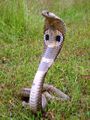 Fig 1. Spectacled Cobra (Naja Naja)
 -
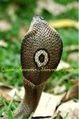 Fig 2. Monocled Cobra (Naja Kaouthia)
 -
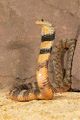 Fig 3. Central Asian Cobra (Naja Oxiana)
 -
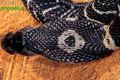 Fig 4. Andaman Cobra (Naja Sagittifera)


King cobra: Ophiophagus hennah
It is common in Western Ghats. Its average length is 10 ft, max-15 ft. It is the longest venomous snake, stout bodied, black, grey, dark olive green or yellowish brown. It has white or yellowish cross bands over entire length of the body.
-
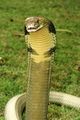 Fig 5.
 -
 Fig 6.
 -
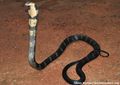 Fig 7.


Mandali sarpa: Comparision- Russell's viper, pit vipers, saw scaled vipers
Russell’s viper (Daboia russelli)
Is the most beautiful of all snakes, average 3 ft. stout with 3 longitudinal series of conspicuous, large, brown or black oval marks on brown or yellowish brown body. Its head is flat, triangular with a ‘V’ shaped mark on it, pointed end towards the front. Its tail is short and thin. Its head is covered by small scales.
Saw scaled viper
It is small and thin snake with 1-1.5 ft in length. Has a triangular head and possesses small scales on the top of head. Has a short and thin tail. Is brown/ brick red/ gray/sand coloured with zig-zag patterns on the back. Head has arrow shaped mark over it.
Pit vipers
20 species of pit vipers found in India all in Viperidae, different genus. They are so called because of pit located between nostril and eye.The membrane in the pit is extremely sensitive to heat- this helps the snake to locate its warm blooded prey even in pitch darkness. Usually found in forest areas and plantations.1-3.5 ft.Has a triangular head broader than the neck. All have vertical pupils. It is venomous, anyhow out of 20 species in India- fatalities less reported.
-
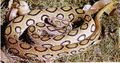 Fig 8. Russell's viper
 -
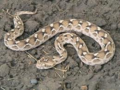 Fig 9. Saw scaled viper
 -
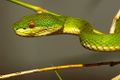 Fig 10. Pit viper


Rajiman Sarpa- Comparision- Common and Banded Krait
Common Krait: Bungarus caeruleus
This snake is seen in fields, jungle, in vicinity of human habitation, inside houses also. It is about 3-5ft. Steel blue, bluish grey, glossy black, brownish black with cross bands of narrow white colour. Fore body may sometimes be free from cross bands.Is nocturnal.Is shy in day, active at night.
Banded krait: Bungarus fasciatus
Has limited distribution in India. Found in south, west or north east India.Is about 5 ft.Its body is triangular in cross section with a prominent raised vertebral ridge.Uppermost row of scales on the back is very large and 6 sided.Moves in night.
Gender wise classification of snakes
The gender wise classification of snakes is based on several features. The same is explained in Sushruta samhita.[11]. Presently the classification of a snake based on the sex can be made only after proper examination of the sex organs or by popping probing ( methods used to confirm the sex of a snake). Apart from this, the sexual dimorphism is also explained based on body size etc which stimulates the above mentioned description.
-
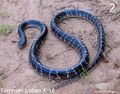 Fig 11. Common Krait (Bungarus caeruleus)
 -
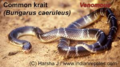 Fig 12. Common Krait (Bungarus caeruleus)
 -
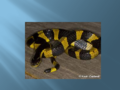 Fig 13. Banded Krait (Bungarus fasciatus)
 -
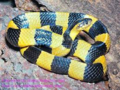 Fig 14. Banded Krait (Bungarus fasciatus)


Godha (monitor)
The same description of godha has been explained in Ashtanga Hridaya. [12] Though there is no such cross breed between a snake and a lizard, in the process of evolution, the snakes are derived from the lizards and both have several features in common. Some lizards can even spread out their upper neck stimulating a cobra or Darveekara Sarpa.(animals.pawnation.com/characteristics-lizards-snakes-have-8612.html) may be such varieties are explained as gaudheyaka.
Drugs to be identified
- बन्धुजीव
- कपित्थ
- व्याघ्रनख
- जीवक
- ऋषभक
- उदीच्य
- कुसुम्भ
- शङ्खिनी
- कत्तृणं
- अक्षिपीडकः
- अश्वकर्ण
- गन्धतृण
- हरेणु
- नागदन्ती
- आढकी
- लाक्षा
- विशाल
- रसान्जन
- श्वेतभण्डा
- अश्वखुरक
- गिरिकर्णिका
- षष्टिक
- कोरदूषा
- वार्ताक
- सुनिषणक
- चुञ्चु
- गोरोचना
Send us your suggestions and feedback on this page.
References
- ↑ Sushruta. Kalpa Sthana, Cha.2 Sthavaravishavijnaneeya Kalpa Adhyaya verse 3. In: Jadavaji Trikamji Aacharya, Editors. Sushruta Samhita. 8th ed. Varanasi: Chaukhambha Orientalia;2005. p.1
- ↑ Sushruta. Kalpa Sthana, Cha.5 Sarpadashtavisha Chikitsitakalpa Adhyaya verse 3-4. In: Jadavaji Trikamji Aacharya, Editors. Sushruta Samhita. 8th ed. Varanasi: Chaukhambha Orientalia;2005. p.1
- ↑ Vagbhata, Ashtanga Sangraha, Uttara Sthana, 42, Sarpavishapratishedha Adhyaya. Verse 8 translated to English by Prof. Murthy KR, 9 th edition, Varanasi,Chaukhambha Orientalia Publisher, 2005; 229.
- ↑ Vagbhata, Ashtanga Sangraha, Uttara Sthana, 42, Sarpavishapratishedha Adhyaya. Verse 19-23 translated to English by Prof. Murthy KR, 9 th edition, Varanasi,Chaukhambha Orientalia Publisher, 2005; 229.
- ↑ Vagbhata. Uttara Sthana, Cha.36 Sarpavishapratishedha Adhyaya verse 46-47. In: Harishastri Paradkar Vaidya, Editors. Ashtanga Hridayam. 1st ed. Varanasi: Krishnadas Academy;2000.p.4.
- ↑ Vagbhata. Uttara Sthana, Cha.36 Sarpavishapratishedha Adhyaya verse 45. In: Harishastri Paradkar Vaidya, Editors. Ashtanga Hridayam. 1st ed. Varanasi: Krishnadas Academy;2000.p.4.
- ↑ Vagbhata, Ashtanga Sangraha, Uttara Sthana, 42, Sarpavishapratishedha Adhyaya. Verse 15-16 translated to English by Prof. Murthy KR, 9 th edition, Varanasi,Chaukhambha Orientalia Publisher, 2005; 229
- ↑ Sushruta. Kalpa Sthana, Cha.1 Annapanaraksha Adhyaya verse 28-33. In: Jadavaji Trikamji Aacharya, Editors. Sushruta Samhita. 8th ed. Varanasi: Chaukhambha Orientalia;2005. p.1.
- ↑ Sushruta. Kalpa Sthana, Cha.4 Sarpadashtavishavijnaaneeya Adhyaya verse 9-10. In: Jadavaji Trikamji Aacharya, Editors. Sushruta Samhita. 8th ed. Varanasi: Chaukhambha Orientalia;2005. p.1.
- ↑ Sushruta. Kalpa Sthana, Cha.4 Sarpadashtavishavijnaaneeya Adhyaya verse 34. In: Jadavaji Trikamji Aacharya, Editors. Sushruta Samhita. 8th ed. Varanasi: Chaukhambha Orientalia;2005. p.1.
- ↑ Sushruta. Kalpa Sthana, Cha.4 Sarpadashtavishavijnaaneeya Adhyaya verse 35 In: Jadavaji Trikamji Aacharya, Editors. Sushruta Samhita. 8th ed. Varanasi: Chaukhambha Orientalia;2005. p.1.
- ↑ Vagbhata. Uttara Sthana, Cha.36 Sarpavishapratishedha Adhyaya verse 7. In: Harishastri Paradkar Vaidya, Editors. Ashtanga Hridayam. 1st ed. Varanasi: Krishnadas Academy;2000.p.4.