Nyaya: Difference between revisions
grammar |
|||
| Line 59: | Line 59: | ||
<p style="text-align:justify;">According to Sanskrit grammar (Vyakarana Shastra), Nyaya is defined as a way of going towards the real meaning. "Nyaya" word is derived from the combination of 'Ni' Upasarga +'in' Dhatu +('घय्') suffix (pratyaya) in various Sanskrit dictionaries; "Nyaya" word has been defined in various definitions and synonyms. These definitions are mentioned below:</p> | <p style="text-align:justify;">According to Sanskrit grammar (Vyakarana Shastra), Nyaya is defined as a way of going towards the real meaning. "Nyaya" word is derived from the combination of 'Ni' Upasarga +'in' Dhatu +('घय्') suffix (pratyaya) in various Sanskrit dictionaries; "Nyaya" word has been defined in various definitions and synonyms. These definitions are mentioned below:</p> | ||
=== Definitions | === Definitions === | ||
<ol><li>Niyamena iyate iti (नियमेन इयते इति न्यायः।)-Nyaya is that which has rules.[Shabdakalpadruma]<ref name="ref1">Rajaradhakanta Dev, Shabdakalpadrumam Vol 2, edited by Vasu HC, 2nd ed. Delhi: Nag Publishers;2003;933.</ref>, [Halayudhakosha]<ref name="ref2">Jayshanker Shastri, Halayudhakosha (A Sanskrit Dictionary), Reprint ed. Lucknow: Uttar Pradesh Hindi Samsthan;1993;403.</ref></li> | <ol><li>Niyamena iyate iti (नियमेन इयते इति न्यायः।)-Nyaya is that which has rules.[Shabdakalpadruma]<ref name="ref1">Rajaradhakanta Dev, Shabdakalpadrumam Vol 2, edited by Vasu HC, 2nd ed. Delhi: Nag Publishers;2003;933.</ref>, [Halayudhakosha]<ref name="ref2">Jayshanker Shastri, Halayudhakosha (A Sanskrit Dictionary), Reprint ed. Lucknow: Uttar Pradesh Hindi Samsthan;1993;403.</ref></li> | ||
<li>Niyante prapyante vivakshitartha yen iti (नीयन्ते प्राप्यन्ते विवक्षितार्थाः येनेति न्यायः ।)- Nyaya is that by which the defined meanings are provided and attained. [Shabdakalpadruma]<ref name="ref3">Rajaradhakanta Dev, Shabdakalpadrumam Vol 2, edited by Vasu HC, 2nd ed. Delhi: Nag Publishers;2003;933.</ref></li> | <li>Niyante prapyante vivakshitartha yen iti (नीयन्ते प्राप्यन्ते विवक्षितार्थाः येनेति न्यायः ।)- Nyaya is that by which the defined meanings are provided and attained. [Shabdakalpadruma]<ref name="ref3">Rajaradhakanta Dev, Shabdakalpadrumam Vol 2, edited by Vasu HC, 2nd ed. Delhi: Nag Publishers;2003;933.</ref></li> | ||
| Line 67: | Line 67: | ||
<li>Nishchitamiyate nirnayate anena iti nyaya (निश्चितमीयते निर्णयते अनेन इति न्यायः । )- the nyaya is that which is determined and decided by something [Vachaspatyam]<ref name="ref7">Trakavachaspati T. Vachaspatyam (A Comprehensive Sanskrit Dictionary) Vol. – V. Reprint ed. Varanasi: Chowkhamba Sanskrit Series Office;2003;4155- 4171.</ref></li></ol> | <li>Nishchitamiyate nirnayate anena iti nyaya (निश्चितमीयते निर्णयते अनेन इति न्यायः । )- the nyaya is that which is determined and decided by something [Vachaspatyam]<ref name="ref7">Trakavachaspati T. Vachaspatyam (A Comprehensive Sanskrit Dictionary) Vol. – V. Reprint ed. Varanasi: Chowkhamba Sanskrit Series Office;2003;4155- 4171.</ref></li></ol> | ||
=== Synonyms | === Synonyms === | ||
<p style="text-align:justify;">Naya, neeta, neetisadhane, upaye, satayanjane, nirnaya, jayajaya mukti, jayopayamukti, bhoga, neeti</p> | <p style="text-align:justify;">Naya, neeta, neetisadhane, upaye, satayanjane, nirnaya, jayajaya mukti, jayopayamukti, bhoga, neeti</p> | ||
| Line 292: | Line 292: | ||
|style="text-align:center;"|13. | |style="text-align:center;"|13. | ||
|Bhuyovirodheswalpamanyayam | |Bhuyovirodheswalpamanyayam | ||
|Chakrapani commentary on Cha. Sa. | |Chakrapani commentary on Cha. Sa. Sutra Sthana 14/16-19, | ||
|style="text-align:center;"|1 | |style="text-align:center;"|1 | ||
|A list of contraindicated patients & diseases is stated using this nyaya. | |A list of contraindicated patients & diseases is stated using this nyaya. | ||
| Line 308: | Line 308: | ||
Cha. Sa. Sutra Sthana 6/51, and Cha. Sa Nidana Sthana 8/43-44, Cha. Sha. 1/28, Cha. Sa. Chikitsa Sthana 9/8, Cha. Chi. 15/15, | Cha. Sa. Sutra Sthana 6/51, and Cha. Sa Nidana Sthana 8/43-44, Cha. Sha. 1/28, Cha. Sa. Chikitsa Sthana 9/8, Cha. Chi. 15/15, | ||
Gangadhara Roy commentary on Cha. Sa. | Gangadhara Roy commentary on Cha. Sa. Nidana Sthana 1/8, | ||
Cha. Sa. Chikitsa Sthana 7/3, | Cha. Sa. Chikitsa Sthana 7/3, | ||
Dalhana commentary on Su. Sa. Sutra Sthana 16/10, Su. Sa. Nidana Sthana 6/20, Su. | Dalhana commentary on Su. Sa. Sutra Sthana 16/10, Su. Sa. Nidana Sthana 6/20, Su. Uttar tantra. 52/6, Gayadasa commentary on Su. Sa. Nidana Sthana 13/1, Su. Sa Uttara Tantra. 39/182-184, | ||
|style="text-align:center;"|13 | |style="text-align:center;"|13 | ||
|This nyaya is more elaborate at each place. The exact definition itself explains the whole about it. | |This nyaya is more elaborate at each place. The exact definition itself explains the whole about it. | ||
| Line 360: | Line 360: | ||
|style="text-align:center;"|22. | |style="text-align:center;"|22. | ||
|Durgruhita-Sugruhita Nyaya | |Durgruhita-Sugruhita Nyaya | ||
|Cha. Sa. Siddhi Sthana 12/49 | |Cha. Sa. Siddhi Sthana 12/49 | ||
|style="text-align:center;"|1 | |style="text-align:center;"|1 | ||
|In the case of abudh/fool, ill-favored weapons & science become debilitating. Well-armed weapons & knowledge protect the wise man. The commentators have mentioned the defects of bad knowledge & the merits of good knowledge. | |In the case of abudh/fool, ill-favored weapons & science become debilitating. Well-armed weapons & knowledge protect the wise man. The commentators have mentioned the defects of bad knowledge & the merits of good knowledge. | ||
| Line 668: | Line 668: | ||
|Gangadhara Roy | |Gangadhara Roy | ||
Commentary on Cha. Sa | Commentary on Cha. Sa Sutra Sthana 5/1, Cha. Sa. Vimana Sthana 8/87, | ||
|style="text-align:center;"|2 | |style="text-align:center;"|2 | ||
|Vimansthan 8/87 states about the karan i.e. medicine given to the patient according to the cause of disease. | |Vimansthan 8/87 states about the karan i.e. medicine given to the patient according to the cause of disease. | ||
| Line 680: | Line 680: | ||
|style="text-align:center;"|63. | |style="text-align:center;"|63. | ||
|Tailapatradhara AWaya | |Tailapatradhara AWaya | ||
| | |Cha. Sa. Sharira Sthana 8/22, | ||
Cha. Sa. Siddhi Sthana 12/3-5, | |||
Su. Sa | Su. Sa. Chikitsa Sthana 39/24, | ||
|style="text-align:center;"|3 | |style="text-align:center;"|3 | ||
|In sharir sthan, acharya charak explains the preventive measures for pregnant women compared with oil-filled vessels. | |In sharir sthan, acharya charak explains the preventive measures for pregnant women compared with oil-filled vessels. | ||
| Line 690: | Line 690: | ||
|style="text-align:center;"|64. | |style="text-align:center;"|64. | ||
|Takra-kaindinya Nyaya | |Takra-kaindinya Nyaya | ||
|Hemadri commentary on A. H. | |Hemadri commentary on A. H. Sutra Sthana 4/5-6, | ||
|style="text-align:center;"|1 | |style="text-align:center;"|1 | ||
|Mala veg dharan chikitsa is explained using this Nyaya. | |Mala veg dharan chikitsa is explained using this Nyaya. | ||
| Line 702: | Line 702: | ||
|style="text-align:center;"|66. | |style="text-align:center;"|66. | ||
|Trina Arani Mani AWaya | |Trina Arani Mani AWaya | ||
|Shivadas Sen commentary on Cha. Sa | |Shivadas Sen commentary on Cha. Sa Sutra Sthana 10/5, | ||
|style="text-align:center;"|1 | |style="text-align:center;"|1 | ||
|Treatment of curable diseases can be done properly only by one good physician. | |Treatment of curable diseases can be done properly only by one good physician. | ||
| Line 714: | Line 714: | ||
|style="text-align:center;"|68. | |style="text-align:center;"|68. | ||
|Utsarga-Apavada Nyaya | |Utsarga-Apavada Nyaya | ||
|Chakrapani commentary on Cha. Sa | |Chakrapani commentary on Cha. Sa. Siddhi Sthana 27/309, | ||
Cha. Sa | Cha. Sa. Vimana Sthana 1/16, | ||
Cha. Sa | Cha. Sa. Vimana Sthana 8/134, | ||
Cha. Sa | Cha. Sa. Sharira Sthana 8/51, | ||
Cha. Sa | Cha. Sa. Chikitsa Sthana 1/3/55-58, | ||
Cha. Sa | Cha. Sa. Chikitsa Sthana 3/139-140, | ||
Cha. Sa | Cha. Sa. Chikitsa Sthana 5/29, | ||
Cha. Sa | Cha. Sa. Chikitsa Sthana 6/56, | ||
Cha. Sa | Cha. Sa Chikitsa Sthan 15/94-95, Cha. Sa Siddhi Sthana 2/24-28, Dalhana commentary on Su. Sa. Sutra Sthana 12/5, Su. Sa Su. 45/6, Su. Sa. Chikitsa Sthana 2/32-33, Su. Sa. Chikitsa Sthana 3/5, Su. Sa. Chikitsa Sthana 35/21, | ||
Arunadatta commentary on A. H. | Arunadatta commentary on A. H. Sutra Sthana 6/64, Hemadri commentary on | ||
A. H. Sutrasthan 10/35, | A. H. Sutrasthan 10/35, | ||
| Line 742: | Line 742: | ||
|style="text-align:center;"|69. | |style="text-align:center;"|69. | ||
|Utpala-Shatapatra- Vedhini Nyaya | |Utpala-Shatapatra- Vedhini Nyaya | ||
|Chakrapani commentary on Cha. Sa | |Chakrapani commentary on Cha. Sa Sutra Sthana 8/5, | ||
Dalhana commentary on Su. Sa. Sutra Sthana 28/4-5 | |||
Arunadatta commentary on A. H. | Arunadatta commentary on A. H. Sharira Sthana 3/62-63 | ||
|style="text-align:center;"|3 | |style="text-align:center;"|3 | ||
|When a hundred lotus petals are stacked one on top of another & pierced with a sharp needle, it feels as if all the petals are pierced at once. The same thing is happening with a mind as it thinks of multiple things at once. | |When a hundred lotus petals are stacked one on top of another & pierced with a sharp needle, it feels as if all the petals are pierced at once. The same thing is happening with a mind as it thinks of multiple things at once. | ||
| Line 750: | Line 751: | ||
|style="text-align:center;"|70. | |style="text-align:center;"|70. | ||
|Visha-Krimi Nyaya | |Visha-Krimi Nyaya | ||
|Su. Sa | |Su. Sa. Sharira Sthana 4/79 | ||
|style="text-align:center;"|1 | |style="text-align:center;"|1 | ||
|The human body consists of/ made with 5 natural components (bhumi, aksha, agni, aap, vayu). That is called panchbhautik sharir. The concept is explained using this Nyaya. | |The human body consists of/ made with 5 natural components (bhumi, aksha, agni, aap, vayu). That is called panchbhautik sharir. The concept is explained using this Nyaya. | ||
Revision as of 06:50, 17 June 2024

The Sanskrit term ‘Nyaya’ or a maxim is defined as “an expression of general truth or principle.” Maxim packs a lot of meaning into a nugget of words. They are specifically used when characterizing a situation. It is a common occurrence or a story that can be applied as an aphorism, to sum up an event, situation, or circumstance. Since ancient times, the word 'nyaya' has been used in Sanskrit literature. As an alternative to 'dharma', the word 'Nyaya' has been used in Brahmanical texts and Taittiriya Samhitas. In public practice, the word 'justice (nyaya)' is regarded as an eternal and universally accepted general rule or principle.
The commentators (bhashyakara) define nyaya as a method for achieving any proposition or arriving at a definite principle.
There are 2 types of nyaya. 1) Laukika (commonly used) 2) Classical/ Shastriya (in ancient samhitas /science-based). Laukik Nyaya is the kind of justice practiced by the common and observed in daily life situations or events. In Vedas, Shastras, and Sanskrit literature, these judgments have been mainly used to enhance the beauty of literature.
In the same matter, these nyaya can be applied to understand etiopathogenesis and treatments of diseases.
Importance of study of Nyaya
A critical study of primary classical texts (brihatrayee) found that nyayas incorporated much less in the original text (moola patha). The commentators used different nyayas abundantly to help readers understand that specific context. So, nyayas in the literature of Ayurveda can be classified into two categories: nyayas in the original text (moola patha) and nyayas referred to in commentary.
In Ayurvedic literature, acharyas meticulously employed different nyayas:
- To beautify the literature
- To get the hidden or concealed meaning of a verse
- To attain determinative knowledge of Ayurvedic concepts
- To achieve success in the analysis of a principle
- For easy understanding of the subject matter
- For differential diagnosis
- In diagnosis and treatment aspects
- Usage of different drugs in various treatment modalities to prepare efficacious formulations (yogas)
One of the most relevant methods is the application of nyaya (maxim) in the shastra (science). So nyayas act as an essential tool for better understanding, analysis, and application of the concepts in Ayurveda. The present article deals with concepts of nyaya and its application in understanding ayurvedic concepts.
| Section/Chapter/topic | Concepts/ Nyaya |
|---|---|
| Authors | Joshi M. R. 1 |
| Reviewers & Editors | Basisht G.2, Deole Y.S.3 |
| Affiliations |
1 Department of Sanskrit, Samhita and Siddhanta, All India Institute of Ayurveda, Goa, India 2 Rheumatologist, Orlando, Florida, U.S.A. 3 Department of Kayachikitsa, G. J. Patel Institute of Ayurvedic Studies and Research, New Vallabh Vidyanagar, Gujarat, India |
| Correspondence emails |
manvantar@gmail.com carakasamhita@gmail.com |
| Publisher | Charak Samhita Research, Training and Development Centre, I.T.R.A., Jamnagar, India & Symbiohealth Foundation, India |
| Date of publication: | May 17, 2024 |
| DOI | 10.47468/CSNE.2024.e01.s09.165 |
Etymology (nirukti)
According to Sanskrit grammar (Vyakarana Shastra), Nyaya is defined as a way of going towards the real meaning. "Nyaya" word is derived from the combination of 'Ni' Upasarga +'in' Dhatu +('घय्') suffix (pratyaya) in various Sanskrit dictionaries; "Nyaya" word has been defined in various definitions and synonyms. These definitions are mentioned below:
Definitions
- Niyamena iyate iti (नियमेन इयते इति न्यायः।)-Nyaya is that which has rules.[Shabdakalpadruma][1], [Halayudhakosha][2]
- Niyante prapyante vivakshitartha yen iti (नीयन्ते प्राप्यन्ते विवक्षितार्थाः येनेति न्यायः ।)- Nyaya is that by which the defined meanings are provided and attained. [Shabdakalpadruma][3]
- Yuktimoolakadrishant vishesha nyaya (युक्तिमूलकदृशन्तविषेषः न्यायः ।) The special judgment of the logical view*[Shabdakalpadruma][4]
- Shad darshanantargata vishesha nyaya (षड्दर्षनान्तर्गतविषेषः न्यायः ।) Special judgment within the six philosophies [Shabdakalpadruma][5]
- Pramananugrahakastako nyaya (प्रमाणानुग्राहकस्तको न्यायः ।) - Proof gracious head is nyaya [Vachaspatyam][6]
- Nishchitamiyate nirnayate anena iti nyaya (निश्चितमीयते निर्णयते अनेन इति न्यायः । )- the nyaya is that which is determined and decided by something [Vachaspatyam][7]
Synonyms
Naya, neeta, neetisadhane, upaye, satayanjane, nirnaya, jayajaya mukti, jayopayamukti, bhoga, neeti
Different words to denote nyaya as per Monnier Williams Sanskrit-English dictionary[8] -
- Method (paddhati, Upaya)
- Rule (A general or universal rule) ( niyama)
- System (vyavastha)
Plan (yojana)
- Judgment (nirnaya)
Principles (siddhnata) Way (marga)
- Logical proof (yukti udaharanam),
- Conclusion (nirnaya)
- Manner (niyama)
- Standard (mapadanda)
Some other meanings from the dictionary
- That into which a thing goes back i.e., an original type, standard, method, rule, a general or universal rule, model, axiom, system, plan, right or fit manner or way, fitness, propriety (Monier Williams, 1951).
- A lawsuit, legal proceeding, judicial sentences, and judgment (Monier Williams, 1951).
- A logical or syllogistic argument or inference (Monier Williams, 1951).
- A system of philosophy delivered by Gautama (Monier Williams, 1951).
- Likeness, analogy, a popular maxim, or apposite illustration (Monier Williams, 1951).
Definition of the term Nyaya with its different interpretations
Mimamsa Nyaya Prakasanam interpreted nyaya as the tattva (truth) with logic (Vettinad Sreedharan Nair, 1989).
An important rule of interpretation in Hindu law from the Yajnavalkyasmriti (Y.S.) deals with resolving a situation in which two authoritative rules contradict one another. There, it is mentioned that when there is a conflict between two Smriti texts, Nyaya (maxim) is more vital than Vyavahara (practice) (Donald R. Davis, Jr., 2007).
In the commentary, Voeramitrodaya at Dharmakosha Varnashrama dharma Kanda stated that Nyaya means reasoning that establishes the scope of each respective rule (Donald R. Davis, Jr., 2007).
Other commentaries such as Mitaksara, and Apararka at Dharmakosha Varnashrama dharma kanda, 1.82 and 1.84, respectively, connect Nyaya with specific maxims of the grammatical and Mimamsa traditions that are used to resolve conflicts between rules. (Donald R. Davis, Jr., 2007)
Nyaya (maxim) is "an expression of well-known truth or principle" (Raja Radha Kanta Deva, 1967). In Sanskrit, the maxim is recognized under the term of Nyaya. 'Maxim' cannot be taken exactly as the equivalent of Nyaya, but adopted because many great scholars had already done so (Colonel G.A. Jacob, 1911). Nyaya has a range of meanings from maxim to reason and logic, even to justice and common sense. In this case, ambiguity is preserved by the commentators as to whether nyaya means reasoning or a maxim.
A brief history of nyayas
Nyayas (maxims) are specifically used when characterizing a situation. Explanation of Nyaya is found from the Vedic period to Purana, Upanishad, Kavya, Darshana, etc. Ayurveda, being the upaveda of Atharvaveda, also explains various maxims to enlighten their treatise and for the easy understanding of the topics. As these maxims are commonly used by the people, Ayurveda Acharyas found it an easy tool for clarification of the views that they want to put forth in their quotations (sutras). Later the commentators of these sutras integrated several nyayas to explore the exact meaning of the actual verses.
In a compilation of nyayas, it is explained that the nyayas can be dealt with under three distinct heads, and are either illustrations (drishtanta), rules, or principles (as in the case of paribhashas), topics (adhikaras) (as in the case of the kapinjala nyaya) (Colonel G.A. Jacob, 1911).[9]
Few nyayas along with their practical utility as per Ayurvedic point of view.
| Text | Timeline | Nyaya | Explanation |
|---|---|---|---|
| Arthapatti pramana, Brihadaranyakopanishad | 900 BCE to 600 BCE | Dandapoopa Nyaya | If a rat can even cut the stick (danda) which is very hard, then it can cut the cake (Apoopa) which is very soft. This nyaya can be incorporated in the treatment aspect. If a drug can cure a chronic disease, then it can cure a mild disease. |
| Shathapatha Brahmana | 5th century BCE | Munjadisheekoddharana Nyaya | Maxim is explained when talking about moksha(salvation). Just as the layers of a Munja (a type of grass) stick come off, the soul detaches from external things to achieve ultimate salvation. |
| Ramayana | 5000 BC | Ashoka Vanika Nyaya | Ravana kept Seeta in Ashoka Vana. He could have kept her in any other garden or prison, but he chose the garden for no special reason and kept her there. Thus, whenever a specific reason is not found to occur a thing, this nyaya is used. |
| Mahabharata | 3000 BC | Simhavalokana Nyaya | A lion, after catching its food, gives a glance all around. Similarly, if the subject is glanced at superficially without going to its depth, this Nyaya is utilized. It is like an abstract or a brief introduction to the topic |
| Meemansa Darshana | 4th century BCE | Dehalideepanyaya. | “Threshold” is known as Dehali in Sanskrit. When you place a lamp on a threshold, it sheds light both inside and outside. Similarly, when we achieve two results with a single task or activity, then this maxim can be quoted. For example, A drug may act for both deepana and pachana purposes. Balachaturbhadra Rasa is indicated both in Jwara and Atisara. |
| Patanjali Mahabhashya | B.C. Middle period of second century or 150 BC | Sthalipulaka Nyaya | We can check if all the grains are boiled, by taking one grain from the cooking pot. This is known as Sthalipulaka Nyaya. This principle can be applied when preparing medicine. By tasting a small amount of avaleha, we can determine if it is properly prepared or not. |
| Sankhyadarshana | 4th century AD | Pangvandha Nyaya | This is explained while describing the Srushti Utpatti. Like a blind person, describing an elephant, everyone states their theories about the evolution of the Universe. |
| Taittariyabhashya Vartika | 6th to 5th century BCE | Shakhachandra Nyaya | To explain one thing, we often use the help of another thing. For instance, to point out the distant moon, we might use the branches of a tree and say that the moon is amidst the branches. Similarly, in Ayurveda, the Adhikarana Siddhanta serves a similar purpose. |
| Kamandaki Neetisara | belongs to the post-Gupta period or A.D. 8th century | Sundopasunda Nyaya | Sunda and Upasunda are the Asura brothers featured in the Hindu epic Mahabharata. Where two friends quarrel with each other to get a thing which was liked by both, this Nyaya is applied. |
| Bhashapariccheda | 1634 AD | Kadambakoraka Nyaya and Veechitaranga Nyaya | By this phenomenon, it is proposed that sound originating from one point doesn’t travel to the listener's ear directly but through a series of origination and destruction. |
| Prasanna Raghava Nataka | 8th to 4th centuries BCE | Kupamanduka Nyaya | One should not have a concise mind. Sushruta also quotes that studying only one Shastra is not enough. We should also know allied sciences to better implement our science. |
| Panchatantra | 4th–6th centuries CE | Pankaprakshalana Nyaya | Panka means mud, and Prakshalana means cleaning. This maxim indicates prevention. After getting wet with mud, one can avoid it instead of cleaning. The stories narrate caution regarding bad things, emphasizing good thoughts. |
| Saahityakoumudi, Kavyaprakasha, and Saptapadartha | 1897 AD
Earlier in the 11th century |
Suchi Kataha Nyaya | It is described as suggesting that we do easy work first when both easy and difficult work are before us. This Nyaya is used when multiple jobs/activities must be completed, and priority is assigned to them based on the duration of each job. |
Many nyaya are mentioned in Dalhana's commentaries on Sushruta Samhita in Nibandhasangraha and Gayadasa's Nyayachandrika. Even Vagbhatacharya in Ashtanga Hridaya and Sangraha quoted various nyayas to establish various concepts.
Method of analyzing a nyaya (maxim)
Analysis can be done in 4 steps:
Step 1: Padartha jnana (meaning): Proper knowledge of the words in nyaya.
Step 2: Prakriya vijnana (phenomenon): Eliciting phenomenon that is implicated in the nyaya.
Step 3: Sandharbha (context): Knowledge of the context in which nyaya is incorporated.
Step 4: Yukti (interpretation): Analysis of padartha jnana, prakriya of nyaya with the sandarbha in samhita.
Classification of maxims (nyayas)
- Based on their existence, these maxims come under mainly two divisions viz. Nyayas in original verses and Nyayas in commentaries.
Original verses such as Tilapidaka Nyaya, Babhrugudha Nyaya, Bhuyasa Alpam Avajiyate Nyaya, Pipilika-Bharaharana Nyaya, Utsargapavada Nyaya, Ambujavanasyarkaha Nyaya, Durgruhita Sugruhita Nyaya in Charak Samhita; Chandana-Bhara-Hara Khara Nyaya, Shabda Archi Jala Santanavat Nyaya, Taila Patra Dhara Nyaya and Visha-Krimi Nyaya in Sushrut Samhita; Munja dishikhoddharana Nyaya, Nira ksheera viveka Nyaya and Ratho-vahamano Nyaya in Ashtanga Hridaya. - Based on utility or applicability: These nyayas can be categorized.[10] However, nyayas are sagacious, they not only enhance the text or literature but also bring up a scholastic blush to it.
The classification is as follows:
- Justification for the consecution of subject matter: For example, Adhikarana Nyaya, Kaka Danta Pareeksha Nyaya, Suchikataha Nyaya, Naprushta Guravo Vadanti Iti Nyaya, etc.
- Justification for the context or Moolashloka: For example, Chhatrinogacchanti Nyaya, Go-Balivarda Nyaya, Shringagrahika Nyaya, Utsarga-Apavada Nyaya, etc.
- For a better understanding of the subject matter-
- Philosophical aspect: Kadamb mukul nyaya, vichitarang nyaya, shilaputrik nyaya, andha-pangu nyaya, shatapatravedhini nyaya, utpalashatapatra-vedhini nyaya, alatachakradarshana nyaya, pinda-brahmanda nyaya etc.
- Physiological aspect: Ksheeradadhi nyaya, kedarikulya nyaya, khalekapota nyaya, ksheeradadhi nyaya, bhuyasa alpam avajiyate nyaya, dhalvaplavana nyaya, Shabda archi jala santanavat nyaya, visha-krimi nyaya, sthalaplavana nyaya etc.
- Pathogenesis of diseases: Nava ghata panka nyaya, parisroto nyaya, etc.
- To emphasize the importance of certain basic principles of ayurveda: Such as the Importance of examination of dhatu body constituent (dhatu saara pariksha)- pipeelika bharaharana nyaya
Importance of tantrayukti jnana- ambujavanasyarkaha nyaya
Importance of samskara vishesha- prakriti vikriti guna nyaya - To explore the concealed subject matter: For example, simhavalokana nyaya, ashmashastra nyaya, abhinava-mrut- kumbha-jala lava syadana nyaya, etc.
- For the differential diagnosis and helping in specific indicated wholesome protocol (pathya-palana): For example, shringagrahika nyaya
- For the determination of the encrypted quantity of an ingredient in compound preparation: Such as kapinjaladhikarana nyaya, prakshepa nyaya, samanya-vishesha nyaya, Dravyadashagunam kshetramiti nyaya, sanhita jnanapravaha iti nyaya etc.
- Successful implementation of therapeutic procedures: such as kakakshigolaka nyaya
- In the field of research:
Such as kaka danta pareeksha nyaya, naprushtaguravovadanti iti nyaya - Others or miscellaneous:
Ghunakshara nyaya, kakataliya nyaya, babhrurguda nyaya, tilapidaka nyaya - Useful for even medicinal preparations, rules and regulations about diet, and ethical clinical practice.[11] Maxims like shrunga grahika nyaya, gobalivardhana nyaya, kapinjaladhikarana nyaya, abhinava-mrut kumbha-jala- lava-syandana nyaya, utsarga apavada nyaya, dhatu poshana nyaya, tailapatradhara nyaya, etc. found useful in understanding cause, pathology, curability of the disease.
- Kedarkulya nyaya-
This is the first and most important nyaya to explain the theory of the metabolism of ingested food (ahara rasa). Kedara means area or field and kulya means patha. Just as the crops in the field are watered by looking at various paths or paths, the dhatu in our bodies are nourished. The main source of water in the field is the field well. The water from that well is pulled up by pulling oxen to the mote or by installing an engine on the well and then the water goes to the crops in the field through a tap or dam. The water first goes to the paths of the crop which is near the engine and nourishes the crop in it. In this way, all the crops in the field are nourished by having water one after the other. In this method, the closest relative is fed first. The one who is in the middle, after him, and the one who is the very last, is nourished last of all. It means that not all are nourished at all and besides this water goes to each place sequentially. You get to see two such things. The same happens in our body.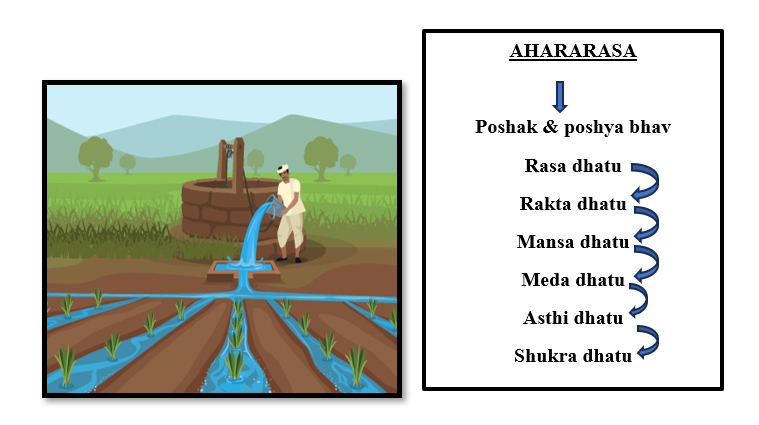
Rasa dhatu is the closest and first dhatu to the alimentary canal expelled through the heart. Ahara rasa is first carried to this rasa, where it nourishes the rasa dhatu. It then moves to the blood vessel and nourishes it. Then it goes to mansa, meda, asthi, majja, and shukra dhatu to nourish them. As the shukra dhatu is at the end of this line, the alimentary canal reaches it last and thus the shukradhatu is nourished last. That is, the first dhatu in this sequence withdraws its element first. Then there was the second, and then the third, and so on, the last dhatu taking its nutrients from the remainder.
That is, in this method of nutrition, dhatus are fed according to their queue (like Queue). This method is called 'Kedarkulyanaya'. Therefore, the nutrient is delivered to all the dhatus at once, (i.e., utpala patra shatpatra suchimev); But structurally these dhatus are far apart. Ahara rasa comes to each dhatu at the same time though reaching, they do the act of taking this rasa from their source and their nourishment as they will. They have such freedom and therefore the time required for each dhatuposhana is not the same. Nourishment of ras dhatu (rasa pushti) happens first means fast. Nourishment of rakta dhatu (rakta Pushti) takes a longer time. Shukra dhatu takes the longest time to absorb that rasa into its source (srotas) and enrich its elements. This makes this nutrition distant in terms of time, that is all. - Kshira dadhi nyaya or kramaparinama paksha:
By burning the milk and mixing it with digestive acid (sour food content), it becomes curd over a period. This curd is affected by the slow ritual fire, and its impurities are removed, and the most pleasant essence is formed. That is, milk takes the form of ghee after frequent digestion and separation. In this way, rasa dhatu gets digested in this body, the faces on it are removed, and this rasa dhatu gets more essence and prasada bhuta form of shukra. That means shukra is in rasa dhatu. There is, but this rasa must go through various digestions to express it. - Khalekapota nyaya:
Many pigeons gather at the granary to eat grain and after eating there, they go in different directions. Their routes to the nests are different. Also, their residences are far or near.
Just like birds that live nearby reach their destination faster than those living far away, different parts of our bodies get nourished at different speeds. This is similar to how our body processes nutrients from food. Our food contains nutrients for all parts of the body, but each part gets nourished differently. This is because the sources that produce these body parts are separate, and they only produce specific parts. So, the nutrients for one body part don't interfere with others.
As these nutrients travel from their sources to different body parts, they take different amounts of time to reach each part. For example, it takes longer to nourish blood (rakta) than the initial tissue (rasa), and even longer to nourish muscle (mansa) than blood, and so on. The nutrients for the reproductive tissue (shukra) take the longest time to reach because their sources are far away. On the other hand, the initial tissue gets nourished quickly because its sources are close. This process of nutrient distribution is called Khalekapota nyaya.
In the dhatuposhana order, there are three main views or parties: Kedarkulya nyaya, Kshiradadhi nyaya, and Khalekpota nyaya. All three believe that the body's tissues (dhatus) can be nourished. However, they have different opinions on some matters.
For example, if the rasa dhatu becomes unhealthy due to eating the wrong foods, it could affect the quality of all the following dhatus made from it. According to Kshiradadhinayaya, when all dhatus eventually turn into the Shukra dhatu, problems in the initial dhatu can lead to issues in the garbha. On the other hand, Khalekpota nyaya suggests that only the specific dhatu affected by bad food will suffer, while others remain healthy.
There are illnesses like jwara, pandu, prameha, rajykshma, and kushtha vyadhis where food plays a big role. These illnesses can affect the whole body because all tissues and their sources are interconnected. Fixing dietary issues is like treating the root cause of the disease. By removing harmful substances from the initial tissue, the other dhatus formed from it can also benefit.
This understanding is also applied in medicine. If a particular dhatu deteriorates due to wrong eating habits, only that specific area is affected, as Khalekpotanyaya suggests. Also, according to this view, certain foods like Pimpli, Ringani, Jyeshtamadha, and Behada may only affect the throat area, making them useful for throat-related issues, known as 'Kanthya'. Overall, these three viewpoints help us understand how the body works, how diseases develop, and how to treat them.

| Sr. No. | Nyaya (Maxim) | Reference of the context along with the name of the Commentator/Author | Total No. of References | Brief Explanation of Nyaya from Samhita |
|---|---|---|---|---|
| 1. | Abhinava-mruta-kumbha-jala lava syadana Nyaya | Arunadatta commentary on A. H. Sharira sthana 3/62- 63, and
A. H. Nidana sthana 5/19-22, |
2 | A.H.Sha- explains the dhatu utapatti from one dhatu to the next one
A.H.Ni- here in the pathology of rajayakshma vyadhi dhatu kshaya occurs gradually |
| 2. | Adhikarana Nyaya | Gangadhara Roy commentary on Cha. Sa. Sutra Sthana 1/1 | 1 | This shloka states the adhikaran (title) of the chapter |
| 3. | Alaatachakradarshana nyaya | Gangadhara Roy commentary on Cha. Sa. Sutra Sthana 8/5 | 1 | This shlok explains the existence of mann by co-ordinating with indriya. |
| 4. | Ambujavanasyarka nyaya | Cha. Sa. Siddhi Sthana 12/46 | 1 | As the sun is required for proper lotus flowering & a lamp is required to lighten up the house same way ‘Tantrayukti is used for understanding the deep meaning’ |
| 5. | Anaagatavekshana nyaya | Chakrapani commentary on Cha. Sa. Sutra Sthana 1/48 | 1 | Explanation of total set of dravya which includes 9 dravya. These dravya will be explained later in the Samhita |
| 6. | Anagatabadhapratishedha Nyaya | Chakrapani commentary on Cha. Sa. Sutra Sthana 8/17, | 1 | Sadavruta palan (adapting good routine habits) helps have a healthy life. |
| 7. | Anvaya-vyatirekanu Vidhayitavya. nyaya | Chakrapani commentary on Cha. Sa. Sutra Sthana 24/4, | 1 | This shlok states with the word prana for rakta dhatu in the body. |
| 8. | Ardhashaucha nyaya | Chakrapani commentary on Cha. Sa. Sutra Sthana 30/27 | 1 | here Acharya Charak explains the eternity of Ayurveda |
| 9. | Ayurghritam nyaya | Chakrapani commentary on Cha. Sa. Sutra Sthana 27/3,
Hemadri commentary on A. H. Sutra Sthana 11/37-38, |
2 | Acharya Charak states about the importance of diet(food). Food prepared ritually with proper methods is considered to be the life of a person |
| 10. | Babhrurghuda nyaya | Cha. Sa. Sutra Sthana 30/77 | 1 | the word Babhrugudha is given to the physician who is surrounded by fools, it is also called Pallavagrahi. |
| 11. | Bhagasiddha nyaya | Chakrapani commentary on Cha. Sa. Sutra Sthana 1/51, | The matter subsisting under the support of dravya, which itself is inert, is called guna. Guna is part of dravya. | |
| 12. | Bhuyasaalpamavajeeyate nyaya | Chakrapani commentary on Cha. Sa. Sutra Sthana 17/62, and Cha. Sa. Viman Sthana 1/14 | 2 | Methods of identifying the kshaya, vriddhi, samya avastha of dosha are explained. |
| 13. | Bhuyovirodheswalpamanyayam | Chakrapani commentary on Cha. Sa. Sutra Sthana 14/16-19, | 1 | A list of contraindicated patients & diseases is stated using this nyaya. |
| 14. | Chandana-bhara-hara-khara nyaya | Su. Sa. Sutra Sthana 4/3 & 4, | 1 | In this shlok, they state about fools who only follow the theoretical knowledge from Samhita. Each student should carry both practical & theoretical information about the text. |
| 15. | Chatrinogacchaniti Nyaya or Chatrini Nyaya | Chakrapani commentary on Cha. Sa. Sutra Sthana 5/76-77,
Cha. Sa. Sutra Sthana 6/51, and Cha. Sa Nidana Sthana 8/43-44, Cha. Sha. 1/28, Cha. Sa. Chikitsa Sthana 9/8, Cha. Chi. 15/15, Gangadhara Roy commentary on Cha. Sa. Nidana Sthana 1/8, Cha. Sa. Chikitsa Sthana 7/3, Dalhana commentary on Su. Sa. Sutra Sthana 16/10, Su. Sa. Nidana Sthana 6/20, Su. Uttar tantra. 52/6, Gayadasa commentary on Su. Sa. Nidana Sthana 13/1, Su. Sa Uttara Tantra. 39/182-184, |
13 | This nyaya is more elaborate at each place. The exact definition itself explains the whole about it.
In Nidana sthana chapter 8th – explanation of the signs, symptoms, and chances of curability of diseases (8 diseases in Nidan sthana) along with their pathology. The treatment part of each disease will be explained in chikitsa sthan. There is an understanding of the other diseases with this pattern of study about what should be learned. |
| 16. | Chikitsabijopadesha nyaya | Dalhana commentary on Su. Sa. Sutra Sthana 1/39, | 1 | Classification of the animal kingdom according to their birth origin. |
| 17. | Dhatuposhana nyaya | Chakrapani commentary on Cha. Sa. Sutra Sthana 28/4, Cha. Sa. Chikitsa Sthana 15/16, Dalhana commentary on Su. Sa. Sutra Sthana 14/10,
Arunadatta commentary on A. H. Sharira Sthana 3/62-63, (Eka-kaladhatu poshana nyaya) |
4 | These all-references state about the formation of dhatu from the ahararasa. Along with the dhatu, there is an explanation about the extraction of mala (unwanted parts from the diet). Ahara rasa is processed to form the dhatu, dosha, and its poshana. |
| 18. | Dhatwaplavana nyaya | Chakrapani commentary on Su. Sa. Sutra Sthana 14/10 | 1 | Chakrapani explained the nutrition of one dhatu carried out by the dividing the previous dhatu into parts. |
| 19. | Dirghashashkulihhakshana nyaya | Chakrapani commentary on Cha. Sa. Sutra Sthana 8/5, | 1 | Unity of mind is explained here. The mind assumes many forms, even with sense perception. |
| 20. | Dravatpadika Sneha iti nyaya | Chakrapani commentary on Cha. Sa. Chikitsa Sthana 29/121-122, | 1 | Treatment of vatarakta vyadhi is explained as the same pathology of coordinating with vata dosha and rakta dhatu |
| 21. | Dravyadashtagunam Ksheeramiti nyaya | Dalhana commentary on Su. Sam. Chikitsa Sthana 7/25, | 1 | They had mentioned the greatness of ksheer as it increased in quality by mixing with other dravyas. |
| 22. | Durgruhita-Sugruhita Nyaya | Cha. Sa. Siddhi Sthana 12/49 | 1 | In the case of abudh/fool, ill-favored weapons & science become debilitating. Well-armed weapons & knowledge protect the wise man. The commentators have mentioned the defects of bad knowledge & the merits of good knowledge. |
| 23. | Duta-sandesha vachana Nyaya | Arunadatta commentary on A.H.Sutra Sthana 1/1, | 1 | Acknowledging the new concept by messaging or praising the third person who works for the best. |
| 24. | Gangayam Ghosha | Chakrapani commentary on Cha. Sam. Sutrasthan 2/9-10, Gayadasa commentary on Su. Sa. Nidana Sthana 1/25,
Hemadri commentary on A. H. Chikitsa Sthana 6/105, |
3 | The list of dravyas is explained in this chapter—a group of drugs/ class of dravyas. |
| 25. | Ghunakshara nyaya | Chakrapani commentary on Cha. Sa. Sutra Sthana 1/134,
Indu commentary on A.S. Uttara Tantra 50/169, |
2 | The medicine that gives a healthy life to the individual is called as best medicine. |
| 26. | Go-dohana nyaya | Gangadhara Roy commentary on Cha. Sa. Sutra Sthana 11/41, Cha. Sa. Nidansthan 1/3, | 2 | This shlok explains about the maintenance of a healthy body, one has to follow healthy habits. |
| 27. | Go-Balivarda nyaya | Chakrapani commentary on Cha. Sa. Sutra Sthana 1/25, Gangadhara Roy commentary on
Cha. Sa. Sutra Sthana 7/42, Chakrapani commentary on Cha. Sa. Sutra Sthana 13/7-8, Cha. Sa. Nidana Sthana 1/11 (4), Cha. Sa. Indriya Sthana 11/21, Cha. Sam Chikitsasthan 7/84-92, Cha. Sam Chikitsasthan 20/6, |
8 | Triskandh of Ayurveda elaborated using the word anantpar. Chakradatta explains Anantapar, which has no beginning or end. |
| 28. | Ghrita-dagdha Nyaya | Chakrapani commentary on Cha. Sa. Sutra Sthana 1/57, sutrasthan 1/25(2), Dalhana commentary on su. Sam. sutrasthan 24/8, su. Sha. 2/4, su. Sam Uttartantra. 54/7, Gayadasa commentary on Su. Sam Nidansthan 1/25, Su. Sam Nidansthan 11/21,
Arunadatta commentary on A.H. Sutrasthan 1/1, A.H. Sutrasthan 1/6, and A.H. Sutrasthan 9/4-5, |
10 | Acharya charak gave an explanation about the sharirika dosha and manasika dosha in the shloka. Chakradatta states that the rakta should be accepted as the 4th dosha. |
| 29. | Kakadanta pariksha Nyaya | Chakrapani commentary on Cha. Sam. Sutrasthan 1/1,
Arunadatta commentary on A. H. Utartantra 40/60-62, |
2 | E.g., If one tries to catch a crow & count its teeth, it is futile because the crow has no teeth. Kakadanta pariksha Nyaya is used when any person does useless and unprofitable work. |
| 30. | Kakakshi-golaka Nyaya | Dalhana commentary on su. Sam sutrasthan 46/43,
Arunadatta commentary A. H. Sutrasthan 22/33, |
2 | Acharya Sushrut stated the qualities of wheat. |
| 31 | Kakataliya Nyaya | Chakrapani commentary on Cha. Sam. Sharirsthan 3/17,
Indu commentary on A.H Sa. Sharirsthan 1/15, A. H. Uttartantra 50/87, |
3 | Commentary states about the origin of man from man. |
| 32. | Kapinjaladhikarana Nyaya | Chakrapani commentary on Cha. Sam Chikitsasthan 15/96-97, | 1 | Adhikaran of chitrakadi vati is explained with their contents. |
| 33. | Kedarikulya Nyaya | Chakrapani commentary on Cha. Sam Sutrasthan 28/4, Cha. Sam Chikitsasthan 15/16,
Arunadatta commentary on A.H. Sa. Sharirsthan 1/56, |
3 | Poshan of dhatu one after the other same as the parts of farms get fielded by water one after the other sequentially. |
| 34. | Khalekapota Nyaya | Arunadatta commentary on Cha. Sam Sutrasthan 28/4,
Cha. Sa Chikitsasthan 15/16, |
2 | Extracts from the food get supplied to both dosha and dhatu properly. The remaining part of the food is called mala. |
| 35. | Kramaparinama Nyaya | Arunadatta commentary on A. H. Sa Sharirsthan 3/62-63, | 1 | There is an explanation of the krama of dhatu utapatti along with its poshan. |
| 36. | Ksheeradadhi Nyaya | Chakrapani commentary on Cha. Sa Sutrasthan 28/4,
Cha. Sa Chikitsasthan 15/16, |
2 | Dhatu poshan of the body can be explainable by this Nyaya. |
| 37. | Kumbhakara pavana ahita pamkalepa Nyaya | Chakrapani commentary on Cha. Sa Chikitsasthan 6/9-10, | 1 | Kaphaj prameha explained using this Nyaya name as an adjective. |
| 38. | Masharashi tulya Nyaya | Gangadhara Roy commentary on Cha. Sa Chikitsasthan 7/3, | 1 | Acharya Punarvasu warned Acharya Agnivesh about the disease kushth(skin disorder). |
| 39. | Munjadishikhoddharana Nyaya | Vriddha Vagbhata
On A. H. Sutrasthan 20/1, Hemadri commentary on A. H. Sa Sutrasthan 20/1, |
2 | Nasya's procedure from the panchakarma is defined in this shlok. |
| 40. | Navaghatapanka Nyaya | Dalhana & Gayadasa commentary on Su. Sa Nidansthan 3/8, | 1 | Kapha Ashmari detailed by Acharya Sushrut |
| 41. | Na Prishtaguravo Vadanti Iti AWaya | Gangadhara Roy
Commentary on Cha. Sa Sutrasthan 1/1, Cha. Sa Indriyasthan 6/1-2, Cha. Sa. Chikitsasthan 18/3, and 23/3, Cha. Chi. 30/2, |
5 | Treatment of kasa roga adhyaya started by acharya charak praising their guru(teacher). |
| 42. | Nira ksheera viveka/Vyaya | A. H. Sa. Sutrasthan 26/42, | 1 | Differentiating the clear milk from the mixture of milk and water. |
| 43. | Pinda-brahmanda Nyaya | Cha. Sa Sharirsthan 5/3, | 1 | Lok purush samya Siddhant is defined as stating the similarities between nature's content and the human body. |
| 44. | Pipeelika-bharaharana Nyaya | Cha. Sa Vimansthan 8/115, | 1 | Acharya charak explained that even though having a small stature is stronger as like load carrying capacity of ants. |
| 45. | Pishta-peshana Nyaya | Arunadatta commentary on A. H. Chikitsasthan 1/39, | 1 | Pakshaghat (hemiplegia) patients’ pathology with signs & symptoms explained. |
| 46. | Prakriti- Vikriti guna Nyaya | Su. Sa Sutrasthan 46/19, | 1 | Prakruti Vikruti of rice plant field is given stating about proper/improper planting. |
| 47. | Prakshepa Nyaya | Chakrapani commentary on Cha. Sa Chikitsasthan 11/49,
Cha. Sa Kalpasthan 7/26-27, |
2 | In the chikitsa sthan, they state about the use of saktu with ghruta. |
| 48. | Prakshepyanamnyatodrishta Nyaya | Chakrapani commentary on Cha. Sa Chikitsasthan 2/3/18, | 1 | Vrushya shatavari ghruta with preparation recipe. |
| 49. | Prati-sroto Nyaya | Arunadatta commentary on A. H. Sharirsthan 3/62-63, | 1 | Each strotas of dhatu gets nourished from its previous dhatu & ahara rasa. |
| 50. | Ratho-vahamano Nyaya | Cha. Sa Vimansthan 3/38,
Vriddha Vagbhata commented A. Sangrah sutrasthan 9/95, |
2 | Description of death patterns according to Ayurvedic rules & restraints, if one follows properly one will die, otherwise one will die prematurely. |
| 51. | Samaneshwartheshu ekatrabhihito vidhiranyatrapyanushanjaneeya Iti Nyaya | Chakrapani commentary on Cha. Sa Sutrasthan 2/7-8,
Cha. Sa Chikitsasthan 21/31, |
2 | A group of drugs which are having same qualities as guna is included in vamak Dravya. |
| 52. | Samanya-vishesha Nyaya | Dalhana commentary on Su. Sa Chikitsasthan 38/30, | 1 | Niruha basti ingredients are divided into specific portions. |
| 53. | Santana Nyaya | Chakrapani commentary on Cha. Sa Sutrasthan 30/27,
Cha. Sa Vimansthan 5/3, Cha. Sa Sharirsthan 1/92-94, |
3 | Diversity in the eternity of Ayurveda stated by Chakrapani |
| 54. | Shasha Vinasha Nyaya | Chakrapani commentary on Cha. Sa Sutrasthan 16/32-33, | 1 | There may be a reason that can be stated/not for the destruction this is most philosophical. |
| 55. | Shabdarchijalasantanavat Nyaya | Su. Sa Sutrasthan 14/16, | 1 | The directional entities from nature which also through the body in the same way explained using this Nyaya. |
| 56. | Shilaputraka Nyaya | Chakrapani commentary on Su. Sa Sharirsthan 1/3, | 1 | According to Shilaputrik Nyaya, it has eight natures (ashta prakruti) regarding the unmanifest itself. |
| 57. | Simhavalokana Nyaya | Arunadatta commentary on A. H. Chikitsasthan 9/106, | 1 | Sauvarchaladi churna is explained using this Nyaya. |
| 58. | Shringagrahika Nyaya | Chakrapani commentary on Cha. Sa Sutrasthan 4/19,
Cha. Sa Sutrasthan 14/67, Cha. Sa Sutrasthan 27/329-330, Cha. Sa Nidansthan 7/15, Cha. Sa Vimansthan 1/13, Cha. Sa Sharirsthan 4/30, Cha. Sa Sharirsthan 6/10, Cha. Sa Indriyasthan 4/7, Cha. Sa Chikitsasthan 8/45-47, Cha. Sa Chikitsasthan 28/72-74, Cha. Sa Chikitsasthan 30/313-314, Cha. Sa Chikitsasthan 30/315-320, |
12 | In the shlok cha su 27- just all immovable and movable substances have millions of medicinal properties, so all kinds of substances are used in various ways in the form of food and drinks (anna pana/ dietary plans). |
| 59. | Snehat chaturgunodravaha Iti Nyaya | Dalhana commentary on Su. Sa Chikitsasthan 17/19, | 1 | For the treatment of nadivrana special preparation of taila is done by increasing its quality (adding various content to it). |
| 60. | Sthalaplavana Nyaya | Dalhana commentary on Su. Sa Sutrasthan 15/18, | 1 | Explanation of vaat vrudhi symptoms considering each organ and various sites of the body. |
| 61. | Suchikataha Nyaya | Gangadhara Roy
Commentary on Cha. Sa Sutra Sthana 5/1, Cha. Sa. Vimana Sthana 8/87, |
2 | Vimansthan 8/87 states about the karan i.e. medicine given to the patient according to the cause of disease. |
| 62. | Swami-Bhritya AWaya | Arunadatta commentary on A.H. Sutrasthan 51-52, | 1 | |
| 63. | Tailapatradhara AWaya | Cha. Sa. Sharira Sthana 8/22,
Cha. Sa. Siddhi Sthana 12/3-5, Su. Sa. Chikitsa Sthana 39/24, |
3 | In sharir sthan, acharya charak explains the preventive measures for pregnant women compared with oil-filled vessels. |
| 64. | Takra-kaindinya Nyaya | Hemadri commentary on A. H. Sutra Sthana 4/5-6, | 1 | Mala veg dharan chikitsa is explained using this Nyaya. |
| 65. | Tilapidaka Nyaya | Cha. Sa Sutrasthan 25/27, | 1 | Like a man walking around an oil slick, we stay where we are, there is no progress only having debate about a thing. This type of debate should be abandoned & thought of something. |
| 66. | Trina Arani Mani AWaya | Shivadas Sen commentary on Cha. Sa Sutra Sthana 10/5, | 1 | Treatment of curable diseases can be done properly only by one good physician. |
| 67. | Utsarga Nyaya | Chakrapani commentary on Cha. Sa Sutrasthan 11/11-13, | 1 | Diseases that occur with small-scale causative factors are easy to treat. The curability of a disease depends mostly on the causative factors of the disease. |
| 68. | Utsarga-Apavada Nyaya | Chakrapani commentary on Cha. Sa. Siddhi Sthana 27/309,
Cha. Sa. Vimana Sthana 1/16, Cha. Sa. Vimana Sthana 8/134, Cha. Sa. Sharira Sthana 8/51, Cha. Sa. Chikitsa Sthana 1/3/55-58, Cha. Sa. Chikitsa Sthana 3/139-140, Cha. Sa. Chikitsa Sthana 5/29, Cha. Sa. Chikitsa Sthana 6/56, Cha. Sa Chikitsa Sthan 15/94-95, Cha. Sa Siddhi Sthana 2/24-28, Dalhana commentary on Su. Sa. Sutra Sthana 12/5, Su. Sa Su. 45/6, Su. Sa. Chikitsa Sthana 2/32-33, Su. Sa. Chikitsa Sthana 3/5, Su. Sa. Chikitsa Sthana 35/21, Arunadatta commentary on A. H. Sutra Sthana 6/64, Hemadri commentary on A. H. Sutrasthan 10/35, A. H. Sutrasthan 11/26-29, |
18 | In siddhi sthan, acharya charak explained the vaman karma indication and contraindication in hridroga. Vaman karma is contraindicated in hridroga, but about special conditions they had mentioned it as a specific treatment. This stated as utsarga apavad Nyaya. |
| 69. | Utpala-Shatapatra- Vedhini Nyaya | Chakrapani commentary on Cha. Sa Sutra Sthana 8/5,
Dalhana commentary on Su. Sa. Sutra Sthana 28/4-5 Arunadatta commentary on A. H. Sharira Sthana 3/62-63 |
3 | When a hundred lotus petals are stacked one on top of another & pierced with a sharp needle, it feels as if all the petals are pierced at once. The same thing is happening with a mind as it thinks of multiple things at once. |
| 70. | Visha-Krimi Nyaya | Su. Sa. Sharira Sthana 4/79 | 1 | The human body consists of/ made with 5 natural components (bhumi, aksha, agni, aap, vayu). That is called panchbhautik sharir. The concept is explained using this Nyaya. |
Nyaya and Therapeutics[14] -
- Shrunga grahika nyaya-
This principle is like catching the horn of a cow or any animal, which can be understood in two ways. One is when details are specified, and the other is when they are not. When discussing medicine dosage, it's generally mentioned without specifics, following the principle of not specifying details. This is because Ayurveda follows the principle of tailoring treatment to each individual, known as 'Prati Purusha Siddhanta’ (personified principles of medicine). Similarly, when considering dietary suitability based on a person's location, Chakrapani refers to the same principle. This means that suitability cannot be generalized, as it varies from person to person. Chakrapani also applies this principle when discussing the understanding of specific actions of drugs. It's important to note that just because certain actions are mentioned doesn't mean other drugs lack those actions. When it comes to understanding the complications of Vatavyadhi, Chakrapani emphasizes considering all possible complications, even if they're not explicitly mentioned. Similarly, although diet specifications aren't mentioned after Swedana, advising patients on appropriate diets, particularly those that balance Pitta is still crucial. This principle, known as Shrunga Grahika Nyaya, finds application in clinical practice, particularly in four key areas: adjusting dosage based on individual patients, considering individual dietary needs, selecting specific drugs for specific conditions, and understanding the treatability of conditions to avoid futile treatment attempts. Understanding and applying this principle is essential for physicians in clinical practice. - Gobalivardhana nyaya-
This nyaya helps to distinguish between similar things. This nyaya explains that there is a difference between cow(gau) and bull (bali) though the word cow is used for the male and female cow. The relative meaning is the hidden meaning of a word that can be considered according to this nyaya. While explaining the word ‘vitiation (dushta)’, it is said that the vitiated or quantitatively increased (matra adhikata) of the affected body part. There are two types of vitiation (dushti): Increase (vruddhi) and decrease (kshaya). Therefore, the verse specifically mentions increase (adhikya). With the help of gobalivardhana nyaya, physicians must consider both. - Kapinjaladhikarana nyaya
It is a maxim of an unspecified number of a type of bird, kapala (grey partridge/gauratittiri). During yajna, a person asks to bring kapinjala to bali (Kapinjalan) without mentioning a number of it. Because of the plural word used in the sentence, it is understood as two or more. In the explanation of Chitrakadi Vati, lavanani (types of salt) is one of the ingredients. So, it can be considered as two or more lavana. Since there is an explanation of pancha lavana (five types of salt) in deerghanjeevitiya adhyaya, it can be considered as five varieties of salt. [Cha.Sa. Sutra Sthana 1].
Kapinjaladhikarana nyaya is important in the aspect of bhaishajya kalpana (medicinal ideas)—to educate the physician about adding the exact number of ingredients mentioned by Acharyas while preparing formulations. - Ghunakshara nyaya
This maxim refers to woodworms. When they eat the wood, there will be a design that appears like letters. It depicts something happening by chance. While explaining signs of good medicine (samyak bheshaja lakshana), it mentions that when the medicine is properly used it gives health(arogya). A physician having good knowledge related to treatment can only do proper management and yield good results. One who accidentally gets results without any logic behind the treatment is automatic results of treatment with some of the anonymous symptoms (yadriccha siddhi). Ghunakshara nyaya highlights the yukti of vaidya for proper management of disease (samyak bheshaja yojana) and successful treatment (chikitsa siddhi). - Abhinava-mrutkumbha-jala lavasya-syandana-nyay
A newly made earthen pot will leak fluid drop by drop. When a meda dhatu (fatty tissues) becomes avruta (covered) by the dosha, it obstructs the srotas and obstructs nourishment to the consecutive asthi, majja dhatu. Consecutive dhatu is undernourished because of a poor nutrient supply, such as the drop-by-drop of water coming from a new earthen pot not being sufficient. - Utsarga apavada nyaya
Sometimes exceptions are examples. General rules or principles are broken for extraordinary reasons. Diseases are said to be curable when they are of recent onset. There are some exceptions like raktaja gulma (type of Gulma disease) where the condition becomes curable ten months after the onset. [Cha.Sa.Chikitsa Sthana 5]. This nyaya is applied in the quotes with exception and special conditions. - Dhatu poshana nyaya
These nyayas explain how dhatu is formed and nourished. When these are unimpaired, one can understand physiology and impaired state tell us about pathology. In short, it can be concluded that Ahara rasa (digestive secretions of diet) reaches srotas according to kedarakulya nyaya. Dhatu based on its requirement according to Khalekapota nyaya selects nutrients in this channel and nutrients transform into dhatus according to ksheera dadhi nyaya. Understanding these nyaya helps in understanding the action of the medicine and for selection of medicine. [Su.Sa. Sutra Sthana 15] - Tailapatradhara nyaya
This nyaya is about raw earthen pot (apakva mrut bhanda) filled with oil (taila). When a new earthen pot is filled with oil, it should be handled carefully so that it does not break while moving from one place to another or oil does not spill out while moving. Utmost care is needed while handling such pots. Patients with wounds/who are oleated/who have taken purificatory therapies/patients with eye diseases/suffering from fever and loose stools etc should be handled carefully like the new earthen pot full of oil. While treating pregnant women, all pregnant women should be handled carefully like a pot brim full of oil. After the procedure of shodhana (bio purification) person becomes durbala (tired), krusha (weakened), and alpagni (slowed digestive capacity), devoid of vitiated dosha and malas, and organs feel empty; the patient will not withstand any kind of harm.
Tailapatradhara Nyaya tells about cautions, which should be known before handling certain conditions. Certain health conditions are susceptible to any kind of health abnormalities, and not able to tolerate any type of measures due to excessive weakness. Hence, the patient should be protected like a brim-full pot of oil. It is a caution for the physician to be alert during the handling of patients. - Gangayam gosha iti nyaya
When discussing rasagata vata, symptoms concerning the skin like color changes, pulsing sensations, dryness, and numbness are highlighted. In this perspective, the skin is considered crucial. Just like how a hut near a river is described as being in the river, this analogy applies: Symptoms manifest on the skin, indicating that rasa, the body fluid, is the underlying cause of these symptoms. Gangayam ghosha iti nyaya says that physicians can be able to identify the relative dosha and dhatu involved in the samprapti (pathogenesis). This helps to adopt the treatment based on those factors. - Ghrita- dagdha nyaya
The heat present in ghrita (ghee), and taila (oil), causes burn, but it is called ghrita-taila dagdha. Rakta (blood tissue) has kunapagandha (foul smell), but it is because of the associated vatadi dosha, not by rakta alone. Every disease is of vata-pitta shleshma origin. While explaining the disease of dushyas(dhatus/ tissues); Sushruta mentions it as rasajo ayam, raktajo ayam, etc in terms of dhatu. Here rasadi vyadhi refers to rasadi sthita vatadi dosha. Though ajeerna (indigestion) is the cause of krimi (worms), it is mentioned that purisha (stools) is the cause, because it is dosha adhishtana (localities of dosha).
Ghrita dagdha nyaya a physician has to decide which dosha is involved in dhatu dushti and treat accordingly as all the treatment protocol depends on the associated dosha in particular.
Useability of nyaya
Maxims like Shrunga grahika nyaya, gobalivardhana nyaya, kapinjaladhikarana nyaya, abhinava-mrut kumbha-jala- lava-syandana nyaya, utsarga apavada nyaya, dhatu poshana nyaya, taila patra dhara nyaya, etc. are found useful in understanding cause, pathology, curability of the disease. It is further noticed that maxims are useful for even medicinal preparations, rules and regulations about diet, and ethical clinical practice.
Send us your suggestions and feedback on this page.
References
- ↑ Rajaradhakanta Dev, Shabdakalpadrumam Vol 2, edited by Vasu HC, 2nd ed. Delhi: Nag Publishers;2003;933.
- ↑ Jayshanker Shastri, Halayudhakosha (A Sanskrit Dictionary), Reprint ed. Lucknow: Uttar Pradesh Hindi Samsthan;1993;403.
- ↑ Rajaradhakanta Dev, Shabdakalpadrumam Vol 2, edited by Vasu HC, 2nd ed. Delhi: Nag Publishers;2003;933.
- ↑ Rajaradhakanta Dev, Shabdakalpadrumam Vol 2, edited by Vasu HC, 2nd ed. Delhi: Nag Publishers;2003;933.
- ↑ Rajaradhakanta Dev, Shabdakalpadrumam Vol 2, edited by Vasu HC, 2nd ed. Delhi: Nag Publishers;2003;933.
- ↑ Trakavachaspati T. Vachaspatyam (A Comprehensive Sanskrit Dictionary) Vol. – V. Reprint ed. Varanasi: Chowkhamba Sanskrit Series Office;2003;4155- 4171.
- ↑ Trakavachaspati T. Vachaspatyam (A Comprehensive Sanskrit Dictionary) Vol. – V. Reprint ed. Varanasi: Chowkhamba Sanskrit Series Office;2003;4155- 4171.
- ↑ Williams M. Sanskrit- English dictionary, Vol- I, 2nd reprint ed. New Delhi: Parimal Publications;2011;836.
- ↑ Manjusha AT, Irshad H, Ramadas PV, Mund JS. Nyaya and its relevance in Ayurveda. Global Journal of Research on Medicinal Plants & Indigenous Medicine. 2015 Dec 1;4(12):247.
- ↑ Chinthala R, Kamble S, Baghel AS, Vyas H, Bhagavathi NN. Significance of Nyayas (Maxims) in understanding philosophical aspects of Ayurveda: A critical review. Journal of Research and Education in Indian Medicine. 2018 Dec 20; 24(3):81.
- ↑ Pallavi H, Kumar AA, Shrikanth PH. Maxim-Therapeutics in Ayurveda.
- ↑ Vd Go Aa Fadke, Doshadhatumalavidgyan book, Madhuri publisher, Pune, sixteenth edition, January 2013.
- ↑ Chinthala R, Kamble S, Baghel A S, Vyas A H, Bhagavathi, Significance of Nyayas (Maxims) in Understanding the Philosophical Aspect of Ayurveda: a critical review, doi -10.5455/ JREIM 82-153796013, November 30, 2018.
- ↑ Pallavi H, Kumar AA, Shrikanth PH. Maximo-Therapeutics in Ayurveda, ISSN 2350-0204, ijapc, March 10th 2022, Volume 16, Issue 2.