Jirna jwara(chronic fever), Krumiroga(worms), gulma(abdominal lumps), kushtha(skin disease),Arsha(haemorrhoids),Kasa(cough),Swasa(breathlessness), pinasa(running nose), sula(pain), karnasoola(earache), vatavyadhi, hikka,medoroga, yoni vyapada(diseases of vagina),visuchika,plihavruddhi(spleenomegaly),kshaya, vishamajwara,unmada,apasmara, sopha(swelling),hrudaroga(heart disease), vrana(wound)trikashool<ref>Anonymous. The Ayurvedic Pharmacopoeia of India. Department of Ayush, Ministry of Health and Family welfare, Govt. of India, New Delhi, Part I. 1986; Volume 3 :50</ref>
Jirna jwara(chronic fever), Krumiroga(worms), Gulma(abdominal lumps), Kushtha(skin disease),Arsha (haemorrhoids),Kasa(cough), Shwasa(breathlessness), Pinasa(running nose), Shula(pain), Karnashoola (earache), Vata vyadhi, Hikka, Medoroga, Yoni vyapada (diseases of vagina),visuchika, Plihavruddhi (spleenomegaly), Kshaya, Vishamajwara, Unmada, Apasmara, Shopha(swelling), Hridroga (heart disease), Vrana(wound), Trikashool<ref>Anonymous. The Ayurvedic Pharmacopoeia of India. Department of Ayush, Ministry of Health and Family welfare, Govt. of India, New Delhi, Part I. 1986; Volume 3 :50</ref>
==Other varieties==
==Other varieties==
Line 145:
Line 145:
|14
|14
|Cha.Sa.[[Chikitsa Sthana]] 9/52
|Cha.Sa.[[Chikitsa Sthana]] 9/52
|Ingredient in Apara lashunadya Ghrita
|Ingredient in Apara Lashunadya Ghrita
|-
|-
|15
|15
Line 178:
Line 178:
|Cha.Sa.[[Chikitsa Sthana]] 28/177
|Cha.Sa.[[Chikitsa Sthana]] 28/177
|As an ingredient of Mulaka taila
|As an ingredient of Mulaka taila
|-
|}
|}
==Dose==
==Dose==
* 3gm of the drug<ref>Anonymous. The Ayurvedic Pharmacopoeia of India. Department of Ayush, Ministry of Health and Family welfare, Govt. of India, New Delhi, Part I. 1986; Volume 3 :50</ref>
* 3 gm of the drug <ref>Anonymous. The Ayurvedic Pharmacopoeia of India. Department of Ayush, Ministry of Health and Family welfare, Govt. of India, New Delhi, Part I. 1986; Volume 3 :50</ref>
==Important formulatios==
==Important formulatios==
Line 221:
Line 220:
=== Broad-Spectrum Antimicrobial Activity ===
=== Broad-Spectrum Antimicrobial Activity ===
Allicin readily crosses microbial cell membranes and reacts rapidly with thiol-containing enzymes (such as alcohol dehydrogenase and RNA polymerase), demonstrating potent bactericidal, antifungal, and antiviral activity against pathogens including ''[[Staphylococcus aureus]]'' and ''[[Candida albicans]]''.<ref name="Harris2001" />
Allicin readily crosses microbial cell membranes and reacts rapidly with thiol-containing enzymes (such as alcohol dehydrogenase and RNA polymerase), demonstrating potent bactericidal, antifungal, and antiviral activity against pathogens including ''Staphylococcus aureus'' and ''Candida albicans''.<ref name="Harris2001" />
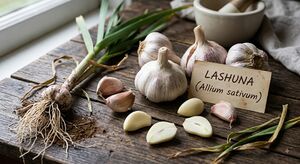
Lashuna (Allium sativum L.) or Garlic is a prominent therapeutic plant widely utilized in Ayurveda and modern pharmacotherapy for its broad spectrum of biological activities, particularly cardiovascular, antimicrobial, and oncological applications.
Allium sativum exerts therapeutic effects predominantly through organosulfur compounds released when alliinase enzymatically cleaves alliin upon tissue crushing or damage. These compounds modulate vascular reactivity, lipid synthesis, oxidative stress, and gene expression involved in apoptosis and inflammation.[7]
Pharmacological Properties and Bioactivities of Allium sativum
Clinical meta-analyses confirm that standardized garlic preparations significantly reduce systolic and diastolic blood pressure in hypertensive individuals. Mechanisms center on endothelial nitric oxide stimulation and hydrogen sulfide generation, promoting systemic vascular smooth muscle relaxation.[8]
Lipid Modulation & Anti-Atherosclerotic Effects
Organosulfur constituents suppress hepatic cholesterol biosynthesis by inhibiting HMG-CoA reductase. Clinical evaluations demonstrate consistent reductions in total cholesterol and low-density lipoprotein (LDL), alongside reduced susceptibility of LDL to oxidative modification.[9]
Broad-Spectrum Antimicrobial Activity
Allicin readily crosses microbial cell membranes and reacts rapidly with thiol-containing enzymes (such as alcohol dehydrogenase and RNA polymerase), demonstrating potent bactericidal, antifungal, and antiviral activity against pathogens including Staphylococcus aureus and Candida albicans.[10]
Oncological & Apoptotic Modulation
Preclinical xenografts and cellular models demonstrate that diallyl sulfides inhibit cancer cell growth via reactive oxygen species (ROS) production, upregulation of p53, suppression of NF-κB, and induction of mitochondrial apoptosis in gastrointestinal and prostate malignancies.[11]
References
↑Anonymous. The Ayurvedic Pharmacopoeia of India. Department of Ayush, Ministry of Health and Family welfare, Govt. of India, New Delhi, Part I. 1986; Volume 3 :50
↑Dr. Indradev Tripathi , Raja Nighantu of pandit Narhari, ed.2006, Chaukhambha Krishnadas Academy, Varanasi, mulakadi varga verse no- 50,51,53,54
↑Anonymous. The Ayurvedic Pharmacopoeia of India. Department of Ayush, Ministry of Health and Family welfare, Govt. of India, New Delhi, Part I. 1986; Volume 3 :50
↑Anonymous. The Ayurvedic Pharmacopoeia of India. Department of Ayush, Ministry of Health and Family welfare, Govt. of India, New Delhi, Part I. 1986; Volume 3 :50
↑El-Saber Batiha, G.; Beshbishy, A. M.; Wasef, L. G. (2020). "Chemical constituents and pharmacological activities of garlic (Allium sativum L.): A review". Nutrients. 12 (3): 872. doi:10.3390/nu12030872.
↑Ried, K. (2020). "Garlic lowers blood pressure in hypertensive individuals, regulates serum cholesterol, and stimulates immunity: An updated meta-analysis and review". The Journal of Nutrition. 150 (7): 1774–1783. doi:10.1093/jn/nxaa082.
↑Varshney, R.; Budoff, M. J. (2016). "Garlic and heart disease". The Journal of Nutrition. 146 (2): 416S–421S. doi:10.3945/jn.114.202333.
↑Harris, J. C.; Cottrell, S. L.; Plummer, S.; Lloyd, D. (2001). "Antimicrobial properties of Allium sativum (garlic)". Applied Microbiology and Biotechnology. 57 (3): 282–286. doi:10.1007/s002530100722.
↑Shang, A.; Cao, S. Y.; Xu, X. Y. (2019). "Bioactive compounds and biological functions of garlic (Allium sativum L.)". Foods. 8 (7): 246. doi:10.3390/foods8070246.