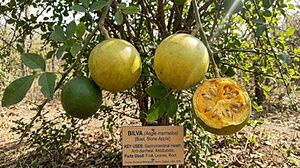
'''''Aegle marmelos''''' (commonly known as '''bael''', '''bilva''', or '''stone apple''') is a plant species in the family [[Rutaceae]].
'''''Aegle marmelos''''' (commonly known as '''bael''', '''bilva''', or '''stone apple''') is a plant species in the family Rutaceae. ''Aegle marmelos'' is a medium-sized, slow-growing, deciduous spiny tree native to dry tropical and subtropical forests of the Indian subcontinent, Myanmar, and Thailand.<ref name="Sharma2011" /> It reaches heights of 8–15 meters and exhibits trifoliate, alternate leaves traditionally associated with religious symbolism in South Asia. The fruit is a globose or pyriform berry with a hard, woody outer shell (5–15 cm diameter) containing aromatic, mucilaginous orange pulp embedded with numerous woolly seeds. All morphological parts—including the unripe fruit, ripe fruit, root bark, leaves, and stem—possess distinct therapeutic profiles in classical Indian medicine.
* '''Vernacular names:''' Bael, Stone Apple, Golden Apple (English); Bel, Bael (Hindi/Bengali); Maredu (Telugu); Vilvam (Tamil); Baelu (Kannada); Koovalam (Malayalam); Kavit (Marathi).
* [[File:Bilva.jpg|thumb|Bilva ''(Aegle marmelos)'']]'''Vernacular names:''' Bael, Stone Apple, Golden Apple (English); Bel, Bael (Hindi/Bengali); Maredu (Telugu); Vilvam (Tamil); Baelu (Kannada); Koovalam (Malayalam); Bel (Marathi).
''Aegle marmelos'' is a medium-sized, slow-growing, deciduous spiny tree native to dry tropical and subtropical forests of the Indian subcontinent, Myanmar, and Thailand.<ref name="Sharma2011" /> It reaches heights of 8–15 meters and exhibits trifoliate, alternate leaves traditionally associated with religious symbolism in South Asia. The fruit is a globose or pyriform berry with a hard, woody outer shell (5–15 cm diameter) containing aromatic, mucilaginous orange pulp embedded with numerous woolly seeds. All morphological parts—including the unripe fruit, ripe fruit, root bark, leaves, and stem—possess distinct therapeutic profiles in classical Indian medicine.
== Ayurvedic energetics and pharmacodynamics ==
== Ayurvedic energetics and pharmacodynamics ==
In classical Ayurvedic pharmacology (''Dravyaguna''), ''Bilva'' presents a distinct dual-action profile depending on fruit maturity. Unripe fruit (''Ama Bilva'') is primary for intestinal and digestive pathology, whereas ripe fruit (''Pakva Bilva'') acts as a laxative but is heavier to digest. Leaves (''Bilva Patra'') and roots (''Bilva Mula'', a constituent of ''[[Dashamula]]'') possess potent ''Vata-Kapha'' pacifying properties.
In classical Ayurvedic pharmacology (''Dravyaguna''), ''Bilva'' presents a distinct dual-action profile depending on fruit maturity. Unripe fruit (''Ama Bilva'') is primary for intestinal and digestive pathology, whereas ripe fruit (''Pakva Bilva'') acts as a laxative but is heavier to digest. Leaves (''Bilva Patra'') and roots (''Bilva Mula'', a constituent of [[Dashamula]]) possess potent ''Vata-Kapha'' pacifying properties.
Aegle marmelos (commonly known as bael, bilva, or stone apple) is a plant species in the family Rutaceae. Aegle marmelos is a medium-sized, slow-growing, deciduous spiny tree native to dry tropical and subtropical forests of the Indian subcontinent, Myanmar, and Thailand.[1] It reaches heights of 8–15 meters and exhibits trifoliate, alternate leaves traditionally associated with religious symbolism in South Asia. The fruit is a globose or pyriform berry with a hard, woody outer shell (5–15 cm diameter) containing aromatic, mucilaginous orange pulp embedded with numerous woolly seeds. All morphological parts—including the unripe fruit, ripe fruit, root bark, leaves, and stem—possess distinct therapeutic profiles in classical Indian medicine.
Bilva (Aegle marmelos)Vernacular names: Bael, Stone Apple, Golden Apple (English); Bel, Bael (Hindi/Bengali); Maredu (Telugu); Vilvam (Tamil); Baelu (Kannada); Koovalam (Malayalam); Bel (Marathi).
Ayurvedic energetics and pharmacodynamics
In classical Ayurvedic pharmacology (Dravyaguna), Bilva presents a distinct dual-action profile depending on fruit maturity. Unripe fruit (Ama Bilva) is primary for intestinal and digestive pathology, whereas ripe fruit (Pakva Bilva) acts as a laxative but is heavier to digest. Leaves (Bilva Patra) and roots (Bilva Mula, a constituent of Dashamula) possess potent Vata-Kapha pacifying properties.
Chemical characterization of Aegle marmelos across various tissues has identified over 100 secondary metabolites.[6][7] The principal active phytochemical groups include:
Coumarins and furanocoumarins: Marmelosin (imperatorin), marmin, umbelliferone, scopoletin, psoralen, aurapten, and xanthotoxol. Marmelosin represents the primary bio-marker constituent responsible for gastroprotective and anti-diarrheal activity.[1]
Triterpenoids and sterols: β-sitosterol, lupeol, and γ-sitosterol.
Phenolics and flavonoids: Rutin, quercetin, ferulic acid, chlorogenic acid, tannic acid, and gallic acid.[8]
Polysaccharides and essential oils: Mucilage and pectins (fruit pulp); limonene, α-phellandrene, p-cymene, and cineole (leaf essential oil).
Therapeutic efficacy and pharmacological profile
Anti-diarrheal, anti-dysenteric, and gastroprotective activity
The primary historical clinical use of unripe Bilva fruit is in managing inflammatory bowel conditions, infectious diarrhea, and irritable bowel syndrome (IBS).
Mechanisms of action: Unripe fruit extracts rich in marmelosin, tannins, and mucilage exhibit antisecretory and antimotility effects. Research demonstrates that aqueous and methanolic extracts significantly reduce castor oil-induced and enterotoxin-induced intestinal fluid accumulation and peristalsis.[9]
Antimicrobial action against enteropathogens:A. marmelos extracts inhibit colonization and toxin production of enteropathogenic bacteria including Escherichia coli, Vibrio cholerae, Shigella dysenteriae, and Salmonella typhimurium.[10]
Ulcer protective effect: Marmelosin and mucosal polysaccharides enhance gastric mucosal resistance, stimulate mucin secretion, and neutralize gastric hyperacidity, showing efficacy comparable to ranitidine in ethanol- and indomethacin-induced ulcer models.[7]
Antidiabetic and hypoglycemic activity
Leaf and fruit extracts of Aegle marmelos possess potent blood-glucose-lowering properties, validating its use in traditional management of Prameha (metabolic syndrome).
Mechanisms of action: Aqueous leaf extract improves systemic glucose tolerance by increasing peripheral glucose uptake, enhancing hepatic glycogen synthesis, and suppressing gluconeogenic enzymes (fructose-1,6-bisphosphatase and glucose-6-phosphatase).[11]
Pancreatic beta-cell protection: Histopathological evaluations show that administration of A. marmelos extract in streptozotocin-induced diabetic models promotes regeneration of pancreatic β-cells and increases serum insulin secretion.[1]
Enzyme inhibition: Extracts demonstrate strong competitive inhibition against α-glucosidase and α-amylase, delaying postprandial glucose absorption.[8]
Anti-inflammatory, analgesic, and antipyretic properties
The root bark and leaf preparations suppress systemic inflammation, joint pain, and fever.
Mechanisms of action: Methanolic leaf and root extracts inhibit carrageenan-induced paw edema and cotton pellet granuloma in animal models.[12] Bioactive coumarins (marmin and umbelliferone) downregulate key inflammatory mediators, including cyclooxygenase-2 (COX-2), inducible nitric oxide synthase (iNOS), tumor necrosis factor-alpha (TNF-α), and interleukin-6 (IL-6).[7]
Antioxidant and hepatoprotective activity
Free radical damage drives many chronic hepatic and systemic pathologies. A. marmelos leaves and fruit pulp contain high concentrations of polyphenols and flavonoids that scavenge reactive oxygen species (ROS).
Mechanisms of action: Administration of A. marmelos restores depleted endogenous antioxidant enzymes—superoxide dismutase (SOD), catalase (CAT), and reduced glutathione (GSH)—while reducing malondialdehyde (MDA) levels in lipid peroxidation assays.[13]
Hepatoprotection: In carbon tetrachloride (CCl4)- and alcohol-induced hepatotoxicity models, Bilva extract significantly reduces elevated serum biomarkers: aspartate aminotransferase (AST), alanine aminotransferase (ALT), alkaline phosphatase (ALP), and total bilirubin, restoring normal liver architecture.[1]
Cardioprotective and antihyperlipidemic activity
Cardioprotection: Pre-treatment with A. marmelos leaf extract attenuates isoproterenol-induced myocardial infarction by preventing membrane phospholipid degradation, maintaining intracellular enzyme leakage (CK-MB, LDH), and mitigating oxidative stress.[14]
Lipid modulation: Extracts lower total cholesterol, low-density lipoprotein (LDL), and triglycerides while elevating high-density lipoprotein (HDL) levels in hyperlipidemic models.[11]
Dosage, formulations, and safety profile
Classical formulations
Bilvadi Churna: Powdered combination of unripe Bilva, Mocharasa, Musta, and Dhataki used for acute diarrhea, dysentery, and IBS.
Bilvashtaka Churna: Traditional polyherbal formulation prescribed for intestinal malabsorption (Grahani) and sluggish digestion.
Bilvadilehya (Bilvadi Lehya): Herbal jam formulation indicated for chronic diarrhea, hyperacidity, vomiting, and nausea.
Dashamularishta / Dashamula Kwatha: Complex decoction and fermented tonic incorporating Bilva root as a primary anti-inflammatory agent.
Bilva Taila: Medicated sesame oil infused with Bilva fruit processed for ear ailments (Karnaroga), particularly tinnitus and hard of hearing.
Recommended posology (raw drug)
Unripe fruit powder (Churna): 2–6 grams daily with warm water or buttermilk.
Leaf powder (Churna): 3–6 grams daily.
Leaf juice (Swarasa): 10–20 mL daily.
Root bark decoction (Kwatha): 50–100 mL daily in divided doses.
Fresh fruit pulp (ripe): 50–100 grams (used as a seasonal cooling beverage).
Toxicology and safety
Aegle marmelos exhibits a broad therapeutic window and high safety profile. Acute toxicity studies in rodents with aqueous and alcoholic leaf/fruit extracts showed no mortality or adverse behavioral parameters up to single doses of 2000 mg/kg body weight (NOAEL).[7]
Precautions: Ripe fruit pulp is heavy to digest (Guru) and, if consumed excessively over prolonged periods, can cause intestinal bloating and constipation due to high pectin and mucosal content. Unripe fruit formulations should be discontinued once acute diarrhea or dysentery resolves to avoid excessive astringent (Stambhana) activity.
References
↑ 1.01.11.21.3Sharma, G. N., Dubey, S. K., Sati, N., & Sanadya, J. (2011). Aegle marmelos (Linn.) Correa: A potential medicinal plant for pharmaceuticals. World Journal of Pharmaceutical Research, 1(1), 10–30.
↑Anonymous. The Ayurvedic Pharmacopoeia of India. Department of Ayush, Ministry of Health and Family welfare, Govt. of India, New Delhi, Part I. 1986; Volume 01:18
↑Anonymous. The Ayurvedic Pharmacopoeia of India. Department of Ayush, Ministry of Health and Family welfare, Govt. of India, New Delhi, Part I. 1986; Volume 01:18
↑Anonymous. The Ayurvedic Pharmacopoeia of India. Department of Ayush, Ministry of Health and Family welfare, Govt. of India, New Delhi, Part I. 1986; Volume 01:18
↑ 6.06.1Dhankhar, S., Ruhil, S., Balhara, M., Dhankhar, S., & Chhillar, A. K. (2011). Aegle marmelos (Linn.) Correa: A potential source of phytomedicine. Journal of Medicinal Plants Research, 5(9), 1497–1507.
↑ 7.07.17.27.3Baliga, M. S., Thilak, C., Haniadka, R., Rao, S., & Arora, R. (2011). Evaluation of the antiinflammatory, analgesic, and antipyretic activities of Aegle marmelos (L.) Correa. Journal of Alternative and Complementary Medicine, 17(11), 1023–1029. https://doi.org/10.1089/acm.2010.0534
↑ 8.08.1Pathirana, C. K., Madhujith, T., & Eeswara, J. (2020). Bael (Aegle marmelos (L.) Corrêa), a versatile medicinal plant: A review on chemical constituents and bioactivities. Journal of Pharmacognosy and Phytochemistry, 9(2), 1619–1629.
↑Bhowmik, D., Kumar, K. S., Yadav, A., Srivastava, S., Paswan, S., & Dutta, A. S. (2012). Recent trends in Indian traditional herb Aegle marmelos and its medicinal potential. The Pharma Innovation, 1(4), 12–22.
↑Rajan, S., Gokila, M., Jancy, P., Brindha, P., & Sujatha, R. (2011). Antioxidant and phytochemical properties of Aegle marmelos fruit pulp. International Journal of Pharmacy and Pharmaceutical Sciences, 3(2), 159–163.
↑ 11.011.1Gandhi, G. R., & Sasikumar, P. (2012). Antidiabetic, antihyperlipidemic and antioxidant activity of Aegle marmelos (L.) Corr. leaf extract in streptozotocin-induced diabetic rats. Asian Pacific Journal of Tropical Biomedicine, 2(3), S115–S122. https://doi.org/10.1016/S2221-1691(12)60140-1
↑Patel, P. K., Patel, M. A., Vyas, B. A., Shah, D. R., & Gandhi, T. R. (2012). Antinociceptive and anti-inflammatory activity of Aegle marmelos leaves. International Journal of Green Pharmacy, 6(1), 23–28.
↑Jagetia, G. C., Venkatesh, P., & Baliga, M. S. (2005). Evaluation of the radioprotective effect of Aegle marmelos (L.) Correa in cultured human peripheral blood lymphocytes. Phytomedicine, 12(1-2), 112–119. https://doi.org/10.1016/j.phymed.2003.09.006
↑Prince, P. S. M., & Rajadurai, M. (2005). Preventive effect of Aegle marmelos leaf extract on isoprenaline-induced myocardial infarction in rats. Journal of Pharmacy and Pharmacology, 57(10), 1353–1358. https://doi.org/10.1211/jpp.57.10.0015