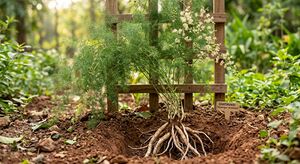
* [[File:Shatavari.jpg|thumb|'''Shatavari (''Asparagus racemosus'')''']]'''Habitat & Distribution:''' Spiny climbing under-shrub native to tropical and subtropical regions of India, Asia, Australia, and parts of Africa.<ref name="Bopana2007">{{cite journal|vauthors=Bopana N, Saxena S|title=Asparagus racemosus—Ethnopharmacological evaluation and conservation needs|journal=Journal of Ethnopharmacology|volume=110|issue=1|pages=1–15|year=2007|doi=10.1016/j.jep.2007.01.001}}</ref><ref name="Alok2013">{{cite journal|vauthors=Alok S, Jain SK, Verma A, Kumar M, Mahor A, Sabharwal M|title=Plant profile, phytochemistry and pharmacology of Asparagus racemosus (Shatavari): A review|journal=Asian Pacific Journal of Tropical Disease|volume=3|issue=3|pages=242–251|year=2013|doi=10.1016/s2222-1808(13)60049-3}}</ref>
==Therapeutic Uses==
Acid Peptic Disorders (Amlapitta), Haemorrhoids (Arsha), Diarrhoea (Atisara), Abdominal lump (Gulma), Kshaya, Bleeding diarrhoea (Raktisara), Intrinsic haemorrhage (Raktapitta), Raktavikara, Gout (Vatarakta), Herpes zoster (Visarpa), Parinama Shoola, Mutrarakta, Vatajvara, Hoarseness of voice (Svarabheda), Night blindness (Naktandhya), Sutika Roga, Stanya Dosha, Stanya Kshaya<ref>Anonymous. The Ayurvedic Pharmacopoeia of India. Department of Ayush, Ministry of Health and Family welfare, Govt. of India, New Delhi, Part I. 1986; Volume IV:50.</ref>
|Stanyadushti(disease of vitiated breast milk) chikitsa- Dhatri karma
|-
|-
|8
|8
|Cha. Sa. Chikitsa sthana 1/1/44
|Cha.Sa.[[Chikitsa Sthana]] 1/1/44
|In formulation of brahma rasayana
|In formulation of Brahma rasayana
|-
|-
|9
|9
|Cha. Sa. Chikitsa Sthana 2/1/25
|Cha.Sa.[[Chikitsa Sthana]] 2/1/25
|Ingredient in Bruhaniya Gutika
|Ingredient in Bruhaniya Gutika
|-
|-
|10
|10
|Cha. Sa. Chikitsa Sthana 2/1/28
|Cha.Sa.[[Chikitsa Sthana]] 2/1/28
|Ingredient in Bruhaniya Gutika
|Ingredient in Bruhaniya Gutika
|-
|-
|11
|11
|Cha. Sa. Chikitsa Sthana 2/1/34
|Cha.Sa.[[Chikitsa Sthana]] 2/1/34
|Ingredient in Vajikaran Ghrit
|Ingredient in Vajikarana Ghrita
|-
|-
|12
|12
|Cha. Sa. Chikitsa Sthana 2/2/6
|Cha.Sa.[[Chikitsa Sthana]] 2/2/6
|Ingredient in Apatyakari Shashtikadi Gutika
|Ingredient in Apatyakari Shashtikadi Gutika
|-
|-
|13
|13
|Cha. Sa. Chikitsa Sthana 2/2/14
|Cha.Sa.[[Chikitsa Sthana]] 2/2/14
|Ingredient in Apatyakar Swaras
|Ingredient in Apatyakara Swaras
|-
|-
|14
|14
|Cha. Sa. Chikitsa Sthana 2/2/18
|Cha.Sa.[[Chikitsa Sthana]] 2/2/18
|Ingredient in Vrushya Kshir
|Ingredient in Vrushya Kshira
|-
|-
|15
|15
|Cha. Sa. Chikitsa Sthana 2/3/18
|Cha.Sa.[[Chikitsa Sthana]] 2/3/18
|Ingredient of Vrushya shatavari Ghrit
|Ingredient of Vrushya Shatavari Ghrita
|-
|-
|16
|16
|Cha. Sa. Chikitsa Sthana 2/4/28
|Cha.Sa.[[Chikitsa Sthana]] 2/4/28
|Ingredient in Apatyakar Ghrit
|Ingredient in Apatyakara Ghrita
|-
|-
|17
|17
|Cha.sa.Chi.3/250
|Cha.Sa.[[Chikitsa Sthana]] 3/250
|As an ingredient of Jeevantyadi anuvasana basti.
|As an ingredient of Jeevantyadi anuvasana basti
|-
|-
|18
|18
|Cha.sa.Chi.3/258
|Cha.Sa.[[Chikitsa Sthana]] 3/258
|As an ingredient of Chandanadhya taila.
|As an ingredient of Chandanadhya taila
|-
|-
|19
|19
|Cha.sa.Chi 5/123
|Cha.Sa.[[Chikitsa Sthana]] 5/123
|Ingredient in Drakshadya Ghrit for Pittaj Gulma
|Ingredient in Drakshadya Ghrita for Pittaja Gulma
|-
|-
|20
|20
|Cha. Sa. Chikitsa Sthana 7/145
|Cha.Sa.[[Chikitsa Sthana]] 7/145
|Ingredient in Mahatikta Ghrit
|Ingredient in Mahatikta Ghrita
|-
|-
|21
|21
|Cha. Sa. Chikitsa Sthana 8/79
|Cha.Sa.[[Chikitsa Sthana]] 8/79
|Ingredient in Shira-Pashva –Ansha Shula nashak lepa
|Ingredient in Shira-Parshva –Ansa Shula nashak lepa
|-
|-
|22
|22
|Cha. Sa. Chikitsa Sthana 8/105
|Cha.Sa.[[Chikitsa Sthana]] 8/105
|Ghrit preparation in treatment of Daha
|Ghrita preparation in treatment of Daha(burning)
|-
|-
|23
|23
|Cha. Sa. Chikitsa Sthana 10/35
|Cha.Sa.[[Chikitsa Sthana]] 10/35
|Ingredient in Palankashadi tail
|Ingredient in Palankashadi taila
|-
|-
|24
|24
|Cha. Sa. Chikitsa Sthana 10/64
|Cha.Sa.[[Chikitsa Sthana]] 10/64
|Ingredient in Atattvabhinivesh nashak yog
|Ingredient in Atattvabhinivesha nashaka yoga
|-
|-
|25
|25
|Cha. Sa. Chikitsa Sthana 11/36
|Cha.Sa.[[Chikitsa Sthana]] 11/36
|Ingredient in Amrutprash Ghrit
|Ingredient in Amrutprasha Ghrita
|-
|-
|26
|26
|Cha. Sa. Chikitsa Sthana 11/46
|Cha.Sa.[[Chikitsa Sthana]] 11/46
|Ingredient in Shvadamshtradi Ghrit
|Ingredient in Shvadamshtradi Ghrita
|-
|-
|27
|27
|Cha. Sa. Chikitsa Sthana 11/66
|Cha.Sa.[[Chikitsa Sthana]] 11/66
|Ingredient in Chaturtha Sarpigud
|Ingredient in Chaturtha Sarpi guda
|-
|-
|28
|28
|Cha.sa.chi.18/40
|Cha.Sa.[[Chikitsa Sthana]] 18/40
|As a ghrita dravya
|As a ghrita dravya
|-
|-
|29
|29
|Cha.sa.chi.18/43
|Cha.Sa.[[Chikitsa Sthana]] 18/43
|As a ghrita dravya
|As a ghrita dravya
|-
|-
|30
|30
|Cha.sa.chi.19/50
|Cha.Sa.[[Chikitsa Sthana]] 19/50
|As a yavagu dravya
|As a yavagu(gruel) dravya
|-
|-
|31
|31
|Cha.sa.chi.19/78
|Cha.Sa.[[Chikitsa Sthana]] 19/78
|Use with paya as a ahara or ghrita
|Use with paya(milk) as a ahara(food) or ghrita
|-
|-
|32
|32
|Cha.sa.chi.19/97
|Cha.Sa.[[Chikitsa Sthana]] 19/97
|As an ingredient of satavari ghrita.
|As an ingredient of Shatavari ghrita
|-
|-
|33
|33
|Cha.sa.chi.19/62
|Cha.Sa.[[Chikitsa Sthana]] 19/62
|As a anuvasana dravya
|As a anuvasana dravya
|-
|-
|34
|34
|Cha.Sa.Chi.21/78
|Cha.Sa.[[Chikitsa Sthana]] 21/78
|As an ingredient of yavaka pradeha.
|As an ingredient of yavaka pradeha(external application)
|-
|-
|35
|35
|Cha.Sa.Chi.21/79
|Cha.Sa.[[Chikitsa Sthana]] 21/79
|As an ingredient of Baladi alepa.
|As an ingredient of Baladi alepa
|-
|-
|36
|36
|Cha.Sa.Chi.21/90
|Cha.Sa.[[Chikitsa Sthana]] 21/90
|For pradeha prayoga in kaphaja visarpa.
|For pradeha prayoga in kaphaja visarpa(herpes)
|-
|-
|37
|37
|Cha.Sa.Chi.21/91
|Cha.Sa.[[Chikitsa Sthana]] 21/91
|For pradeha prayoga in kaphaja visarpa.
|For pradeha prayoga in kaphaja visarpa(herpes)
|-
|-
|38
|38
|Cha.Sa.Chi.21/84
|Cha.Sa.[[Chikitsa Sthana]] 21/84
|For pradeha prayoga in Vata-pittaja visarpa.
|For pradeha prayoga in Vata-pittaja visarpa(herpes)
|-
|-
|39
|39
|Cha.sa.Chi.25/47
|Cha.Sa.[[Chikitsa Sthana]] 25/47
|As an ingredient of Vijayadi pralepa.
|As an ingredient of Vijayadi pralepa
|-
|-
|40
|40
|Cha.sa.Chi.25/75
|Cha.Sa.[[Chikitsa Sthana]] 25/75
|Used in shoola with sneha & sarkara.
|Used in shoola with sneha & sharkara
|-
|-
|41
|41
|Cha.Sa.Chi.28/110
|Cha.Sa.[[Chikitsa Sthana]] 28/110
|Use for nadi sveda.
|Use for nadi sweda(fomentation)
|-
|-
|42
|42
|Cha.Sa.Chi.28/160
|Cha.Sa.[[Chikitsa Sthana]] 28/160
|As an ingredient of Amrutadi taila.
|As an ingredient of Amrutadi taila
|-
|-
|43
|43
|Cha.Sa.chi.29/52
|Cha.Sa.[[Chikitsa Sthana]] 29/52
|Used as Shaka dravya.
|Used as Shaka dravya
|-
|-
|44
|44
|Cha.Sa.chi.29/56
|Cha.Sa.[[Chikitsa Sthana]] 29/56
|As an ingredient of Baladi Ghrita.
|As an ingredient of Baladi Ghrita
|-
|-
|45
|45
|Cha.Sa.chi.29/58
|Cha.Sa.[[Chikitsa Sthana]] 29/58
|As an ingredient of Parushaka Ghrita.
|As an ingredient of Parushaka Ghrita
|-
|-
|46
|46
|Cha.Sa.chi.29/61
|Cha.Sa.[[Chikitsa Sthana]] 29/61
|As an ingredient of Jeevaniya Ghrita.
|As an ingredient of Jeevaniya Ghrita
|-
|-
|47
|47
|Cha.Sa.chi.29/72
|Cha.Sa.[[Chikitsa Sthana]] 29/72
|As an ingredient of Jeevakadi mahasneha.
|As an ingredient of Jeevakadi mahasneha
|-
|-
|48
|48
|Cha.Sa.chi.29/76, 77
|Cha.Sa.[[Chikitsa Sthana]] 29/76, 77
|As an ingredient of Sthiradi Ghrita/Taila.
|As an ingredient of Sthiradi Ghrita/Taila
|-
|-
|49
|49
|Cha.Sa.chi.29/81
|Cha.Sa.[[Chikitsa Sthana]] 29/81
|As an ingredient of Baladi yoga.
|As an ingredient of Baladi yoga
|-
|-
|50
|50
|Cha.Sa.chi.29/92
|Cha.Sa.[[Chikitsa Sthana]] 29/92
|As an ingredient of Madhuparnyadi taila.
|As an ingredient of Madhuparnyadi taila
|-
|-
|51
|51
|Cha.Sa.Chi.30/53
|Cha.Sa.[[Chikitsa Sthana]] 30/53
|As an ingredient of Kashmaryadi ghrita, used in the treatment of Vataja yoni.
|As an ingredient of Kashmaryadi ghrita, used in the treatment of Vataja yoni
|}
|}
==Dose==
* Churna – 3 – 6 gm<ref>Anonymous. The Ayurvedic Pharmacopoeia of India. Department of Ayush, Ministry of Health and Family welfare, Govt. of India, New Delhi, Part I. 1986; Volume IV:50.</ref>
==Important formulations==
As per A.P.I.<ref>Anonymous. The Ayurvedic Pharmacopoeia of India. Department of Ayush, Ministry of Health and Family welfare, Govt. of India, New Delhi, Part I. 1986; Volume IV:50.</ref>
Sri Lanka, Nepal, Bangladesh, Bhutan, Myanmar, Thailand, Indonesia, Malaysia
==Current researches ==
== Phytochemical profile ==
The primary therapeutic activity of ''Asparagus racemosus'' stems from its rich mixture of steroidal [[saponin]]s and secondary metabolites concentrated within the tuberous roots.<ref name="Alok2013" />
{| class="wikitable"
{| class="wikitable"
== Ayurvedic pharmacological properties ==
|+ Phytochemical Profile of ''Asparagus racemosus''
{| class="wikitable"
|-
|+Properties
! Chemical Class !! Key Bioactive Compounds !! Biological Significance
| '''Trace Minerals''' || Zinc (Zn), Copper (Cu), Manganese (Mn), Calcium (Ca) || Nutritional support and metabolic cofactor functions
|Actions (karma)
|Pacify Vata and Pitta
|}
|}
==Current availability ==
== Pharmacological actions and therapeutic efficacy ==
Available
==Current researches ==
=== Galactagogue effect and lactation enhancement ===
[[Category: Database of herbs and minerals | Herbs]]
''Asparagus racemosus'' is recognized in [[Ayurveda|Ayurvedic medicine]] as a primary [[galactagogue]]. Modern clinical trials support its ability to enhance breast milk production by stimulating systemic [[prolactin]] release and promoting the growth of mammary lobuloalveolar tissues.<ref name="Alok2013" /><ref name="Birla2022">{{cite journal |vauthors=Birla A, Satia M, Shah R, et al. |title=Postpartum Use of Shavari Bar® Improves Breast Milk Output: A Double-Blind, Prospective, Randomized, Controlled Clinical Study |journal=Cureus |volume=14 |issue=8 |pages=e26831 |year=2022 |doi=10.7759/cureus.26831}}</ref>
This article is under development ..
* '''Mechanism of Action:''' Bioactive saponins (specifically Shatavarin I–IV) modulate hormone axes to trigger endogenous prolactin release, leading to alveolar hyperplasia and increased milk synthesis.
* '''Clinical Evidence:''' Randomized double-blind clinical trials evaluating postpartum women administered ''A. racemosus'' root preparations demonstrated a statistically significant increase in maternal serum prolactin levels, enhanced total breast milk output, and proportional infant weight gain compared to placebo groups.<ref name="Birla2022" />
{{quote|text=The galactagogue action of Shatavari is attributed to its dual hormonal regulation—boosting prolactin expression while providing systemic antioxidant support to lactating tissue.}}
=== Female reproductive health and endocrine modulation ===
The root extract exhibits phytoestrogenic properties due to structural similarities between Shatavarins/isoflavones and 17β-[[estradiol]], allowing selective binding to estrogen receptors (alpha and beta).<ref name="Alok2013" />
* '''Menopausal Symptom Relief:''' Studies demonstrate that ''A. racemosus'' root extracts alleviate vasomotor symptoms (hot flashes, night sweats) and mood fluctuations during pre-, peri-, and post-menopausal phases through partial estrogenic receptor modulation without inducing unwanted endometrial proliferation.<ref name="Alok2013" />
=== Adaptogenic, neuroprotective and anxiolytic properties ===
Classified as a ''[[Rasayana]]'' (rejuvenative tonic), Shatavari functions as a systemic adaptogen by buffering the central nervous system against physical and emotional stressors.<ref name="Bopana2007" /><ref name="Singh2023">{{cite journal |vauthors=Singh N, Garg M, Prajapati P, et al. |title=Adaptogenic property of Asparagus racemosus: Future trends and prospects |journal=Heliyon |volume=9 |issue=4 |pages=e14932 |year=2023 |doi=10.1016/j.heliyon.2023.e14932}}</ref>
<pre>
                             [ Environmental / Physiological Stress ]
                                                │
                                                ▼
                             [ Hypothalamic-Pituitary-Adrenal (HPA) Axis ]
                                                │
                          ┌─────────────────────┴─────────────────────┐
                          ▼                                           ▼
            (Unmodulated Cortisol Surge)             (Modulated via A. racemosus)
                          │                                           │
                          ▼                                           ▼
             [ Neuronal Cell Loss & ]                 [ Upregulation of BDNF & ]
             [ Memory Impairment    ]                 [ GABAergic Homeostasis  ]
</pre>
* '''Neuroprotection:''' ''In vivo'' models show that root extracts protect hippocampal sub-regions (<math>\text{CA1}</math>, <math>\text{CA3}</math>, and dentate gyrus) from stress-induced cell degeneration by reducing lipid peroxidation and restoring endogenous antioxidant enzymes, such as superoxide dismutase (SOD) and glutathione (GSH).<ref name="Saxena2007">{{cite journal |vauthors=Saxena G, Singh M, Meena P, et al. |title=Neuroprotective Effects of Asparagus Racemosus Linn Root Extract: An Experimental and Clinical Evidence |journal=Annals of Neurosciences |volume=14 |issue=3 |pages=57–63 |year=2007 |doi=10.5214/ans.0972.7531.2007.140302}}</ref><ref name="Singh2023" />
* '''Cognitive & Anticonvulsant Support:''' Network pharmacology studies demonstrate that key phytoconstituents target neuro-inflammatory cascade proteins (such as TNF-alpha, CASP3, and PTGS2), providing protective effects in neurodegenerative and seizure models.<ref name="Kaur2023">{{cite journal |vauthors=Kaur B, Kumar S, Kaur A, Goel RK |title=A network pharmacology approach to explore pharmacological mechanisms of Asparagus racemosus for ameliorative effect in epilepsy and comorbid progressive memory dysfunction |journal=In Silico Pharmacology |volume=11 |issue=1 |pages=28 |year=2023 |doi=10.1007/s40203-023-00169-x}}</ref>
=== Gastroprotective and anti-ulcer activity ===
''A. racemosus'' root extract acts as a cytoprotective agent within the gastrointestinal tract.<ref name="Alok2013" />
* '''Mechanism:''' Rather than purely suppressing gastric acid secretion, it enhances mucosal resistance by increasing mucosal secretion, extending the lifespan of mucosal cells, and reducing gastric hypermotility.
* '''Therapeutic Application:''' Effective in managing duodenal ulcers, hyperacidity, and stress-induced gastric mucosal lesions.<ref name="Bopana2007" /><ref name="Alok2013" />
=== Immunomodulatory activity ===
Shatavari saponins, notably Immunoside and Shatavarin IV, act as biological response modifiers.<ref name="Alok2013" />
* Potentiates both humoral and cell-mediated immunity by enhancing macrophage phagocytic activity.
* Stimulates leucocytosis and restores immune equilibrium during stress-induced immunosuppression.<ref name="Bopana2007" />
== Dosage, safety, and toxicology ==
=== Standard clinical dosage ===
* '''Crude Root Powder (''Churna''):''' 3–6 g/day in divided doses, traditionally taken with milk or warm water.
* '''Standardized Extract (Water/Ethanol):''' 500–1000 mg/day (standardized to steroidal saponins).
=== Toxicology and contraindications ===
* '''Toxicity:''' Animal studies demonstrate high safety margins with no significant acute or sub-acute oral toxicity observed at standard therapeutic ranges.<ref name="Bopana2007" />
* '''Adverse Effects:''' Mild, transient gastrointestinal discomfort may occur in sensitive individuals.
* '''Precautions:''' Patients with estrogen-sensitive conditions (e.g., specific breast or uterine malignancies) should consult a physician prior to high-dose standardized extract therapy due to its phytoestrogenic receptor interaction profile.
== Summary and clinical outlook ==
''Asparagus racemosus'' is an adaptogenic herb with demonstrated clinical applications in female reproductive care, galactagogue support, gastroprotection, and neuroprotection. Modern pharmacological research confirms that its complex array of steroidal saponins, flavonoids, and alkaloids underpins its traditional use as a multi-system restorative agent.
Shatavari (Asparagus racemosus)Habitat & Distribution: Spiny climbing under-shrub native to tropical and subtropical regions of India, Asia, Australia, and parts of Africa.[1][2]
Sri Lanka, Nepal, Bangladesh, Bhutan, Myanmar, Thailand, Indonesia, Malaysia
Current researches
Phytochemical profile
The primary therapeutic activity of Asparagus racemosus stems from its rich mixture of steroidal saponins and secondary metabolites concentrated within the tuberous roots.[2]
Phytochemical Profile of Asparagus racemosus
Chemical Class
Key Bioactive Compounds
Biological Significance
Steroidal Saponins
Shatavarins (I–IV), Immunoside, Sarsasapogenin
Phytoestrogenic, galactagogue, and immunomodulatory activity
Nutritional support and metabolic cofactor functions
Pharmacological actions and therapeutic efficacy
Galactagogue effect and lactation enhancement
Asparagus racemosus is recognized in Ayurvedic medicine as a primary galactagogue. Modern clinical trials support its ability to enhance breast milk production by stimulating systemic prolactin release and promoting the growth of mammary lobuloalveolar tissues.[2][8]
Mechanism of Action: Bioactive saponins (specifically Shatavarin I–IV) modulate hormone axes to trigger endogenous prolactin release, leading to alveolar hyperplasia and increased milk synthesis.
Clinical Evidence: Randomized double-blind clinical trials evaluating postpartum women administered A. racemosus root preparations demonstrated a statistically significant increase in maternal serum prolactin levels, enhanced total breast milk output, and proportional infant weight gain compared to placebo groups.[8]
The galactagogue action of Shatavari is attributed to its dual hormonal regulation—boosting prolactin expression while providing systemic antioxidant support to lactating tissue.
Female reproductive health and endocrine modulation
The root extract exhibits phytoestrogenic properties due to structural similarities between Shatavarins/isoflavones and 17β-estradiol, allowing selective binding to estrogen receptors (alpha and beta).[2]
Menopausal Symptom Relief: Studies demonstrate that A. racemosus root extracts alleviate vasomotor symptoms (hot flashes, night sweats) and mood fluctuations during pre-, peri-, and post-menopausal phases through partial estrogenic receptor modulation without inducing unwanted endometrial proliferation.[2]
Adaptogenic, neuroprotective and anxiolytic properties
Classified as a Rasayana (rejuvenative tonic), Shatavari functions as a systemic adaptogen by buffering the central nervous system against physical and emotional stressors.[1][9]
Neuroprotection:In vivo models show that root extracts protect hippocampal sub-regions (<math>\text{CA1}</math>, <math>\text{CA3}</math>, and dentate gyrus) from stress-induced cell degeneration by reducing lipid peroxidation and restoring endogenous antioxidant enzymes, such as superoxide dismutase (SOD) and glutathione (GSH).[10][9]
Cognitive & Anticonvulsant Support: Network pharmacology studies demonstrate that key phytoconstituents target neuro-inflammatory cascade proteins (such as TNF-alpha, CASP3, and PTGS2), providing protective effects in neurodegenerative and seizure models.[11]
Gastroprotective and anti-ulcer activity
A. racemosus root extract acts as a cytoprotective agent within the gastrointestinal tract.[2]
Mechanism: Rather than purely suppressing gastric acid secretion, it enhances mucosal resistance by increasing mucosal secretion, extending the lifespan of mucosal cells, and reducing gastric hypermotility.
Therapeutic Application: Effective in managing duodenal ulcers, hyperacidity, and stress-induced gastric mucosal lesions.[1][2]
Immunomodulatory activity
Shatavari saponins, notably Immunoside and Shatavarin IV, act as biological response modifiers.[2]
Potentiates both humoral and cell-mediated immunity by enhancing macrophage phagocytic activity.
Stimulates leucocytosis and restores immune equilibrium during stress-induced immunosuppression.[1]
Dosage, safety, and toxicology
Standard clinical dosage
Crude Root Powder (Churna): 3–6 g/day in divided doses, traditionally taken with milk or warm water.
Standardized Extract (Water/Ethanol): 500–1000 mg/day (standardized to steroidal saponins).
Toxicology and contraindications
Toxicity: Animal studies demonstrate high safety margins with no significant acute or sub-acute oral toxicity observed at standard therapeutic ranges.[1]
Adverse Effects: Mild, transient gastrointestinal discomfort may occur in sensitive individuals.
Precautions: Patients with estrogen-sensitive conditions (e.g., specific breast or uterine malignancies) should consult a physician prior to high-dose standardized extract therapy due to its phytoestrogenic receptor interaction profile.
Summary and clinical outlook
Asparagus racemosus is an adaptogenic herb with demonstrated clinical applications in female reproductive care, galactagogue support, gastroprotection, and neuroprotection. Modern pharmacological research confirms that its complex array of steroidal saponins, flavonoids, and alkaloids underpins its traditional use as a multi-system restorative agent.
↑ 1.01.11.21.31.41.5Bopana N, Saxena S (2007). "Asparagus racemosus—Ethnopharmacological evaluation and conservation needs". Journal of Ethnopharmacology. 110 (1): 1–15. doi:10.1016/j.jep.2007.01.001.
↑ 2.02.12.22.32.42.52.62.7Alok S, Jain SK, Verma A, Kumar M, Mahor A, Sabharwal M (2013). "Plant profile, phytochemistry and pharmacology of Asparagus racemosus (Shatavari): A review". Asian Pacific Journal of Tropical Disease. 3 (3): 242–251. doi:10.1016/s2222-1808(13)60049-3.
↑Anonymous. The Ayurvedic Pharmacopoeia of India. Department of Ayush, Ministry of Health and Family welfare, Govt. of India, New Delhi, Part I. 1986; Volume IV:50.
↑Anonymous. The Ayurvedic Pharmacopoeia of India. Department of Ayush, Ministry of Health and Family welfare, Govt. of India, New Delhi, Part I. 1986; Volume IV:50.
↑Anonymous. The Ayurvedic Pharmacopoeia of India. Department of Ayush, Ministry of Health and Family welfare, Govt. of India, New Delhi, Part I. 1986; Volume IV:50.
↑ 8.08.1Birla A, Satia M, Shah R, et al. (2022). "Postpartum Use of Shavari Bar® Improves Breast Milk Output: A Double-Blind, Prospective, Randomized, Controlled Clinical Study". Cureus. 14 (8): e26831. doi:10.7759/cureus.26831.
↑ 9.09.1Singh N, Garg M, Prajapati P, et al. (2023). "Adaptogenic property of Asparagus racemosus: Future trends and prospects". Heliyon. 9 (4): e14932. doi:10.1016/j.heliyon.2023.e14932.
↑Saxena G, Singh M, Meena P, et al. (2007). "Neuroprotective Effects of Asparagus Racemosus Linn Root Extract: An Experimental and Clinical Evidence". Annals of Neurosciences. 14 (3): 57–63. doi:10.5214/ans.0972.7531.2007.140302.
↑Kaur B, Kumar S, Kaur A, Goel RK (2023). "A network pharmacology approach to explore pharmacological mechanisms of Asparagus racemosus for ameliorative effect in epilepsy and comorbid progressive memory dysfunction". In Silico Pharmacology. 11 (1): 28. doi:10.1007/s40203-023-00169-x.