(One intermediate revision by the same user not shown)
Line 1:
Line 1:
Herpestis monniera Benth.
{{#seo:
|title=Charak Samhita
|titlemode=append
|keywords= Brahmi, Bacopa,Bacopa monnieri, Water hyssop,Thyme Leaved Gratiola,Indian pennywortCharak Samhita, Dravyaguna, carakasamhitaonline, carakasamhita, caraka samhita, Ayurveda, Charak Samhita English translation, ancient Ayurveda text, Indian system of medicine, Ayurveda, Charak, Charaka Samhita, agnivesha, atreya, gopal basisht, yogesh deole, charak samhita wikipedia edition, charak samhita new edition, charaka samhita new edition, carak samhita new edition, caraka samhita new edition, research on charak samhita, text book charak samhita, fundamental principles of ayurveda, basic concepts of ayurveda,
|description= Brahmi (Bacopa mnonieri) is classified as a '''"Medhya Rasayana"'''—a premier rejuvenative tonic believed to nourish the intellect, expand memory capacity, and promote mental longevity.
|data5 = [[Charak Samhita Research, Training and Skill Development Centre]]
|data5 = Team Dravyaguna
|label6 = DOI
|label6 = Year of publication
|data6 = Awaited
|data6 = 2026
|label7 = Publisher
|data7 = [[Charak Samhita Research, Training and Skill Development Centre]]
|label8 = DOI
|data8 = Awaited
}}
}}
Brahmi (Bacopa mnonieri) is classified as a '''"Medhya Rasayana"'''—a premier rejuvenative tonic believed to nourish the intellect, expand memory capacity, and promote mental longevity.
== Nomenclature & Botanical Profile ==
* '''Scientific Name:''' ''Bacopa monnieri'' (L.) Wettst. (''Note: Often historically misspelled in literature as Bacopa monneiri'').
* '''Family:''' Scrophulariaceae
* '''Synonyms:''' ''Lysimachia monnieri'' L., ''Gratiola monnieri'' L.
* '''Common Names:''' Brahmi, Water Hyssop, Herb of Grace, Indian Pennywort, Jalabrahmi.
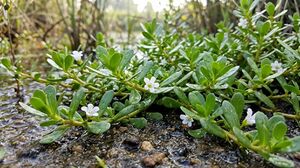
* [[File:Brahmi.jpg|thumb|'''Brahmi (''Bacopa monnieri'')''']]'''Botanical Description:''' ''Bacopa monnieri'' is a perennial, creeping, succulent herb native to the wetlands, marshes, and warm damp regions of India, Asia, Australia, and the Americas. It is characterized by small, oblong, sessile leaves and white-to-pale blue flowers with five petals.
==English name==
==English name==
Bacopa, Water hyssop,Thyme Leaved Gratiola,Indian pennywort
==Therapeutic uses==
Kushtha(skin disease), jwara(fever), shopha(swelling), pandu(anemia), prameha(diabetes ), manasa vikara<ref>Anonymous. The Ayurvedic Pharmacopoeia of India. Department of Ayush, Ministry of Health and Family welfare, Govt. of India, New Delhi, Part I. 1986; Volume 02:11</ref>
|Stanya dushti chikitsa(treatment of vitiated breast milk)
|-
|-
|5
|5
|Cha. Sa. Chikitsa sthana 1/3/24
|Cha.Sa.[[Chikitsa Sthana]] 1/3/24
|In formulation of indra rasayana
|In formulation of Indra rasayana
|-
|-
|6
|6
|Cha. Sa. Chikitsa Sthana 7/69
|Cha.Sa.[[Chikitsa Sthana]] 7/69
|Ingredient in Triphaladi Churna
|Ingredient in Triphaladi Churna
|-
|-
|7
|7
|Cha. Sa. Chikitsa Sthana 10/25
|Cha.Sa.[[Chikitsa Sthana]] 10/25
|Ingredient in Brahmi Ghrita
|Ingredient in Brahmi Ghrita
|-
|-
|8
|8
|Cha. Sa. Chikitsa Sthana 10/62
|Cha.Sa.[[Chikitsa Sthana]] 10/62
|In treatment of Atattvabhinivesh
|In treatment of Atattvabhinivesh
|-
|-
|9
|9
|Cha. Sa. Chikitsa Sthana 10/64
|Cha.Sa.[[Chikitsa Sthana]] 10/64
|Ingredient in Atattvabhinivesh nashak yog
|Ingredient in Atattvabhinivesh nashak yoga
|-
|-
|10
|10
|Cha.sa.chi.18/40
|Cha.Sa.[[Chikitsa Sthana]] 18/40
|As a ghrita dravya
|As a ghrita dravya
|-
|-
|11
|11
|Cha.Sa.Chi.23/55
|Cha.Sa.[[Chikitsa Sthana]] 23/55
|As an ingredient of Mrita sanjivani agada.
|As an ingredient of Mrita sanjivani agada.
|-
|-
|12
|12
|Cha.Sa.Chi.23/244
|Cha.Sa.[[Chikitsa Sthana]] 23/244
|As an ingredient of Amruta ghrita.
|As an ingredient of Amruta ghrita
|}
|}
== Ayurvedic pharmacological properties ==
==Dose==
{| class="wikitable"
* 1-3 gm in powder form<ref>Anonymous. The Ayurvedic Pharmacopoeia of India. Department of Ayush, Ministry of Health and Family welfare, Govt. of India, New Delhi, Part I. 1986; Volume 02:11</ref>
|+'''Properties'''
|'''Sr.no.'''
==Important formulations==
|'''Pharmacological criteria'''
As per A.P.I.<ref>Anonymous. The Ayurvedic Pharmacopoeia of India. Department of Ayush, Ministry of Health and Family welfare, Govt. of India, New Delhi, Part I. 1986; Volume 02:11</ref>
|'''Properties'''
* Sarasvatarishta
|-
* Brahmi ghruta
|1
* Ratnagiri rasa
|Taste (rasa)
* Brahmi vati
|Bitter (tikta), Astringent (kashaya)
* Sarasvata churna
* Smrutisagara rasa
==Current availability ==
Available
==Current researches ==
== Active Phytochemical Profile ==
The therapeutic activity of ''Bacopa monnieri'' is predominantly attributed to its complex profile of triterpenoid saponins.
* '''Bacoside A:''' Considered the primary bioactive mixture responsible for cognitive and neuroprotective efficacy. It consists of a mixture of four distinct saponins:
** Bacoside A<sub>3</sub>
** Bacopaside II
** Bacopaside X (jujubogenin isomer of bacopasaponin C)
** Bacopasaponin C
* '''Bacoside B:''' A structurally related saponin mixture that assists in overall systemic and cognitive rejuvenation.
* '''Alkaloids & Flavonoids:''' Contains trace alkaloids (brahmine, herpestine) and therapeutic flavonoids (luteolin, apigenin, and quercetin) which exert synergistic antioxidant actions.
* '''Bioactive Aglycones:''' Saponins undergo ''in vivo'' transformation into lipophilic aglycones, such as '''ebelin lactone''' and '''bacogenin A<sub>1</sub>'''. These aglycones easily cross the blood-brain barrier (BBB) to interact directly with target central nervous system (CNS) receptors.
''B. monnieri'' acts directly on neural architecture to promote structural connectivity. Standardized extracts stimulate '''dendritic arborization''' and synaptic branching in the basolateral amygdala and CA1 hippocampal subfield. Bacosides upregulate '''Brain-Derived Neurotrophic Factor (BDNF)''' and the expression of '''NMDA receptor subunits (specifically GluN2B)''', which are vital for establishing long-term potentiation (LTP)—the biological foundation of learning and memory consolidation.
=== Neurotransmitter Modulation ===
The cognitive-enhancing properties of Brahmi are highly mediated by the cholinergic system. It modulates acetylcholine (ACh) levels through:
# '''Receptor Activation:''' ''In silico'' and ''in vitro'' assays show that its active aglycone, ebelin lactone, possesses high binding affinity toward muscarinic (M<sub>1</sub>) and serotonergic (5-HT<sub>2A</sub>) receptors, directly enhancing processing capacity.<ref name="Ramasamy2015">Ramasamy, S., Chin, S. P., Sukumaran, S. D., Buckle, M. J., Kiew, L. V., & Chung, L. Y. (2015). In silico and in vitro analysis of Bacoside A aglycones and its derivatives as the constituents responsible for the cognitive effects of ''Bacopa monnieri''. ''PLoS One'', 10(5), e0126565.</ref>
=== Antioxidant & Free Radical Scavenging ===
''B. monnieri'' establishes a highly protective antioxidant defense system in the central nervous system. Bacosides have been shown to upregulate key cellular antioxidant enzymes—including '''superoxide dismutase (SOD)''', '''catalase (CAT)''', and '''glutathione peroxidase (GPX)'''—in the frontal cortex, striatum, and hippocampus.<ref name="Bhattacharya2000">Bhattacharya, S. K., Bhattacharya, A., Kumar, A., & Ghosal, S. (2000). Antioxidant activity of ''Bacopa monniera'' in rat frontal cortex, striatum, and hippocampus. ''Phytotherapy Research'', 14(3), 174-179.</ref> This reduces brain lipid peroxidation, neutralizing oxidative-stress-induced neurodegeneration.
Preclinical evaluations show that ''B. monnieri'' protects against toxic protein aggregation, a hallmark of Alzheimer's disease. It actively reduces β-amyloid accumulation and diminishes pro-inflammatory cytokine release (such as TNF-α and IL-6) by downregulating activated microglial cells. It has also demonstrated clear therapeutic pathways in reducing alpha-synuclein aggregation in preclinical models of Parkinson's disease.<ref name="Jadiya2011">Jadiya, P., Khan, A., Sammi, S. R., Kaur, S., Mir, S. S., & Nazir, A. (2011). Anti-Parkinsonian effects of ''Bacopa monnieri'': insights from transgenic and pharmacological ''Caenorhabditis elegans'' models of Parkinson’s disease. ''Biogerontology'', 12(3), 259-271.</ref>
== Clinical Efficacy & Human Evidence ==
''Bacopa monnieri'' has been systematically evaluated in numerous double-blind, randomized, placebo-controlled trials (RCTs).<ref name="Kongkeaw2014">Kongkeaw, C., Dilokthornsakul, P., Thasorsa, P., Limpeanchob, N., & Scholfield, C. N. (2014). Meta-analysis of randomized controlled trials on cognitive effects of ''Bacopa monnieri'' extract. ''Journal of Ethnopharmacology'', 151(1), 528-535.</ref>
* '''Healthy Adults:''' In a landmark RCT conducted by Stough et al. (2001), 46 healthy adults were administered 300 mg/day of standardized ''B. monnieri'' extract (CDRI-08). At 12 weeks of chronic supplementation, the treatment group exhibited a statistically significant improvement in the speed of visual information processing, verbal learning rate, and memory consolidation, coupled with a decrease in state anxiety.<ref name="Stough2001">Stough, C., Lloyd, J., Clarke, J., Downey, L. A., Hutchison, C. W., Rodgers, T., & Nathan, P. J. (2001). The chronic effects of an extract of ''Bacopa monniera'' (Brahmi) on cognitive function in healthy human subjects. ''Psychopharmacology'', 156(4), 481-484.</ref> Notably, these improvements were absent at the 5-week assessment, illustrating that the cognitive benefits of Brahmi are cumulative and require sustained intake.
* '''The Aging Population:''' To evaluate age-associated cognitive decline, Calabrese et al. (2008) conducted a 12-week RCT on 54 healthy elderly participants (≥ 65 years old) using 300 mg/day of standardized extract. The treatment group experienced highly significant improvements in delayed word recall (Rey Auditory Verbal Learning Test) and attentional performance (Stroop Task reaction times) compared to the placebo group, proving its potential in preventing age-related cognitive decline.<ref name="Calabrese2008">Calabrese, C., Gregory, W. L., Leo, M., Kraemer, D., Bone, K., & Oken, B. (2008). Effects of a standardized ''Bacopa monnieri'' extract on cognitive performance, anxiety, and depression in the elderly: a randomized, double-blind, placebo-controlled trial. ''The Journal of Alternative and Complementary Medicine'', 14(6), 707-713.</ref>
* '''Long-Term Memory Retention:''' These findings are mirrored by Roodenrys et al. (2002), who demonstrated that ''B. monnieri'' significantly decreased the rate of forgetting newly acquired information in a cohort of middle-aged adults.<ref name="Roodenrys2002">Roodenrys, S., Booth, D., Bulzomi, S., Phipps, A., Micallef, C., & Smoker, J. (2002). Chronic effects of Brahmi (''Bacopa monnieri'') on human memory. ''Neuropsychopharmacology'', 27(2), 279-281.</ref>
=== Adaptogenic & Anxiolytic Properties ===
''B. monnieri'' exhibits robust adaptogenic capabilities by modulating the hypothalamic-pituitary-adrenal (HPA) axis. Clinical studies reveal a significant reduction in serum '''cortisol levels''' (the primary physiological stress biomarker) and a reduction in subjective anxiety scores following 8 to 12 weeks of supplementation. This creates a state of "calm alertness" that is highly unique to nootropics.
== Summary of Key Therapeutic Indications & Evidence ==
| In vitro & in vivo reduction of lipid peroxidation and structural hippocampal damage.
| '''Moderate'''<br />(Robust preclinical data; early clinical support)
|-
|-
|6
| '''Anti-Neurodegenerative'''
|Extra ordinary effect (prabhava)
| Interferes with amyloid-β aggregation and reduces microglial pro-inflammatory cytokines.
|Brain tonic (Medhya Rasayana)
| Preclinical reduction of tau phosphorylation and alpha-synuclein aggregation.
| '''Emerging'''<br />(Requires larger, robust human trials in clinical cohorts)
|}
|}
==Current availability ==
== Dosage, Safety, and Tolerability ==
Available
* '''Clinical Dosage:''' The standard therapeutic oral dose of ''B. monnieri'' extract ranges from '''300 to 450 mg per day''', typically standardized to contain 20% to 55% active bacosides. In traditional powder form, a daily intake of 5 to 10 grams of crude herb is utilized.
==Current researches ==
* '''Tolerability:''' ''B. monnieri'' is generally characterized by a high therapeutic index and safety profile. It is non-addictive and does not cause sedative or stimulatory withdrawal.
[[Category: Database of herbs and minerals | Herbs]]
* '''Adverse Effects:''' The most commonly reported side effects in clinical trials are '''gastrointestinal in nature''', including increased stool frequency, mild abdominal cramping, and transient nausea. These effects are expected due to saponin-mediated local irritation and the upregulation of cholinergic activity in the gut. Taking the extract with meals significantly mitigates these effects.
This article is under development ..
* '''Contraindications & Interactions:''' Due to its cholinergic activity, ''B. monnieri'' may exhibit additive effects when co-administered with acetylcholinesterase inhibitors (e.g., donepezil) or cholinergic agonists. Caution is advised for patients taking thyroid medications, as preclinical models suggest mild thyroid hormone-stimulating activity.
Brahmi (Bacopa mnonieri) is classified as a "Medhya Rasayana"—a premier rejuvenative tonic believed to nourish the intellect, expand memory capacity, and promote mental longevity.
Scientific Name:Bacopa monnieri (L.) Wettst. (Note: Often historically misspelled in literature as Bacopa monneiri).
Family: Scrophulariaceae
Synonyms:Lysimachia monnieri L., Gratiola monnieri L.
Common Names: Brahmi, Water Hyssop, Herb of Grace, Indian Pennywort, Jalabrahmi.
Brahmi (Bacopa monnieri)Botanical Description:Bacopa monnieri is a perennial, creeping, succulent herb native to the wetlands, marshes, and warm damp regions of India, Asia, Australia, and the Americas. It is characterized by small, oblong, sessile leaves and white-to-pale blue flowers with five petals.
English name
Bacopa, Water hyssop,Thyme Leaved Gratiola,Indian pennywort
The therapeutic activity of Bacopa monnieri is predominantly attributed to its complex profile of triterpenoid saponins.
Bacoside A: Considered the primary bioactive mixture responsible for cognitive and neuroprotective efficacy. It consists of a mixture of four distinct saponins:
Bacoside A3
Bacopaside II
Bacopaside X (jujubogenin isomer of bacopasaponin C)
Bacopasaponin C
Bacoside B: A structurally related saponin mixture that assists in overall systemic and cognitive rejuvenation.
Alkaloids & Flavonoids: Contains trace alkaloids (brahmine, herpestine) and therapeutic flavonoids (luteolin, apigenin, and quercetin) which exert synergistic antioxidant actions.
Bioactive Aglycones: Saponins undergo in vivo transformation into lipophilic aglycones, such as ebelin lactone and bacogenin A1. These aglycones easily cross the blood-brain barrier (BBB) to interact directly with target central nervous system (CNS) receptors.
B. monnieri acts directly on neural architecture to promote structural connectivity. Standardized extracts stimulate dendritic arborization and synaptic branching in the basolateral amygdala and CA1 hippocampal subfield. Bacosides upregulate Brain-Derived Neurotrophic Factor (BDNF) and the expression of NMDA receptor subunits (specifically GluN2B), which are vital for establishing long-term potentiation (LTP)—the biological foundation of learning and memory consolidation.
Neurotransmitter Modulation
The cognitive-enhancing properties of Brahmi are highly mediated by the cholinergic system. It modulates acetylcholine (ACh) levels through:
Receptor Activation:In silico and in vitro assays show that its active aglycone, ebelin lactone, possesses high binding affinity toward muscarinic (M1) and serotonergic (5-HT2A) receptors, directly enhancing processing capacity.[6]
Antioxidant & Free Radical Scavenging
B. monnieri establishes a highly protective antioxidant defense system in the central nervous system. Bacosides have been shown to upregulate key cellular antioxidant enzymes—including superoxide dismutase (SOD), catalase (CAT), and glutathione peroxidase (GPX)—in the frontal cortex, striatum, and hippocampus.[7] This reduces brain lipid peroxidation, neutralizing oxidative-stress-induced neurodegeneration.
Anti-Amyloidogenic & Anti-Inflammatory Properties
Preclinical evaluations show that B. monnieri protects against toxic protein aggregation, a hallmark of Alzheimer's disease. It actively reduces β-amyloid accumulation and diminishes pro-inflammatory cytokine release (such as TNF-α and IL-6) by downregulating activated microglial cells. It has also demonstrated clear therapeutic pathways in reducing alpha-synuclein aggregation in preclinical models of Parkinson's disease.[8]
Clinical Efficacy & Human Evidence
Bacopa monnieri has been systematically evaluated in numerous double-blind, randomized, placebo-controlled trials (RCTs).[9]
Cognitive Performance & Memory Consolidation
Healthy Adults: In a landmark RCT conducted by Stough et al. (2001), 46 healthy adults were administered 300 mg/day of standardized B. monnieri extract (CDRI-08). At 12 weeks of chronic supplementation, the treatment group exhibited a statistically significant improvement in the speed of visual information processing, verbal learning rate, and memory consolidation, coupled with a decrease in state anxiety.[10] Notably, these improvements were absent at the 5-week assessment, illustrating that the cognitive benefits of Brahmi are cumulative and require sustained intake.
The Aging Population: To evaluate age-associated cognitive decline, Calabrese et al. (2008) conducted a 12-week RCT on 54 healthy elderly participants (≥ 65 years old) using 300 mg/day of standardized extract. The treatment group experienced highly significant improvements in delayed word recall (Rey Auditory Verbal Learning Test) and attentional performance (Stroop Task reaction times) compared to the placebo group, proving its potential in preventing age-related cognitive decline.[11]
Long-Term Memory Retention: These findings are mirrored by Roodenrys et al. (2002), who demonstrated that B. monnieri significantly decreased the rate of forgetting newly acquired information in a cohort of middle-aged adults.[12]
Adaptogenic & Anxiolytic Properties
B. monnieri exhibits robust adaptogenic capabilities by modulating the hypothalamic-pituitary-adrenal (HPA) axis. Clinical studies reveal a significant reduction in serum cortisol levels (the primary physiological stress biomarker) and a reduction in subjective anxiety scores following 8 to 12 weeks of supplementation. This creates a state of "calm alertness" that is highly unique to nootropics.
In vitro & in vivo reduction of lipid peroxidation and structural hippocampal damage.
Moderate (Robust preclinical data; early clinical support)
Anti-Neurodegenerative
Interferes with amyloid-β aggregation and reduces microglial pro-inflammatory cytokines.
Preclinical reduction of tau phosphorylation and alpha-synuclein aggregation.
Emerging (Requires larger, robust human trials in clinical cohorts)
Dosage, Safety, and Tolerability
Clinical Dosage: The standard therapeutic oral dose of B. monnieri extract ranges from 300 to 450 mg per day, typically standardized to contain 20% to 55% active bacosides. In traditional powder form, a daily intake of 5 to 10 grams of crude herb is utilized.
Tolerability:B. monnieri is generally characterized by a high therapeutic index and safety profile. It is non-addictive and does not cause sedative or stimulatory withdrawal.
Adverse Effects: The most commonly reported side effects in clinical trials are gastrointestinal in nature, including increased stool frequency, mild abdominal cramping, and transient nausea. These effects are expected due to saponin-mediated local irritation and the upregulation of cholinergic activity in the gut. Taking the extract with meals significantly mitigates these effects.
Contraindications & Interactions: Due to its cholinergic activity, B. monnieri may exhibit additive effects when co-administered with acetylcholinesterase inhibitors (e.g., donepezil) or cholinergic agonists. Caution is advised for patients taking thyroid medications, as preclinical models suggest mild thyroid hormone-stimulating activity.
References
↑Anonymous. The Ayurvedic Pharmacopoeia of India. Department of Ayush, Ministry of Health and Family welfare, Govt. of India, New Delhi, Part I. 1986; Volume 02:11
↑Dr. Indradev Tripathi , Raja Nighantu of pandit Narhari, ed.2006, Chaukhambha Krishnadas Academy, Varanasi, parpatadi varga verse no- 66,67
↑Anonymous. The Ayurvedic Pharmacopoeia of India. Department of Ayush, Ministry of Health and Family welfare, Govt. of India, New Delhi, Part I. 1986; Volume 02:11
↑Anonymous. The Ayurvedic Pharmacopoeia of India. Department of Ayush, Ministry of Health and Family welfare, Govt. of India, New Delhi, Part I. 1986; Volume 02:11
↑Ramasamy, S., Chin, S. P., Sukumaran, S. D., Buckle, M. J., Kiew, L. V., & Chung, L. Y. (2015). In silico and in vitro analysis of Bacoside A aglycones and its derivatives as the constituents responsible for the cognitive effects of Bacopa monnieri. PLoS One, 10(5), e0126565.
↑Bhattacharya, S. K., Bhattacharya, A., Kumar, A., & Ghosal, S. (2000). Antioxidant activity of Bacopa monniera in rat frontal cortex, striatum, and hippocampus. Phytotherapy Research, 14(3), 174-179.
↑Jadiya, P., Khan, A., Sammi, S. R., Kaur, S., Mir, S. S., & Nazir, A. (2011). Anti-Parkinsonian effects of Bacopa monnieri: insights from transgenic and pharmacological Caenorhabditis elegans models of Parkinson’s disease. Biogerontology, 12(3), 259-271.
↑Kongkeaw, C., Dilokthornsakul, P., Thasorsa, P., Limpeanchob, N., & Scholfield, C. N. (2014). Meta-analysis of randomized controlled trials on cognitive effects of Bacopa monnieri extract. Journal of Ethnopharmacology, 151(1), 528-535.
↑Stough, C., Lloyd, J., Clarke, J., Downey, L. A., Hutchison, C. W., Rodgers, T., & Nathan, P. J. (2001). The chronic effects of an extract of Bacopa monniera (Brahmi) on cognitive function in healthy human subjects. Psychopharmacology, 156(4), 481-484.
↑Calabrese, C., Gregory, W. L., Leo, M., Kraemer, D., Bone, K., & Oken, B. (2008). Effects of a standardized Bacopa monnieri extract on cognitive performance, anxiety, and depression in the elderly: a randomized, double-blind, placebo-controlled trial. The Journal of Alternative and Complementary Medicine, 14(6), 707-713.
↑Roodenrys, S., Booth, D., Bulzomi, S., Phipps, A., Micallef, C., & Smoker, J. (2002). Chronic effects of Brahmi (Bacopa monnieri) on human memory. Neuropsychopharmacology, 27(2), 279-281.